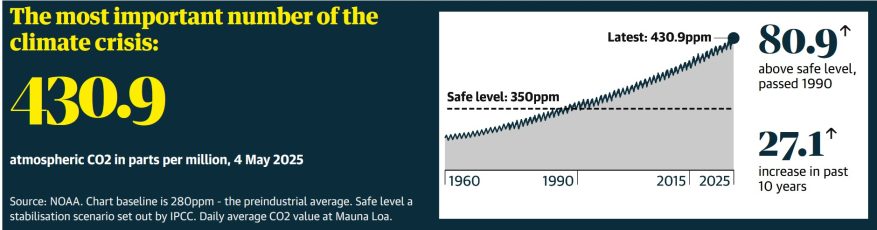
Missed climate targets mean mounting damages. More forests burn, more ecosystems are lost, more people are killed or displaced by extreme weather.
This article was written by Steve Easterbrook and was published in the Toronto Star on December 30, 2023.
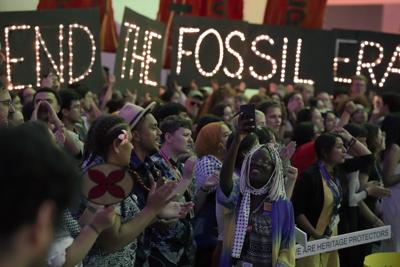
Eight years ago, at the Paris climate change talks, the United Nations agreed a legally binding treaty to limit global warming to well below 2C above pre-industrial global average temperatures, and to pursue efforts to keep the temperature increase below 1.5°C. Canada was a vocal supporter of the more stringent 1.5C limit. But with the failure to agree on a meaningful timeline to phase out fossil fuels at this year’s COP28 meeting, and monthly global temperatures regularly shattering records, some scientists are starting to say it’s too late to save the UN’s 1.5C target. It now looks likely we’ll pass that temperature threshold within the next decade.
However, we must never give up on the 1.5C target, no matter how desperate it seems. The actions we must take to meet the 1.5C target are the same actions we need to take to stay below the 2C target (or indeed any similar target). Both targets require us to make massive investments in renewable energy alternatives and phase out fossil fuels as rapidly as possible. The only difference between the targets is how fast we must do it. Discarding a hard goal for an easier goal will merely remove some of the urgency. And if we relax our goal, we’ll stop trying so hard. We then risk missing the 2C goal as well.
Fossil fuel companies pay lip service to the 1.5C goal, but simultaneously work to undermine it because they want to sell as much oil, coal, and gas as they can before they are forced to stop. They are the most profitable industries in the world, so their intransigence is understandable. But with the price of renewable energy dropping fast, the clean energy infrastructure we must build will be just as profitable for whichever companies create it. The problem isn’t that we’ll somehow destroy the economy, or all end up poorer, or as Sultan al-Jaber, the chair of COP28 put it, end up sheltering in caves. The real question is who will reap the rewards of the energy transition: a handful of giant fossil fuel companies who want to keep doing what they have always done, or a vast array of smaller, more agile, cleantech companies who are already making the necessary investments.
It now looks likely that the world will reach and then exceed 1.5C of warming within a decade from now. Climate scientists might disagree on how exactly to determine the threshold has been passed, but that’s irrelevant. There’s no point arguing at what point the car can be said to be over the edge of the cliff, when the most important thing is that the car is going off the cliff.
But the car going over the cliff is the wrong metaphor anyway. The world doesn’t end at 1.5C, nor at 2C. What happens is the damages pile up. More forests burn down, more ecosystems are lost, more crops fail, more people are killed or displaced by extreme weather, more land is lost to the rising seas. So when we pass 1.5C, it is not game over. It is not even a defeat. It is an overshoot that needs to be managed and contained.
By retaining the 1.5C target even after we see it in our rearview mirror, we will commit to reversing course as fast as possible. We must then redouble our efforts to bring carbon emissions to zero as rapidly as possible, and ramp up emergency measures to remove carbon from the atmosphere to cool the planet back down again. It will never be okay to say we can give up on everybody whose lives or communities will be destroyed in the interval between 1.5C and 2C.
Every fraction of a degree matters; every fraction of a degree multiplies the destruction. So we must fight to avoid every fraction of a degree of further warming. If and when we miss the 1.5 degree target, we cannot let ourselves off the hook. The correct answer for how much more warming we should aim for is: none at all. The correct target for a world hotter than 1.5C is to get back to a world below 1.5C as rapidly as possible.
Steve Easterbrook is a professor and director of the School of the Environment at the University of Toronto.
 Mobilize, Canada!