This editorial was written and published by the Toronto Star on January 17, 2024.
It’s hard to imagine the catastrophic costs and consequences of climate change being laid out in more apocalyptic words than those contained in reports from the United Nations over the last few years.
You’d have to go some distance, after all, to top UN Secretary-General António Guterres who described the 2022 report from the UN’s Intergovernmental Panel on Climate Change as “an atlas of human suffering and a damning indictment of failed climate leadership.”
It would be difficult, likewise, to conjure a more horrific kaleidoscope of fire, drought, storm, flood and devastation than has played out live and in colour around our beleaguered planet. The evidence of what’s at stake is overwhelming, just about everywhere, inescapable. Another UN official has said, simply and starkly, that “the places where people live and work may cease to exist.”
From Nova Scotia to P.E.I., northern Ontario to the West and the Northwest Territories, flood, hurricane and wildfires have destroyed homes and devastated lives.
Yet it wasn’t the warming planet that sparked recent debate over climate change strategies. Rather, it was a polar cold snap in the Prairies and the resulting strain on Alberta’s electrical grid that prompted political potshots at the push for green energy.
As urgent warnings went out Saturday asking Albertans to curb their hydro usage or risk rolling blackouts, Saskatchewan Premier Scott Moe used the moment to take a shot at Ottawa’s draft clean electricity regulations which set the goal of net-zero greenhouse emissions by 2035.
“SaskPower is providing 153 MW of electricity to AB this evening to assist them through this shortage. That power will be coming from natural gas and coal-fired plants, the ones the Trudeau government is telling us to shut down (which we won’t),” he said on X, the social media platform previously known as Twitter.
In another posting, Moe weighed in again: “We will not risk plunging our homes, schools, hospitals, special care homes and our businesses into the cold and darkness because of the ideological whims of others.
“Net zero by 2035 is not only impossible, it’s irresponsible as it would leave Saskatchewan and Western Canadian families freezing and in the dark.”
The office of Steven Guilbeault, the federal minister of environment and climate change, denies that the proposed regulations, now in the consultation phase, would unilaterally shut down natural gas plants and leave people without power. In fact, the regulations would grandfather existing plants. With demand for electricity increasing, the goal is to diversify power sources and reduce the reliance on fossil fuels.
“The regulations would never put the province in a situation where they did not have a reliable electricity. We have proposed provisions so that provincial utilities can use natural gas electricity units to address peak power needs and in emergency situations. Fossil fuel plants of course would also be able to run if they have carbon capture technologies applied and blend with low carbon fuels,” Guilbeault’s office said in a statement to the Star.
Given Moe’s opposition to the federal carbon tax, such hyperbole might be expected. But partisan opposition to initiatives to curb greenhouse emissions, especially in the absence of meaningful alternatives, is disheartening and disingenuous as evidence of climate change mounts.
Another wake-up call came recently from the European Union’s Copernicus Climate Change Service which said the Earth shattered global heat records in 2023 and is flirting with the world’s agreed-upon warming threshold. Copernicus said 2023 was 1.48 C, or 2.66 F, above pre-industrial times. That’s a sliver below the 1.5 C limit the world hoped to stay within to avoid the most severe effects of global warming.
The planet’s rising temperature will for the first time exceed the 1.5 C threshold for a 12-month period in January or February.
In many places around the world extreme weather events wrought death and destruction, from a drought in the Horn of Africa, to torrential downpours that wiped out dams and killed thousands in Libya, to Canadian wildfires that sullied skies as far away as Europe. Millions of people are directly affected by weather disasters that result in hundreds of billions of dollars in damages.
Yet it appears conditions will have to get still worse in the way of wilder weather, species lost to changing climate, more areas made uninhabitable to shake us from our stupor.
Copernicus said that it wasn’t just a month or a season that was exceptional in 2023, but more than half the year. Simply put, the 2023 record underscored the extreme urgency of reducing greenhouse gas emissions, scientists said. To date, the speed of change in the political world simply hasn’t matched the speed of change of extreme weather and warming.
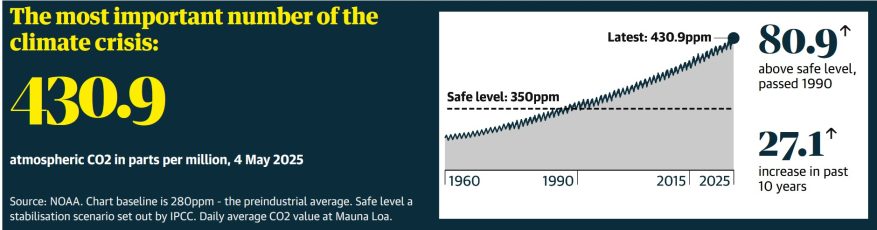
Copernicus said the concentration of CO2 in the atmosphere actually rose to the highest levels ever recorded at 419 parts per million last year. That makes even more depressing the debates over a carbon tax here in Canada.
Even comparatively small changes in global temperatures have huge impacts on people and ecosystems, scientists say. “Every tenth of a degree matters,” said Friederike Otto, a scientist in global weather research.
Alongside climate change caused by humans, the 2023 temperatures were increased by the El Nino weather phenomenon, which warms Pacific Ocean surface waters.
What scientists said they do not know is whether the extreme heat of 2023 is a sign global warming is accelerating.
“Whether there’s been a phase shift or a tipping point, or it’s an anomalously warm year, we need more time and more scientific studies to understand,” said Samantha Burgess, deputy director of Copernicus.
Tipping point. There’s a term you’d expect might catch our attention. This is not some ideological whim. This is science.
But perhaps humankind is neurologically wired to fail to react to dangers that should prompt significant action. Perhaps our species will go obliviously to calamity like the fabled frog basking in the pot of increasingly hot water.
One thing is certain. No one can ever say we weren’t warned.
 Mobilize, Canada!