World Meteorological Organization says 2023 will be hottest year on record, leaving ‘trail of devastation and despair’
This article was written by Damian Carrington and was published in The Guardian on November 30, 2023.
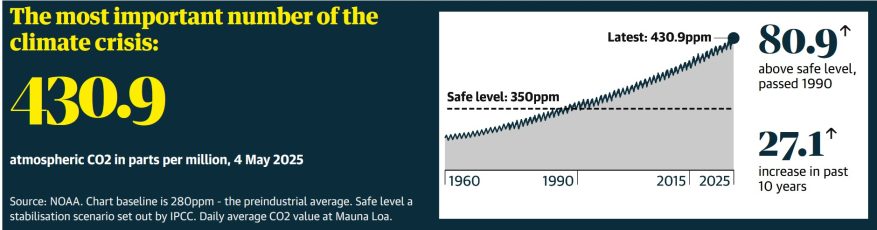

This article was written by Damian Carrington and was published in The Guardian on November 30, 2023.
This article was written by Patrick Greenfield, Phoebe Weston, and Ajit Niranjan, and was published in The Guardian on November 29, 2023.
This article was written by Damian Carrington, Anna Leach, Paul Scruton, and Harvey Symons, and was published in The Guardian on November 30, 2023.
This article was written by Marco Chown Oved and was published in the Toronto Star on November 30, 2023.
Local municipal councils in Eastern Ontario rejected one new gas plant but welcomed another this week, complicating the province’s plan to build new fossil fuel projects.
At a meeting on Monday evening, Loyalist Township declined to support a new gas plant, with councillors saying they could not support energy projects that both pollute local air and make climate change worse.
“We should not entertain at all any fossil fuel developments in our township,” said Loyalist Coun. Paul Proderick.
On Tuesday, Napanee council endorsed a bid by Atura power — a subsidiary of the publicly-owned Ontario Power Generation — to build a new gas plant in their community, citing the growing demand for electricity.
“I believe we are going to need more power than wind and solar (are going to be able to provide),” said Napanee Coun. Dave Pinnell Jr.
The conflicting decisions testify to the way that energy planning in Ontario has transformed from a top-down decree to a courtship road show, in which energy planners and electricity developers have to make their cases to each and every community where they want to build.
In Napanee, Atura offered annual payments of $400,000 as part of its pitch to get the town to accept a new gas plant.
The local votes went from being a courtesy to a requirement when Premier Doug Ford promised to give locals a veto over new energy projects in their communities.
While pitched as a way to combat wind and solar farms, the new found local power has evolved into a way to stymie fossil fuel projects.
“Essentially, we have a veto,” said Loyalist Coun. Lorna Willis.
And communities across the province have been using it.
In addition to Loyalist township, Thorold, in Niagara region, rejected a new gas plant in September. Last January, Windsor became the first community in the province to welcome a new gas plant.
All these communities already host gas plants. Loyalist township is close to three: Lennox, Kingston and Napanee.
“This area has probably shouldered its fair share of poor air quality,” said Loyalist Coun. Jake Ennis. “The community has strongly raised concerns, particularly with regard to the expansion of the cogeneration plant, and concerns with environmental impacts and impacts on human health.”
Dr. Mili Roy, co-chair of Canadian Association of Physicians for the Environment (CAPE), Ontario, said the cavalcade of municipalities rejecting gas plants is heartening to see.
“I hope we’re going to see a domino effect where a no vote in one municipality empowers the next municipality to stand up and say no as well,” she said.
CAPE has been speaking out against natural gas expansion because of its serious implications for human health.
“Natural gas is not a benign bridge fuel, it’s methane, a highly potent greenhouse gas,” she said.
“Climate change is the single greatest health threat that we face around the world.”
Aric McBay, a campaigner with the Providence Centre for Justice, Peace and Integrity of Creation, said the case against gas plants is based on three arguments: health, climate and economics.
Healthwise, the toxic pollutants that emerge from the smokestacks of gas plants have been linked to preterm births, increased hospitalization and a higher incidence of childhood asthma. According to the Public Health Agency of Canada, air pollution causes more than 15,000 premature deaths each year.
From a climate point of view, natural gas was once hailed as a transition fuel that would help wean the world off fossil fuels while emitting less carbon than coal. Unfortunately, research now shows that natural gas actually produces just as much greenhouse gasses as coal when all the methane leaks in the extraction and pipeline system are factored in.
Economically, the volatility of global fossil fuel prices contrasts dramatically with the consistently dropping price of renewables, making natural gas one of the most expensive ways to generate electricity and wind one of the cheapest. Layered on top of that is the province’s promise to pay gas plants to sit idle if they are forced to shut down due to the federal government’s clean electricity regulations.
“These plants, if expanded, would harm the health of regular people, put greater burdens on our health care system and needlessly delay a transition to renewable energy. All the while making the cost of living more expensive for regular Ontarians,” McBay said.
As a Star investigation revealed last month, Ontario’s gas plants run far more often than advertised. In downtown Toronto, the Portlands gas plant ran 21 hours a day last summer.
As a result, Ontario’s electricity grid, which is one of the cleanest in North America, is getting far dirtier. Projections put out by the IESO show that gas plant use — and the resulting greenhouse gas emissions — is set to triple in the next three years.
This rise in electricity emissions risks undermining efforts to reduce carbon in virtually every other sector.
“The plans of most municipalities and most organizations and even individuals to decarbonize depends on electrification. That’s been the push in really every sector from home heating and cooling to the steel industry,” said McBay.
“If the amount of electricity produced from fossil fuels increases instead of decreases, then it’s going to not only harm the planet and the health of people, but it’s going to undermine our efforts to fight climate change in the long term. And more specifically, it will actually deceive regular people because it will make us think that we’re fighting climate change with electrification when we’re just consuming fracked natural gas without even realizing it.”
The IESO said more gas plants in the short term is compatible with moving to net zero by 2035.
“We do need to add some gas as we move through the energy transition,” said Chuck Farmer, chief energy transition officer and vicepresident, planning, conservation & resource adequacy at IESO.
“We are supporting an orderly transition to a net zero electricity system and economy in a way that balances reliability and affordability.”
Over the last 20 years, electricity demand has been flat in Ontario. But in the next 20 years, the IESO projects a need for at least 40 per cent more power.
“There is an urgent need to get infrastructure built to ensure we meet the growing needs of the province,” he said.
Three new battery and electric vehicle plants alone will use as much energy as the entire city of London, Farmer said.
The grid “is a key enabler of decarbonization in other sectors of our economy. But it does need to increase in size to support electric vehicles, people switching to heat pumps and the electrification of industrial processes. And the emissions reductions we’re achieving from those efforts are greater than the incremental emissions that we will see from new natural gas generation.”
Gas will be needed into the early 2030s, at which point it will be replaced with a combination of energy conservation and new non-emitting generation, like wind, solar and hydro, Farmer said.
“All of these things will contribute to our net zero future. But they will take time to deploy and we need incremental generation now,” he said.
Jack Gibbons, a former commissioner with Toronto Hydro and the Chair of the Ontario Clean Air Alliance, said he hopes Ford will start listening to the municipalities that don’t want more gas plants.
“Municipalities are fighting back and saying no to new gas fired power plants. This is great news and shows very clearly that Doug Ford’s plans don’t make political or economic sense. It’s time for the province to rethink how we’re going to meet our provincial power needs. We need to look to Quebec which will be massively expanding its electricity grid with 100 per cent renewable power.”
‘‘
I hope we’re going to see a domino effect where a no vote in one municipality empowers the next municipality to stand up and say no as well.
DR. MILI ROY CO-CHAIR OF CANADIAN ASSOCIATION OF PHYSICIANS
This article was written by Michael Byers and was published in the Globe & Mail on November 25, 2023.
Climate change effects are becoming worse. In order to save our planet, we must change our behaviours and insist on brave and bold policies from our leaders, Michael Byers writes
My mom has always loved the Alberta foothills, and this past summer, I took her there one last time. I grew up in this prairie city, with the Rocky Mountains a constant presence on the western horizon. But in August, as we drove toward the town of Pincher Creek, a thick haze of forest fire smoke hung from the sky.
“Where are my mountains?” my mom cried.
Then, like white knights on horseback, dozens of towering windmills appeared, their long blades slicing through the smoke, driving turbines engaged in an actual battle.
Every watt of electricity produced from Alberta’s frequent winds reduces the need for coal, oil and gas – the fossil fuels that have caused the climate crisis, thus contributing to the increasing number and severity of forest fires.
The windmills are fighting for our future.
In the 2004 Arctic Climate Impact Assessment, an international team of scientists and Indigenous elders reported that climate change was advancing faster in the Arctic than elsewhere.
Receding sea-ice was allowing more sunlight to enter the ocean, warming the water, which then caused the ice to recede further, and so on. Increasingly severe and expansive forest fires were thickening the blanket of carbon dioxide in the atmosphere, driving up temperatures and drying the remaining forests. Melting permafrost was releasing methane, another greenhouse gas, trapping more heat on the planet and melting more permafrost. Each of these feedback loops was its own process, but all had been set in motion by humanity’s burning of fossil fuels.
The message was clear: Human beings, through our day-today activities, were unwittingly destroying our only possible home. I had trouble accepting this. I needed to learn more.
In October, 2006, I boarded Canada’s research icebreaker, the CCGS Amundsen, at Kugluktuk, Nunavut, at the western end of the Northwest Passage. It was late in the shipping season and the crew expected to encounter lots of sea-ice on the long voyage home to Quebec City. They were particularly worried about thick, hard “multiyear” ice in Bellot Strait, the narrow passage around the top of the Boothia Peninsula, the northernmost part of the North American mainland.
Almost everyone on board was gathered on the front deck three days later, as the ship turned into the strait. I still remember the collective gasp as, instead of ice, we saw nothing but open water. Eighty sailors, scientists and technicians, most of them with decades of Arctic experience, all understood the implications. In the Canadian Arctic, at least, climate change was advancing faster than anyone had feared.
Growing up in Lethbridge in the 1980s, I was aware of the tar sands but had no cause to think about them. They did not pay for the Alberta Heritage Scholarship that I received after high school. Those funds came from the modest royalties then-premier Peter Lougheed was charging on conventional oil and gas, and using to build a financial reserve for the benefit of all Albertans.
Unlike those easy-to-extract-and-refine resources, the tar sands were a speculative project that depended on large subsidies, tax holidays and the lowest possible royalties. Still, one could argue that exploring different production methods made sense – in those days before a scientific consensus on climate change, when it seemed the world might run on oil forever.
Also, back then, everyone called them the “tar sands.” The rebranding exercise came later, when concerns about climate change made it necessary to obfuscate the very high energy inputs and greenhouse-gas outputs involved in accessing this socalled “oil.”
Raw bitumen is asphalt, used for paving roads. Before it can power a car or an airplane, it must be mined, refined, diluted with natural gas condensate, forced through thousands of kilometres of pipe to another country and then refined some more.
In the summer of 2008, Jack Layton, the federal NDP leader, invited me on a fact-finding trip to Nunavut.
We visited Auyuittuq National Park, the “land that never melts,” where an Inuk warden showed us receding glaciers, overflowing rivers and species of birds and insects from southern latitudes that were suddenly present in the Arctic. Jack was deeply affected by what he saw. We spoke about the need for major policy changes, and how these required a change in government.
After I returned to Vancouver, I picked up the phone and told Jack that I wanted to run for the NDP.
I became a candidate in the riding of Vancouver Centre in mid-August, just three weeks before Stephen Harper called a snap election. I was learning basic political skills on a very short timeline – and discovering that one essential skill was beyond my reach: I’m incapable of keeping my opinions to myself, which makes it difficult to toe a party line.
I took part in 22 all-candidate debates during that campaign. Media was often present, but nobody expected a camera crew from CBC to appear at a small event organized by a journalism class at UBC.
My political downfall began with what should have been a harmless question: What kind of animal might each candidate imagine themselves to be? My mind flashed back to the Arctic. A polar bear, I replied, because they’re at existential risk from climate change.
It was then that I dropped what, at the time, became known as the “Byers bomb.” To save the bears, I said, “We need to shut the tar sands down.”
Everyone gasped. The CBC cameraman gave a thumbs-up to his producer. The Green Party candidate called my position “radical.”
I quickly explained that I was not proposing to padlock the tar sands. We just need to stop the subsidies and tax breaks, I said, and the industry will phase itself out.
Ultimately, I told the students, there was no choice. “If we are burning oil and gas in 20 and 30 years, this planet is finished.”
Afterward, my BlackBerry rang. It was Jack.
“Shit happens,” he said. “Besides, I’ve been wanting to talk more about the tar sands.”
He probably did. But then, the NDP team in Alberta demanded that he denounce my comments. And being a very good politician, Jack split the difference and said nothing at all.
Jack was struck down by cancer in 2011. I missed the funeral, because I was back on a ship in the Arctic. This time, I was a lecturer on an “eco-cruise,” trying, with mixed results, to educate wealthy tourists about the climate change they could see outside.
After I returned home from that trip, I threw my support behind Tom Mulcair for the NDP leadership. I knew that during his time as environment minister in Quebec, Tom had acquired a reputation for standing up to corporate lobbies and taking meaningful action.
After Tom became leader, he flew to Fort McMurray and spoke about sustainable development. Predictably, this generated lots of negative media. What was not predictable, at least to me, was that Tom would then go silent, just as Jack had.
Tom’s silence left the climate change issue available for a new Liberal leader to pick up in the next election campaign. And between 2011 and 2015, about a million young Canadians, many of them greatly concerned about the environment, reached the voting age of 18.
When I was born in 1966, atmospheric carbon dioxide was at 321 parts per million. By 2008, the year I ran for Parliament, it had risen to 385 ppm. In 2015, when Justin Trudeau embraced the climate change issue and won the election, it was at 401 ppm.
To the new Prime Minister’s credit, he asked for a public briefing by climatologists. Greg Flato, a senior research scientist with Environment Canada, explained that “Warming is unequivocal and human influence on the climate system is clear.” Dr. Flato was just as emphatic about the required policy response: Reductions in greenhouse-gas emissions were needed to stabilize Earth’s temperature.
Mr. Trudeau vowed to take the matter seriously.
Just two years later, in 2017, the Prime Minister told a gathering of oil industry executives in Texas that “no country would find 173 billion barrels of oil in the ground and leave them there.”
The next year, the Trudeau government bought the Trans Mountain Pipeline. The purchase included a project to build a second, larger pipeline alongside an existing pipeline from the tar sands to the coast of British Columbia.
At the time, the cost to taxpayers was believed to be $4.4-billion, with a further $7.4-billion in estimated construction costs. Those estimates were badly off the mark. The total cost is now projected to exceed $30-billion.
The pipeline expansion was needed to deliver bitumen to world markets, where it would command a higher price than that available in the United States – or so we were told. Nobody knows whether this will actually be the case when the project is finally complete.
We do know that there are lots of energy sources around the world that are cheaper to access than tar sands oil. In other words, the $30-billion pipeline is not supported by market principles. It’s just another politically-driven subsidy for tar sands production. Were it not for all that taxpayer money, the project would have died.
My political downfall began with what should have been a harmless question: What kind of animal might each candidate imagine themselves to be? My mind flashed back to the Arctic. A polar bear, I replied, because they’re at existential risk from climate change.
Last spring, Alberta held an election as forest fires raged across the northern half of the province. Smoke was ever-present, yet Alberta NDP Leader Rachel Notley refused the chance to talk about climate change. She claimed the Trudeau government’s purchase of the Trans Mountain Pipeline as a critically important achievement, delivered when she was premier.
The leader of the United Conservative Party, Danielle Smith, also avoided the topic of climate change. Her response to the fires was to launch an investigation into the role played by arson, rather than asking why the forests were tinder-dry so early in the year.
Since winning the election, Ms. Smith has been fighting to protect oil and gas companies against the already more economically competitive alternatives of wind and solar power. She even introduced a seven-month moratorium on new renewable energy projects.
Anyone who is paying attention will realize that climate change effects are growing worse. Whether it’s forest fires, heat domes, floods, hurricanes or melting permafrost, our country is already feeling the strain. Similar things are happening around
the planet. As UN Secretary-General António Guterres warned in September, “Humanity has opened the gates of hell.”
I aspired to be a cabinet minister once, before realizing that outspokenness disqualifies me.
Jonathan Wilkinson is the federal Minister of Energy and Natural Resources. We knew each other as university students in Saskatoon and later Montreal, back when he was a New Democrat and I was a Progressive Conservative. He later led an environmental technology company in Vancouver. I expect that his personal views on climate and energy align with mine, but in public, he toes the party line.
Steven Guilbeault, the federal Minister of the Environment, was once an uncompromising activist. He’s planning to eliminate some of the subsidies to fossil fuel companies, while creating some new subsidies, including for carbon sequestration. Designed to allow the continued extraction of oil and gas, these projects are a form of harm reduction – not so much for the environment, but for the companies themselves.
Mr. Guilbeault has recently defended a three-year suspension of the carbon tax on heating oil, a move that sacrifices climate policy for the crass political purpose of retaining Liberal seats in Atlantic Canada. Soon, he’ll attend the COP28 climate summit in the United Arab Emirates.
Don’t expect anything to come from that. Earlier this month, Jerry DeMarco, the federal Environment Commissioner, reported on the government’s lack of progress in meeting its own targets for greenhouse-gas reductions. Indeed, in the 18 years since the COP11 took place in Montreal, Canada has done worse in this regard than every other Group of Seven country, including the United States.
As one might guess, Mr. Wilkinson and Mr. Guilbeault both support the Trans Mountain Pipeline. Both insist that working with industry requires trade-offs. Politics is about compromise, after all.
The problem is that atmospheric chemistry does not compromise. If the response to climate change isn’t commensurate with the threat, it’s not a response; it’s an evasion of responsibility.
A proposal to drill three exploratory oil wells within Lethbridge city limits was met by strong local opposition over the winter of 2013-14. Part of the pushback was of the “not in my backyard” variety. Another part, however, was based on concerns about climate change.
My mom joined a group of “Raging Grannies” who stood alongside a major road each day waving placards. I remember how proud I was of her, and how skeptical I was about the chances for success. After all, how many oil projects are shelved because of protests in Alberta?
Yet as the protests went on, and more people joined, local businesses and politicians came on board. In May, 2014, the project was cancelled, with the company stating that “the barriers here did not justify the costs.” My mom, with her hands-on approach, had more success fighting climate change than anything I’d done.
On our summer drive to the Alberta foothills, we stopped for sandwiches at the Bear Grass Café, and chatted with some elderly men in cowboy boots. After lunch, as we drove toward the hamlet of Beaver Mines, the grassy hills gave way to sweeping forests of trembling aspen and lodgepole pine.
At Lundbreck Falls, I held my mom’s hand as we walked along the Crowsnest River. The chokecherry bushes were heavy with fruit. An osprey dove into the crystal-clear water and flew away with a fish. The mountains came into view.
“It’s still beautiful!” my mom exclaimed.
My mom is losing her final battle. Just days after our trip, she entered a care home for Alzheimer’s patients. It makes her happy when, on a clear day, she can see the mountains out the window.
As for the rest of us, we must not concede the future. So, let’s change our behaviours. Let’s insist on truly brave and bold policies. Let’s do the previously unimaginable. Let’s shut the tar sands down.
Our beautiful planet is still worth fighting for.
This article was written by Thomas Homer-Dixon, executive director of the Cascade Institute at Royal Roads University and professor emeritus at the University of Waterloo, and was published in the Globe & Mail on November 25, 2023.
Human beings have a natural optimism bias. For most of our species’ history, this bias has served us well, helping us persevere in the face of overwhelming odds. But when it comes to the climate crisis, our natural optimism could be our undoing. Our collective response to the crisis has been marked by denial, delay and delusion – denial of the problem’s seriousness, delay in doing anything significant about it and delusion about the efficacy of those things we’ve finally gotten around to doing.
One person who has railed against these tendencies is the renowned climate scientist James Hansen. Throughout his long career, Dr. Hansen has developed a reputation for being consistently ahead of the scientific curve in his assessment of climate change and its implications, most famously in the summer of 1988 when, as director of the NASA Goddard Institute, he brought public attention to global warming in testimony to the United States Senate. Now retired from NASA and based at Columbia University, he’s still vigorously engaged in climate science and policy advocacy.
In recent years, Dr. Hansen has argued that the scientific consensus, as reflected in the voluminous reports of the Intergovernmental Panel on Climate Change (IPCC), greatly underestimates the rate and magnitude of future warming. Earlier this month, he and 17 colleagues forcefully stated their case in a peer-reviewed paper, Global Warming in the Pipeline, published by a University of Oxford journal. I’d rank it as the most important scientific article I’ve read in the past decade.
If Dr. Hansen and his colleagues are right, the received wisdom of today’s supposedly informed climate cognoscenti – people such as David Wallace-Wells of The New York Times – is substantially wrong. Mr. Wallace-Wells and others tell us, with evident relief, that warming will likely peak somewhere around 2 to 3 C. The rapid decline in the cost of wind and solar power means we won’t burn all the world’s coal to get an eventual rise in temperature of 4 C or even more. But Global Warming in the Pipeline shows that we don’t need to burn all our coal to get a 4 C rise in climate or hotter.
The paper makes two vital arguments undergirded by one striking empirical observation. The first argument is that Earth’s climate is much more sensitive to humanity’s carbon-dioxide emissions than conventionally estimated. Taking into account feedbacks involving clouds, water vapour, snow cover and sea ice, “equilibrium climate sensitivity” – the eventual warming produced by a doubling of CO2 in the atmosphere – is likely around 4.8 C, rather than the IPCC’s best estimate of 3 C.
Greater climate sensitivity means that far more warming is “in the pipeline” than conventional models predict. Indeed, Dr. Hansen and his colleagues estimate that the atmosphere’s current concentrations of greenhouse gases are already producing a radiative effect (what scientists call “forcing”) equivalent to a doubling of CO2 and that this effect, if not reduced, could readily double or triple the 1.2 C the planet is already experiencing.
The article’s second key argument is that until recently a significant portion of humancaused greenhouse warming has been offset by our aerosol emissions – fine particles in the air that reflect sunlight and cool the planet. This effect is now declining, as key sources of pollution are cleaned up. The authors call aerosol cooling a “Faustian bargain,” because payment in greater global warming is coming due as we reduce pollution from shipping, vehicles, industry and power plants.
Finally, the striking empirical observation is that Earth’s energy imbalance (EEI) has recently soared. This imbalance arises as our planet receives more energy from the sun than it radiates as heat back to space, because our greenhouse gases are trapping heat in the atmosphere. The authors estimate that between 2005 and 2015, EEI averaged about 0.7 watts per square metre across Earth’s surface. From early 2020 to the middle of this year, they argue, it reached 1.36 watts per square metre, likely in part because lower aerosol emissions allowed more solar energy to reach Earth’s surface.
A 1.36-watt imbalance may seem trivial, but when added up across the planet’s entire surface, the total amounts to nearly a million Hiroshima bombs of extra energy injected into Earth’s atmospheric-ocean system – over and over, each and every day. Currently, most of this excess energy is melting the world’s glaciers and ice caps and heating the oceans, but it’s also supercharging the droughts, storms and heat waves now afflicting every corner of our world.
As Earth’s energy imbalance increases by about half a watt each decade, the authors argue, it’s accelerating Earth’s warming – from about 0.18 C per decade between 1970 and 2010 to at least 0.27 C per decade now. In a more recent commentary, Dr. Hansen and his colleagues go on to estimate that the world will at least temporarily cross the 1.5 C ceiling this coming year, in part because of the influence of El Nino, reaching about 1.7 C of warming by 2030 and 2 C “by the late 2030s.”
Now, to be clear, some prominent climate scientists vehemently disagree with Dr. Hansen and his team, especially with their claim that warming is accelerating – Michael Mann at the University of Pennsylvania being one. Ultimately, the dispute will be adjudicated by nature itself, as the warming rate is revealed in coming years.
But betting against Dr. Hansen would seem foolish, even if our optimism bias inclines us to do so, given his track record and the worldwide evidence of a spiralling climate crisis we’ve seen this past year.
So, it’s worth unpacking the broader implications of the paper. I believe there are four.
First, if Dr. Hansen and his colleagues are correct, warming will melt the world’s great ice sheets in Antarctica and Greenland much faster than the IPCC currently predicts, possibly entailing a rise of multiple metres in sea levels within the expected lifespan of coastal infrastructure being built now – that is, within the next century. Coastal communities should start planning for this change now.
Second, heating this century is likely to overwhelm many nature-based solutions to climate change. Fires and droughts will kill tree plantations intended to absorb carbon, while heating will weaken biological processes that practices such as regenerative agriculture must exploit to sequester carbon in soil.
Third, the most dangerous aspect of the climate problem is the long lag between emissions and full climate response. This lag facilitates denial, delay and delusion, and so increases the likelihood that some countries will ultimately attempt to “geoengineer” the atmosphere under emergency conditions – perhaps by using fleets of large aircraft to dump huge quantities of reflective sulfate particles into the stratosphere – with potentially catastrophic side effects.
Lastly and most fundamentally, if James Hansen and his team are right, humanity’s responses to the climate crisis must be far more radical than currently planned. Incrementalism is now a waste of resources – and of time.
If Dr. James Hansen and his colleagues are correct, warming will melt the world’s great ice sheets in Antarctica and Greenland much faster than the IPCC currently predicts, possibly entailing a rise of multiple metres in sea levels within the expected lifespan of coastal infrastructure being built now – that is, within the next century. Coastal communities should start planning for this change now.
This article was written by Amanda Stephenson of the Canadian Press and was published by Global News on November 23, 2023.
This article was written by Marco Chown Oved and was published in the Toronto Star on November 24, 2023.
Carbon capture just isn’t going to cut it.
That’s the message behind a new report put out by the International Energy Agency (IEA) ahead of global climate talks set to begin next week in Dubai.
“The oil and gas industry is facing a moment of truth,” said IEA executive director Fatih Birol. “The industry needs to commit to genuinely helping the world meet its energy needs and climate goals — which means letting go of the illusion that implausibly large amounts of carbon capture are the solution.”
Many of the world’s major oil companies have committed to net zero and plan to get there by increasing production and capturing their emissions. These plans rely on a technology that hasn’t yet been proven at scale and would require a massive and rapid build up of carbon capture projects all over the world.
It is a vision that simply won’t work, the IEA’s report concludes.
“The uncomfortable truth that the industry needs to come to terms with is that successful clean energy transitions require much lower demand for oil and gas, which means scaling back oil and gas operations over time — not expanding them,” Birol said.
In Canada, where Alberta oil sands producers have been lobbying for public funds to finance a massive carbon capture and underground storage project (CCUS), the report hits close to home, said Aaron Cosbey, a senior associate at the International Institute for Sustainable Development.
“The report’s findings, arguments and recommendations are of course delivered to a global audience, but so many of them feel like they are spoken directly to Canada. The question is whether we are listening,” he said.
Canada is the only G7 country
‘‘ The uncomfortable truth that the industry needs to come to terms with is that successful clean energy transitions require much lower demand for oil and gas, which means scaling back oil and gas operations over time — not expanding them.
FATIH BIROL IEA EXECUTIVE DIRECTOR
where emissions are higher now than they were in 1990. Carbon emissions have dropped in virtually every sector of the economy, but these reductions have been cancelled out by a dramatic rise in emissions from the oil and gas sector, which now accounts for 28 per cent of Canada’s total.
The Pathways Alliance of oil sands producers’ plan to build a CCUS project in Alberta would cost $16.5 billion to build and would capture about 10 per cent of the industry’s extraction emissions. This does not include the emissions caused by burning the fossil fuels extracted.
“Excessive expectations and reliance on CCUS is a mistake. To give an idea of the scale of infeasibility: if production continued at normal levels and we simply sucked up the emissions with CCUS, by 2050 it would require more electricity than the entire world consumed in 2022, as well as USD $3.5 trillion in investments every year between now and then,” Cosbey said.
In response to questions, Pathways Alliance president Kendall Dilling sent a statement saying carbon capture is only one of the technologies the oil sands companies are working on to decarbonize.
“With more than 50 years of scientific and technological innovation, carbon capture and storage is a safe and proven technology that is critical to reaching global climate change goals,” he said. “Several global organizations, including the UN Intergovernmental Panel on Climate Change, have deemed (carbon capture) an essential solution to the climate challenge.”
The IEA’s latest projections show global demand for oil and gas peaking before the end of the decade. Yet many oil companies continue to expand production, stating they intend to provide the world with its last barrel of oil as fossil fuels are phased out.
“This IEA report shows that if governments continue to sit back and let every oil company try to be the last one standing, then we all lose,” said Kaisa Kosonen, a policy coordinator with Greenpeace International.
“Industry self-regulation leads to collective disaster, so the real moment of truth will come at this year’s climate summit when governments have the chance to agree to make fossil fuels history, in a fair and fast manner.”
In Canada, federal environment minister Steven Guilbeault has promised to introduce a hard cap on oil and gas emissions before the end of the year.
In addition to highlighting falling demand for oil and gas, the IEA report emphasizes the need to invest in non-emitting energy sources, like wind and solar.
Globally, the oil and gas industry invested about $20 billion (U.S.) in clean energy in 2022, or roughly 2.5 per cent of its total capital spending. The report found that producers looking to align with the aims of the Paris Agreement would need to ramp that up to 50 per cent of their capital expenditures by 2030, on top of the investment required to reduce emissions from their own operations.
“The moment of reckoning has arrived for the oil and gas industry. Their smoke and mirrors game with carbon capture and forest offsets is no longer fooling anyone. Aligning with the Paris Agreement means scaling up renewable energy solutions while scaling back oil and gas operations,” Kosonen said.
This article was written by Sibi Arasu and was published in the Globe & Mail on November 24, 2023.
The oil and gas sector, one of the major emitters of planet-warming gases, will need a rapid and substantial overhaul for the world to avoid even worse extreme weather events fuelled by human-caused climate change, according to a report released Thursday.
The current investment of US$800-billion a year in the oil and gas sector will need to be cut in half and greenhouse emissions, which result from the burning of fossil fuels such as oil, will need to fall by 60 per cent to give the world a fighting chance to meet its climate goals, the International Energy Agency said. Greenhouse gases go up into the atmosphere and heat the planet, leading to several impacts, including extreme weather events.
The IEA’s report comes just ahead of the United Nations climate conference, or COP28, which begins next week. Oil and gas companies, as well as other people and organizations connected to fossil fuels, often attend the meeting, drawing criticism from environmentalists and climate experts. But others say the sector needs to be at the table to discuss how to transition to cleaner energy.
“The oil and gas industry is facing a moment of truth at COP28 in Dubai,” said Fatih Birol, executive director of the IEA in a press statement on the report’s release. “Oil and gas producers need to make profound decisions about their future place in the global energy sector.”
Last year’s climate conference in Egypt saw 400 people connected with fossil-fuel industries at the event, according to an analysis by Associated Press. The coming meeting has also come under fire for appointing the chief of the Abu Dhabi National Oil Company as the talks’ president.
The energy sector is responsible for more than two-thirds of all human activity-related greenhouse-gas emissions, and oil and gas is responsible for about half of those, according to the IEA. Oil and gas companies are also responsible for more than 60 per cent of methane emissions. Oil and gas companies can find alternative revenue from the clean energy economy, including hydrogen and hydrogen-based fuels and carbon-capture technologies, the report said.
The report looked at climate promises made by countries as well as a scenario where the world had reached net-zero emissions by 2050. It found that if countries deliver on all climate pledges, demand for oil and gas will be 45 per cent lower than today’s level by 2050. If the world reaches net zero by then, demand would be down 75 per cent, it said.
This press release was written and published by the United Nations on November 20, 2023.

 Mobilize, Canada!