Earth breaches critical warming threshold
Reply

This article was written by Seth Borenstein and was published in the Globe & Mail on November 21, 2023.
Earth is speeding to 2.5 to 2.9 degrees Celsius of global warming since preindustrial times, set to blow well past the agreed-upon international climate threshold, a United Nations report calculated.
To have an even money shot at keeping warming to the 1.5 degree limit adopted by the 2015 Paris climate agreement, countries have to slash their emissions by 42 per cent by the end of the decade, said the UN Environment Programme’s Emissions Gap report issued Monday. Carbon emissions from the burning of coal, oil and gas rose 1.2 per cent last year, the report said.
This year Earth got a taste of what’s to come, said the report, which sets the table for international climate talks later this month.
Through the end of September, the daily global average temperature exceeded 1.5 degrees above mid-19th century levels on 86 days this year, the report said. But that increased to 127 days because nearly all of the first two weeks of November and all of October reached or exceeded 1.5 degrees, according to the European climate service Copernicus. That’s 40 per cent of the days so far this year.
On Friday, the globe hit 2 degrees above preindustrial levels for the first time in recorded history, according to Copernicus deputy director Samantha Burgess.
“It’s really an indication that we are already seeing a change, an acceleration,” said report lead author Anne Olhoff of Denmark’s climate think tank Concito. “Based on what science tells us, this is just like a whisper. What will be in the future will be more like a roar.”
It’s dangerous already, said UNEP director Inger Andersen.
“Temperatures are hitting new heights, while extreme weather events are occurring more and more often, developing faster and becoming much more intense,” Ms. Andersen said. The new report “tells us that it’s going to take a massive and urgent shift to avoid these records falling year after year.”
The 1.5-degree goal is based on a time period measured over many years, not days, scientists said. Earlier reports put Earth reaching that longer term limit in early 2029 without dramatic emission changes.
To keep that from happening, the countries of the world have to come up with more stringent goals to cut emissions of carbon dioxide and implement policies to act on those goals, Ms. Olhoff said.
In the past two years only nine countries have come up with new goals, so that hasn’t moved the needle, but some countries, including the United States and those in Europe, have put policies in place that slightly improved the outlook, she said.
The United States’ Inflation Reduction Act, which has US$375-billion in spending on clean energy, by 2030 would reduce yearly emissions of carbon dioxide by about 1 billion tonnes, Ms. Olhoff said.
That sounds like a lot, but the world in 2022 spewed 57.4 billion tonnes of greenhouse gases. Current country pledges would trim that to 55 billion tonnes, and to limit warming to the 1.5 degree mark emissions in 2030 have to be down to 33 billion tonnes. That’s an “emissions gap” of 22 billion tonnes.
United Nations Secretary-General Antonio Guterres said “the emissions gap is more like an emissions canyon – a canyon littered with broken promises, broken lives and broken records.”
That’s why the report said the chance of keeping warming at or under 1.5 degrees is about one-in-seven or about 14 per cent, “very, very slim indeed,” Ms. Olhoff said.
If the world wants to settle for a warming limit of 2 degrees – a secondary threshold in the Paris agreement – it only has to trim emissions down to 41 billion tonnes, with a gap of 16 billion tonnes from now, the report said.
Because the world has already warmed nearly 1.2 degrees since the mid-19th century, the report’s projections would mean another 1.3 to 1.7-degree warming by the end of this century.
For two years countries have known they have to come up with more ambitious emission cuts targets if the world wants to limit warming to 1.5 degrees, but “none of the large emitters have changed their pledges,” said study co-author Niklas Hohne, a scientist at the New Climate Institute in Germany.
That’s why for the past few years the grim outlook from annual Emissions Gap reports barely changed, Ms. Olhoff said.
This article was written by Damian Carrington and was published in The Guardian on November 20, 2023.
This Letter to the Editor was written by Ray Nakano and published in the Toronto Star on November 18, 2023.
Green co-leader says Canada’s climate fight is nearly lost, Nov. 9
Although I appreciate Jonathan Pedneault’s harsh words, telling it like it is, it is not the way to win over the public by calling them “idiots.” He is correct in stating that we are headed to a “climate hell” if we continue as we are doing business as usual.
The current federal climate action plan is problematic: its continuing policy delays (clean electricity, emissions caps), few measurable targets, a now tarnished carbon fee and dividend program (not a carbon tax), and implementation delays (the federal promise to plant two billion trees by 2030). As pointed out by the federal environmental commissioner, we are on our way to missing (again) our latest emissions reduction goal set for 2030, continuing our reputation as the laggard country of the G7.
We, Canadians, need to wake up. We are experiencing what will be our hottest year ever. Our worst wildfire season will get worse. There is no “new normal.” It will get hotter, drier, wetter … all because we are in a climate crisis. Our children and grandchildren will be choking on increasing carbon pollution and wildfire smoke, or worse — unless we wake up and take action.
Switch your furnace to a heat pump, switch to an EV … stop burning fossil fuels. Talk about our climate crisis. Unless we talk about it, we won’t do anything about it.
Our politicians are being lobbied by fossil fuel companies, land developers, even our financial institutions (RBC was the largest investor in fossil fuels in 2022, in the world). We voters need to demand that our elected representatives take urgent and drastic action to stop the development and expansion of more fossil fuel production, stop subsidizing the fossil fuel industry, stop supporting developers in building unnecessary highways and encroaching on our greenbelts, stop fossil gas heating in new housing development. Instead, start investing in electrification of our heating and our public transit, and renewables: solar, wind, geothermal, and tidal.
We should be demanding that our fossil fuel companies develop their plans for winding down their production: 40 per cent by 2030, to zero by 2050.How else will we get to net zero?
We need to demand all of this before it’s too late.
Ray Nakano, Toronto
This article was written by Mili Roy and was published in the Toronto Star on November 16, 2023.
DR. MILI ROY IS AN ASSISTANT PROFESSOR, FACULTY OF MEDICINE, UNIVERSITY OF TORONTO.
The province’s gas plant expansion plan is a blueprint for a made-inOntario public health failure. It will unravel previous climate progress, leading to increased illness, lives lost, and economic fallout further raising our cost of living.
This summer saw the hottest global temperatures in recorded human history, triggering the worst wildfires in Canadian history. Ignoring the escalating fossil fueldriven climate crisis, our provincial government inexplicably plans to burn even more fossil fuels in the form of natural gas to generate electricity.
“Natural” gas is primarily methane, a highly potent fossil fuel about 85 times worse than carbon dioxide as a greenhouse gas (GHG). Fugitive methane leaks throughout its entire life cycle make the carbon impact of gas comparable to coal, previously considered the dirtiest fuel on the planet. In 2020, gas was responsible for nearly as many health harms and deaths worldwide as coal. Also in 2020, renewable energy became the cheapest energy source on earth for the first time ever.
Ontario’s coal phaseout in 2014 was the single largest GHG reduction ever achieved in North America, and virtually eliminated health harming smog days. Ramping up gas-fired electricity would largely erase Ontario’s hard won gains in getting off coal. Gas-fired electricity produces both carbon pollution causing the climate crisis, and toxic air pollution, such as nitrogen oxides and particulate matter, also found in coal-fired smog.
The health harms and resulting economic costs of gas-fired electricity are staggering. The climate crisis is widely recognized as the single greatest human health crisis of the 21st century. Climate change causes illness, injury and death related to extreme weather and heat, wildfires, food and housing insecurity, and devastating mental health impacts. Over half of all human pathogenic diseases may be aggravated, while antibiotic resistance is ominously rising. Local risks of Lyme, West Nile and pandemics have already increased. Near future risks include local malaria, yellow fever, Zika and other diseases never before originating in Ontario.
Air pollution prematurely kills at least 6,600 Ontarians annually at a cost of nearly $50 billion to our province every year. Breathing toxic polluted air, further worsened by gas expansion, causes disease throughout our bodies. This ranges from debilitating asthma and mental health impacts, to heart disease, strokes, dementia, diabetes, multiple cancers, risks to pregnant women, including birth defects and stillbirths, and rising antibiotic resistance.
The few studies specific to gas plant exposure suggest emergency room visits, asthma, pregnancy risks, disability and premature deaths may all be increased.
Other jurisdictions worldwide are successfully combining energy conservation, storage, and safe large-scale renewable energy transitions using solar, wind and hydro. Overlooking these low-cost, ready and reliable solutions, the Ontario government deliberately cancelled pre-existing renewable projects, costing taxpayers approximately $231 million.
Federal Clean Energy Regulations may soon shut down polluting gasfired electricity. Our provincial government is incentivizing gas companies to expand regardless, at public expense. Hundreds of millions of public dollars were promised to keep paying shuttered gas companies even if no longer generating electricity. Currently, $4.8 million tax dollars are on offer to Greater Napanee directly tied to supporting a massive local gas-plant expansion.
Gas expansion poses unacceptable and unnecessary risks to public health, infrastructure, the economy and affordability. Decisions made now will lock in for generations. Green energy investments generate far more employment than gas investments, while capturing future investments from businesses increasingly looking for a clean energy base. Ontario risks being left behind, mired in declining public health and an obsolete economy dependent on volatile spiking fossil fuel prices escalating the cost of living.
With enough immediate public pressure opposing any further gas expansion, including imminent municipal decisions in Halton Hills and Napanee, we could instead redirect public money to urgently implement the affordable reliable clean energy solutions already available at large scale. This is the best path forward to a sustainable, healthy and thriving future that will benefit us all.
This article was written by Reuters and was published in the Globe & Mail on November 16, 2023.
Heat-related illnesses and deaths are rising as the world warms, an international team of health experts said on Tuesday, forecasting a 370-per-cent surge in yearly heat deaths by midcentury if the world warms by two degrees Celsius above preindustrial levels.
Already, at roughly 1.1 degrees of warming, people experienced about 86 days of health-threatening high temperatures on average in 2022, the report from the Lancet medical journal found.
The findings, assembled by more than 100 experts from 52 different research institutions and United Nations agencies, deepen concerns over the health effects posed by heat.
“We are paying in lives,” report executive director Marina Romanello said of the world’s inaction on climate change.
The United Nations’ annual climate change conference, COP28, in Dubai will focus in part on health effects for the first time.
Some 46 million health professionals have called on the COP28 presidency to push for a phase-out of fossil fuels.
This article was written by Ivan Semeniuk and was published in the Globe & Mail on November 16, 2023.
Released two weeks before international climate talks, data show carbon dioxide in atmosphere hit 50% above preindustrial level
The amount of heat-trapping gases in Earth’s atmosphere continued to grow at a relentless pace last year, a sign that efforts to reduce fossil-fuel emissions have yet to make a dent in the principal cause of global climate change.
The latest tally, issued on Wednesday by the World Meteorological Organization, underscores the challenge that countries face when they gather in two weeks for a new round of international climate talks.
While moves toward climatefriendly energy sources and lowcarbon technologies such as electric vehicles offer some hope for future emissions reductions, “what matters is what happens in the real atmosphere, and in the real atmosphere we haven’t seen any positive change so far,” said Petteri Taalas, the organization’s secretary-general, at a news conference in Geneva.
According to the WMO’s Greenhouse Gas Bulletin, atmospheric concentrations of carbon dioxide, methane and nitrous oxide – the three gases that collectively account for close to 90 per cent of global warming – all reached record highs in 2022.
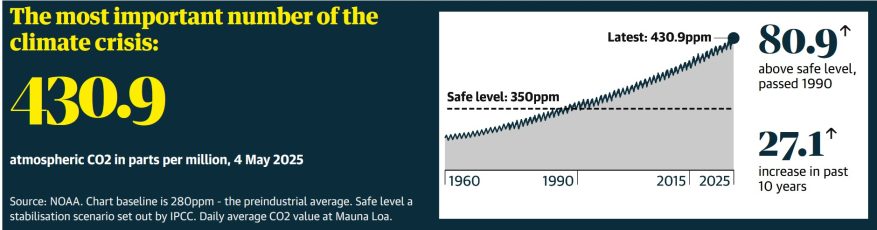
Carbon dioxide, which is by far the most significant contributor to climate change, exceeded its historic, preindustrial level by 50 per cent for the first time.
The bulletin, which is published annually, quantifies atmospheric levels of greenhouse gases measured during the previous year.
Over the years, it has chronicled a steady climb in carbondioxide emissions, occasionally punctuated by slight downturns during times of global economic upheaval, such as the during the height of the COVID-19 pandemic or the 2008 financial crisis.
But these are minor blips in what has otherwise been the growing accumulation of the gas, which is produced by fossil-fuel combustion in power plants and vehicle engines and then persists in the atmosphere for thousands of years after its release.
The latest bulletin also shows a slight decrease in the rate at which carbon dioxide is accumulating in the atmosphere compared with the past decade, but this can be accounted for by natural variations in the global carbon cycle.
The data supporting the findings were drawn from a global network of dozens of atmospheric sensors located on land, on ships at sea and on aircraft.
A key concern for authors of the bulletin is the risk that tropical forests and the global ocean, which absorb much of the carbon dioxide emitted through human activity, will become less effective at doing so as the climate warms. Evidence already suggests a portion of the Amazon rain forest has become a net emitter of carbon dioxide.
The ocean is less well-understood because current observations only cover about 3 per cent of Earth’s marine waters, said Oksana Tarasova, who leads the WMO’s global atmosphere watch program.
“It’s very important to understand how those things will behave, because if we have a reduced uptake by the ocean and if we have reduced uptake by the forest, then everything will stay in the atmosphere and the impact will be much stronger on climate,” Dr. Tarasova said.
The other two gases tracked by the bulletin are also on the rise. Nitrous oxide, the bulk of which is emitted through agricultural activity, saw its highest ever yearon-year rise from 2021 to 2022.
Collectively, human-caused emissions of greenhouse gases have raised the average global temperature by approximately 1.1 degrees, a change that has been linked to an increase in extreme weather events, including forest fires, droughts and floods.
Countries, including Canada, that are signatories to the Paris Climate Agreement have pledged to try to hold the global rise in temperature to 1.5 degrees in order to avoid more severe effects of climate change.
Canada is among the countries falling short on key climate targets as emissions continue to climb.
A recent assessment by the Canadian Climate Institute found that rising emissions from the oil and gas industry are undercutting Canada’s progress made in other sectors. The result is reduced credibility at the negotiating table.
“Despite significant climate policy in the country, other countries have a hard time looking beyond Canada as a major oil producer,” said Dave Sawyer, principal economist for the Ottawabased institute.
The bulletin comes just days after Canadian company GHGSat launched the first commercial satellite to monitor industrial sources of carbon dioxide, a development that could lead to greater accountability for emitters.
In global terms, experts say there is little time left to change course on emissions without the planet experiencing significantly higher temperatures in the coming decades.
In a study published last month in Nature Climate Change, a British-led team found that the remaining carbon available to be burned without exceeding 1.5 degrees of warming will be used up in just six years at current emission rates.
Dr. Taalas said there remains some hope of achieving the 1.5 goal through dramatic emissions’ reductions, “but to reach that we should really raise our ambition level.”
He said that while world events, including continuing wars in Ukraine and Gaza, frequently command media headlines, “climate change is still the biggest challenge for the welfare of mankind this century.
“It’s not the problem tomorrow – it’s long term. And it’s a persistent challenge if we are not able to tackle it.”
This article was written and published by the United Nations News on November 15, 2023.
This article was written by Seth Borenstein and was published in the Toronto Star on November 15, 2023.
Humanity’s fight to curb climate change is failing in dozens of ways with people getting sicker and dying as the world warms and the fossil fuels causing it get more subsidies, according to two global reports issued Tuesday.
The health journal Lancet’s annual Countdown on climate and health found more people, especially the elderly, dying because of heat waves in recent years and it projects that will soar as temperatures keep rising. The international team of doctors, scientists and economists looked at 47 measurements, many outside health, to diagnose a sick Earth, emphasizing harms they attribute directly to the fossil fuel industry.
Earlier in the day, the World Resources Institute, Climate Action Tracker, the Bezos Earth Fund and others issued their State of Climate Action report, which found the world off track in 41 of 42 important measurements. It said six indicators are heading in the wrong direction, including fossil fuel subsidies. Also Tuesday, the United States government issued its more than 2,200-page National Climate Assessment that looked at hundreds of measurements for what warming is doing to America.
Worldwide heat deaths for people over 65 were 85 per cent higher in the last 10 years compared to 1991 to 2000, the study found. Researchers compared the death increase to computer simulations for the same population but in a world that hadn’t warmed and found they could attribute most of those deaths to climate change, not population growth.
In the U.S., heat deaths for the elderly increased 88 per cent in the past five years compared to 2000 to 2004 with most of that attributable to climate change, the study found. There were 23,200 elderly heat deaths in 2022, the report found.
“We are already seeing climate change claiming lives and livelihoods in every part of the world,” said Lancet Countdown executive director Marina Romanello. “However, these impacts that we’re seeing today could be just an early symptom of a very dangerous future unless we tackle climate change urgently.”
Romanello said people self-reporting hunger because of heat waves and drought has also soared, adding “this could be just an early glimpse into what we now know could be a very dangerous future.”
“These findings are stark and — coming from the most thorough annual scientific assessment at the nexus of climate change and health — should be considered accurate,” said Dr. Jonathan Patz, formerly of the University of Wisconsin-Madison, who wasn’t part of the study. “Worrisome is our sluggish response to depart from fossil fuels, which the authors show offers enormous immediate health benefits.”
Report authors directly blasted the fossil fuel industry, comparing it to tobacco companies, and the banks that loaned them money.
“All our indicators on the fossil fuel industry are extremely relevant because this is an industry that is actually killing people in large numbers and making them ill in even larger numbers,” said report co-author Paul Ekins, an economics professor at the University College of London.
 Mobilize, Canada!