This article was written by Anne Shibata Casselman and was published by Maclean’s in September, 2023.
Maclean’s Canada in the year 2060
Reply

This article was written by Anne Shibata Casselman and was published by Maclean’s in September, 2023.
This article was written by Ajit Niranjan and was published in The Guardian on October 31, 2023.
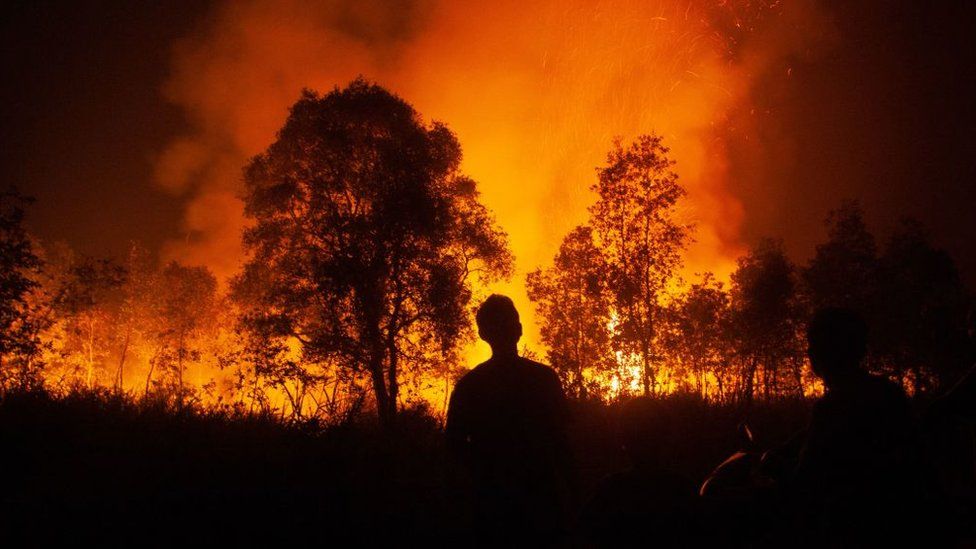
Human fossil fuel emissions are threatening a key climate threshold more quickly than previously thought, a new report says.
This article was written by Matt McGrath and was published by BBC News on October 30, 2023.
This article was written by Seth Borenstein and was published in the Toronto Star on October 31, 2023.
In a little more than five years — sometime in early 2029 — the world will likely be unable to stay below the internationally agreed temperature limit for global warming if it continues to burn fossil fuels at its current rate, a new study says.
The study moves three years closer the date when the world will eventually hit a critical climate threshold, which is an increase of 1.5 degrees Celsius since the 1800s.
Beyond that temperature increase, the risks of catastrophes increase, as the world will likely lose most of its coral reefs, a key ice sheet could kick into irreversible melt and water shortages, heat waves and death from extreme weather dramatically increase, according to an earlier United Nations scientific report.
Hitting that threshold will happen sooner than initially calculated because the world has made progress in cleaning up a different type of air pollution — tiny smoky particles called aerosols. Aerosols slightly cool the planet and mask the effects of burning coal, oil and natural gas, the study’s lead author said. Put another way, while cleaning up aerosol pollution is a good thing, that success means slightly faster rises in temperatures.
The study in Monday’s journal Nature Climate Change calculates what’s referred to as the remaining “carbon budget,” which is how much fossil fuels the world can burn and still have a 50 per cent chance of limiting warming to 1.5 C since pre-industrial times. That is the threshold set by the 2015 Paris Agreement.
The past 10 years are already on average 1.14 C hotter than the 19th century.
Last year was 1.26 C warmer and this year is likely to blow past that, according to scientists.
The new study set the carbon budget at 250 billion metric tons. The world is burning a little more than 40 billion metric tons a year (and still rising), leaving six years left. But that six years started in January 2023, the study said, so that’s now only five years and a couple of months away.
“It’s not that the fight against climate change will be lost after six years, but I think probably if we’re not already on a strong downward trajectory, it’ll be too late to fight for that 1.5-degree limit,” said lead author Robin Lamboll, an Imperial College of London climate scientist.
This article was written by Damian Carrington and was published in The Guardian on October 25, 2023.
This article was written by Damian Carrington and was published in The Guardian on October 24, 2023.
This article was written by Danny Halpin and was published in the Independent on October 24, 2023.
This article was written by Joel Schlesinger and was published in the Globe & Mail on October 30, 2023.
It’s often stated that Canada’s abundant oil and gas reserves provide energy security. Yet recent geopolitical turmoil – such as Russia’s invasion of Ukraine – has tested this notion, causing oil and gas prices to surge, fuelling inflation and making Canadians’ lives more costly.
Increasingly, especially given climate change’s existential threat, it’s apparent Canada’s energy-security future involves moving beyond oil and gas.
Renewable energy offers not only a more sustainable path forward; it can reduce the negative impact of geopolitics on energy security, says Nichole Dusyk, senior policy adviser with the International Institute for Sustainable Development (IISD).
“Switching to renewables won’t get rid of the politics entirely, but one of the things it does do is limit exposure to commodity markets and other geopolitical factors,” she explains.
Ms. Dusyk recently co-authored with Lasse Toft Christensen a 2022 report entitled “Why Canada’s Energy Security Hinges on Renewables,” examining the growing benefits of renewables given that their inputs – largely wind and solar – are free and generally unaffected by the actions of foreign governments or commodity markets. Meanwhile, the report pointed out that natural gas prices have surged to multiyear highs, and gasoline hit a record high in the spring of 2022.
Yet the study also outlined the challenges, notably that Canada must quickly expand renewable energy capacity, particularly to reach the country’s goal of netzero emissions by 2050.
Certainly, politics affects renewables’ growth, given that oil and gas remain a key part of the Canadian economy, especially in Alberta and Saskatchewan, Ms. Dusyk says. Yet a majority of Canadians want governments “to make it so our energy systems no longer contribute to climate change,” she adds.
It’s not just Canadians; governments and businesses globally are increasingly investing in renewables, says Stephen Thomas, clean energy manager at the David Suzuki Foundation.
“Solar, for example, already has more investment globally this year than oil and gas,” he says, pointing to recent data from the International Energy Agency (IEA) showing about US$1-billion is invested daily in solar energy development, or US$382-billion for the year, outpacing oil production investment at US$371-billion.
As well, he adds, about 90 per cent of investment globally in electrical power systems is for renewable projects.
The problem is that not enough of that investment is happening in Canada, Mr. Thomas says. “If we don’t act soon, we will be left behind, and arguably that’s already happening because we’re bogged down by the politics of oil and gas.”
Yet the glass is arguably more than half-full for Canada on its journey toward net zero. As the IISD report notes, 82 per cent of Canada’s electricity grid is supported by non-emitting sources. Most is hydroelectric power, resulting from large public projects that today provide low-cost reliable electricity.
But large-scale projects take decades to complete, says Grant Arnold, president and chief executive officer of BluEarth Renewables in Calgary.
“To quickly scale up to a 100per-cent clean grid, we’re going to need more wind and solar because we cannot build those massive projects quickly enough,” he says, pointing to BC Hydro’s Site C dam, a massive project under development for decades and still not complete.
Renewable projects’ timelines are measured in years, not decades, Mr. Arnold adds. BluEarth should know, having developed and operated wind, solar, battery storage and small-scale hydroelectric projects in North America for about a decade.
Most importantly, over that span, renewables’ fast growth has led to their costs falling dramatically. “Wind and solar are now the cheapest forms of new energy,” he says, pointing to a 2021 report by Equinor, also cited in the IISD study.
In turn, Canada has seen a recent boom in renewables, Mr. Arnold says. Last year, newly completed renewable projects added 1.8 gigawatts (GW) to Canada’s energy, enough to power about 1.6 million homes for one year, up from 1 GW in 2021, Canadian Renewable Energy Association data show. At the end of 2022, Canada had more than 19 GW of installed renewable energy capacity.
“It is growing at an impressive rate, but we still have quite a bit of work to do,” says Vittoria Bellissimo, president and CEO of the Canadian Renewable Energy Association, also based in Calgary.
While the electrical grid – outside of Alberta and Saskatchewan – is mostly non-emitting, oil and gas still make up 76 per cent of Canada’s energy end use, given these are essential inputs for transportation, industry and heating.
Electrification, as well as geothermal energy for heating and cooling buildings, can and must replace most of fossil fuels’ share, she says. “But we need to accelerate renewables at a pace we haven’t seen.”
That will not be easy given that Canada’s grid capacity must expand between 2.2 to 3.4 times its current capacity, essentially about five gigawatts of new capacity annually until 2050, Canadian Renewable Energy Association research shows.
So far, Canada’s two largest oil and gas-producing provinces – Alberta and Saskatchewan – have actually led the country in growth, accounting for 98 per cent of new renewable capacity added last year, the David Suzuki Foundation’s Mr. Thomas says.
“They’re already leaders,” he says, noting the provinces otherwise generate electricity from natural gas, or, in Saskatchewan, coal.
Again, renewable energy’s increasingly low cost compared with fossil-fuel-derived electricity, especially in Alberta, is “because there is an open electricity market,” Ms. Bellissimo adds.
Yet that growth was put on hold recently.
In August, Alberta’s United Conservative Party government announced that approvals of all new renewable projects would be paused for six months to review various concerns, including their impact on rural and agricultural land.
The announcement came shortly before the federal Liberal government unveiled its Clean Electricity Regulations framework to make Canada’s electrical grid net zero by 2035, which Alberta Premier Danielle Smith has criticized as unrealistic.
“We’re at a particularly political moment right now around energy,” Ms. Dusyk notes.
However, the winds of change are blowing increasingly in a favourable direction for renewables, both politically and economically.
“Regardless of what happens in Canada, the world is transitioning away from fossil fuels,” she says.
“That has largely been prompted by climate-change policies, but it’s also because renewables are increasingly cheaper than other energy, and that is really a tipping point.”
If we don’t act soon, we will be left behind, and arguably that’s already happening because we’re bogged down by the politics of oil and gas. STEPHEN THOMAS CLEAN ENERGY MANAGER AT THE DAVID SUZUKI FOUNDATION
This article was written by Omar Mosleh and was published in the Toronto Star on October 29, 2023.
Over the last decade, the devastation caused by wildfires in Canada has been unprecedented, and 2023 is looking to be another recordbreaking year.
In British Columbia, more area has been burned by wildfires in the last seven years than in the previous 58 years, and the province has recorded all of its worst four years on record since 2017, said Mike Flannigan, professor of wildland fire at Thompson Rivers University in Kamloops, B. C.
As the country comes to grips with what scientists say is a new normal, here are five things they’ve learned or observed in recent years that in some cases surprised even them.
There are wildfires in places there weren’t before
The scale of destruction caused by wildfires is happening sooner than scientists projected and in areas where it’s far less common. One recent example of this is the wildfire that swept through Maui, Hawaii last month, which left 97 people dead.
While that area has seen wildfires before, they didn’t have the fire management experience or labour force to fight a fire of that scale.
“That scale of fire really caught people off guard. But I think the point taken is that we are starting to see fire in places where we don’t normally see fire, or don’t see fire at all,” Flannigan said.
“And the 2019- 2020 fires in Australia, were burning into tropical forests, which to anyone’s knowledge never burned before,” he added. “Because things have changed so dramatically.”
In B. C., Flannigan said they’re seeing more fires on Vancouver Island, which is home to temperate rainforests, as well as on the coast, which is atypical.
Robert Scheller, a professor in the department of forestry and environmental resources at North Carolina State University, said he wasn’t expecting to see what’s happening in California until the 2050s.
“Climate change is changing the baseline. I think what we’re seeing is more and more fires happening in what I call fire naïve communities,” Scheller said.
“As climate changes keep accelerating and these things start happening in more and more populated areas, my forecast is we’re going to be seeing many more unpleasant events,” he added. “In the immediate future and over the next decades. This isn’t going to slow down in my lifetime.”
In some cases, the science can’t keep up, he added. He said there is scientific uncertainty because the climate and the associated fire risk is changing faster than the research can catalogue it.
Studies examining the causes and impact of a single extreme weather event can take years. Now it seems like rare events that were anticipated once every 10 or 50 years are happening annually in different parts of the world, at a pace which makes it difficult for scientists to fully understand them, Scheller said.
“The gap between what we know and what we need to know has widened, a lot,” he said. “It feels like it’s somewhat accelerated a lot faster than we thought it was going to. And so that leaves us behind the eight ball, where we’re kind of struggling to keep up with the data.”
Some fires are insuppressible There is a common perception that when a big wildfire is out of control, governments need to throw everything they have at it to get it under control. But we’ve now reached a point where all the manpower and technology we have can’t hold a candle to the sheer scale and intensity of some fires.
The intensity of wildfires is measured in kilowatts per metre of fire line. At above 4,000 kilowatts, it’s too hot and dangerous to have people in front of the fire. At 10,000 kilowatts, even aerial attack with the most expensive and high capacity airplanes becomes ineffective, Flannigan said.
These days, there are fires that reach 100,000 kilowatts per metre.
Flannigan said trying to put out these fires with aerial attack is ineffective because the water evaporates before it even hits the ground.
“It’s basically wasting your money. Almost every agency does it. And the optics are fine, but it doesn’t mean anything … it’s like spitting on a campfire,” he said.
In some cases, the walls of smoke are so thick personnel can’t get close enough to the fire to even attempt extinguishing it.
The potential destruction these fires can cause is compounded by the fact that we don’t have the manpower or technology to respond to them.
“What is concerning is, if this does come to reality, and maybe it’s coming
Mike Flannigan, professor of wildland fire at Thompson Rivers University in Kamloops, B. C., says trying to put out a fire of 10,000 kilowatts or more is ineffective because water evaporates before it hits the ground
much quicker than we anticipated, it means that fire management’s ability to extinguish fires is gonna become really challenging,” Flannigan said.
Floods and fires are linked
Fires leading to floods may not seem intuitive, but scientists say the frequency, intensity and duration of wildfires are making catastrophic floods more likely in certain areas of Canada.
It comes down to a phenomenon known as hydrophobic soil, or water repellent soil. It can have different causes, but in this instance it’s caused by the ash from fires carrying burned plant materials such as tree sap and debris. The organic material builds up the surface of the soil and creates a waxy coating that prevents the soil from absorbing water.
“It’s almost like concrete,” Flannigan said. “Instead of the tree canopies intercepting the rain and the roots and organic material on the forest floor sucking up the moisture, it just flows down the hill.”
The decreased soil absorption leads to increased overland and stream flow and increased runoff clogs stream channels which all contributes to greater likelihood of flooding.
This happened during the atmospheric river event in B. C. in November 2021, where torrential rain caused mudslides and flooding along Highway 5, leading to sections of the highway collapsing. The event ultimately caused about $ 1 billion in damages and left at least five people dead.
These hydrophobic soils can persist for years, making recently burned areas much more susceptible to flooding.
Fires can create their own weather The types of megafires we’re seeing in parts of Canada can create their own weather systems, which are known as fire- generated thunderstorms or pyroCb ( pyrocumulonimbus) clouds. Essentially, the energy from the fire creates convection which forms into clouds that can bring water and hail, but also more lightning strikes.
“In the fire and the combustion process, there’s heat, but there’s also moisture being released. It’s almost like you’re going through the water cycle, air rises, cools, condenses, forms clouds and that eventually develops into a thunderstorm,” Flannigan said.
The lightning that is created from these weather systems is a particularly vicious cycle, as it can generate more fires. That happened in Fort McMurray in 2016, where a fire- generated thunderstorm started four new fires.
More recently, the Sparks Lake fire in B. C. in 2021 created approximately 7,000 lighting strokes and 40 new fires.
Flannigan wrote a paper about fire- generated thunderstorms in 1986, but said back then “it was really quite rare.” In 2021, there were more than 100 fire- generated thunderstorms globally, about half of which were in Canada, Flannigan said. That was the previous record year for pyroCbs; it’s already surpassed by 2023. Canada has seen about 120 to 130 fire- generated thunderstorms this year alone, Flannigan estimated.
Megafires aren’t being driven by arson
Large wildfires, especially when they’re burning close to cities, are often blamed on people deliberately starting them.
The frequency of extreme fire events has led to conspiracy theories about “eco- terrorists” igniting fires to drive fear about climate change.
In Canada, about 50 per cent of wildfires are started by lightning and 50 per cent are caused by human activity, Flannigan said. But only about two to three per cent of those human- caused fires were sparked by arson.
“They’re really blown out of proportion. About 50 per cent in Canada are started by lightning, but they’re responsible for 80 to 90 per cent of the area burned. So humancaused fires are going down,” thanks to measures such as fire education and fire bans, Flannigan said.
This means that most of the destruction caused by fires in remote parts of Canada isn’t caused by humans, but by more lightning, higher than average temperatures and dryness, which most scientists agree are being driven by climate change.
Another misconception is how fires reach areas that are highly populated, Flannigan said. Fires that are started within cities are usually extinguished quickly.
“Fire harms a community through a rain of burning embers, generally not through the fire front,” Flannigan said.
“And these embers can travel long distances, as we’ve seen recently in Kelowna, where it jumped the lake.”
This article was written by Kate Allen and was published in the Toronto Star on October 29, 2023.
Even after the wildfire smoke started blowing in, Carter Vigh was having a perfect summer day.
He had a picnic lunch and played at the water park. He kicked around a soccer ball. The nine- year- old loved soccer, and his asthma had never seriously interfered with his ability to play.
He found out it was free Slurpee day at 7- Eleven, and begged his mom to go.
“After dinner,” she promised. Carter, the baby of the family, helped his mom pick out a rotisserie chicken at the grocery store. They drove back to their home in 100 Mile House, B. C., where he sat next to his older brother and sister on the sofa so they could show him the virtual worlds they had built on Roblox.
That’s when he started coughing. When the coughing wouldn’t stop, his parents gave him his puffer and tried to keep him cool and calm in the bath. While concerning, this wasn’t unusual.
Carter’s parents, like hundreds of thousands of others in Canada, were accustomed to dealing with his asthma, the most common chronic disease in children.
The puffer wasn’t helping, so they bundled Carter into the car and drove to the hospital. A team of doctors, nurses and paramedics worked furiously on him.
“I stood there with him the whole time and told him, ‘ Just slow down, baby, it’s OK. I love you. Just keep trying to breathe,’ ” said Carter’s mother, Amber Vigh.
“Even until the point that the doctor asked us to leave the room to talk, I still thought there was a chance.”
Experts would later say Carter’s parents did everything right. What happened to him was part of a bigger problem.
Air pollution’s new risk
In recent decades, air pollution has receded as a public health threat. Thanks to regulations on cars, trucks and industry, emissions of some major pollutants have been slashed by more than three- quarters. But as climate change fuels the intensity and reach of wildfires, that progress is eroding. An unprecedented 18.5 million hectares burned across Canada this year, sending toxic plumes over cities across North America and darkening skies as far away as Europe.
Experts say this record- setting summer is likely a beginning, rather than a blip.
“Things will probably get worse,” says Paul Villeneuve, an environmental epidemiologist in the Faculty of Science at Carleton University.
“Sometimes the temptation is to say, ‘ Oh, this is a really bad year and things will get back to normal.’ But the larger trend is that we’re going to be seeing more of these, and they’re going to be worse.”
The contours of this emerging health threat, however, are still hard to make out. While some of the short- term consequences are well understood, wildfire smoke behaves very differently from car and truck exhaust, and the longterm effects are much less well studied. Links between air pollution and both neurological and psychiatric conditions suggest the risks extend beyond the physical.
As researchers race for answers, the public health response has been disjointed, leaving average Canadians in the dark. That day, the Vigh family had no idea how bad the air really was.
Since Carter’s death on July 11, Amber Vigh has not been able to bring herself to look at her son’s death certificate. But a few days later, the coroner told her the cause of death was asthma exacerbated by wildfire smoke, she says.
“I never thought in a thousand years I’d be talking to people about my son dying from asthma,” Vigh says.
“It was like any other day.”
Wildfire smoke is unpredictable The Vigh family moved to 100 Mile House in central B. C. so they could be closer to nature.
They fell in love with the forest and the lakes while visiting a relative, and relocated from Alberta, where all three kids were born, so they could spend more time boating, camping, ice- fishing and enjoying the outdoors.
That day, their distance from a major urban centre carried major consequences.
When they checked the Air Quality Health Index in the morning and saw a reading that indicated low risk, that number was based on air quality measurements taken almost 100 kilometres away.
There is no air- quality monitoring station in 100 Mile House, or anywhere between Williams Lake and Kamloops, a three- hour drive.
Canada’s air- quality monitoring program was designed for a different public health threat.
“The thing about wildfire smoke is that it’s very complex, and very variable,” says Angela Yao, a senior scientist at the B. C. Centre for Disease Control who has studied wildfires for the past decade.
When cars and trucks emit pollution, they are all burning roughly the same fuel source: gasoline. But the components of wildfire smoke can change from one fire and even one day to the next, as these blazes consume trees, houses, infrastructure and more.
The way wildfire smoke behaves is also very different. Car- related air pollution tends to build slowly and predictably, peaking at rush hour and lingering near busy roadways. But wildfire smoke can billow in rapidly and unpredictably, spiking pollution in areas far from the source of the blaze. Environment and Climate Change Canada has tweaked the Air Quality Health Index to respond better to the behaviour and type of pollutant in wildfire smoke. B. C. pioneered the new system, but not all provinces have adopted it. The B. C. Environment Ministry also issues “Smoky Skies Bulletins,” advisories that use smoke modelling and other data, and said in a statement that one was issued on July 11 for 100 Mile House. The Vigh family never saw it: “I didn’t even know that was a thing,” Amber Vigh says.
Ultimately, there are big gaps in where air quality is measured and significant lags in how that information gets to the public. There is also misunderstanding about when and how to act.
This past summer, media stories and public attention focused on episodes when Canadian wildfire smoke drove air pollution levels staggeringly high, crowning cities like Toronto, Montreal and New York City the worst in the world.
But research by Yao and others suggest the public should be concerned long before pollution ever reaches these sky- high maximums.
Since wildfire smoke can vary hugely in a single day, Yao and her colleagues looked at hourly pollutant readings during wildfire season in B. C. and compared that with emergency medical services dispatches.
They discovered that ambulance calls for respiratory concerns such as asthma and cardiovascular problems such as heart attacks increased in the first hour of a bad air episode.
This means people at risk — children, seniors, pregnant women, anyone with respiratory conditions, and more — need to react well before the index hits the maximum 10- plus.
And it means communities need to plan, Yao says, equipping buildings with air filtration systems to provide the pollution equivalent of a heat- relief network.
Installing more air quality sensors locally would also be a big benefit, and these are becoming much easier to obtain with the proliferation of low- cost off- the- shelf systems like Purple Air.
To regular Canadians, Yao has this message: “Get prepared.”
“The first time you actually see this, you’re probably shocked and panicked at what’s happening. But over time, then people will understand that this is something we will have to live with. It’s something we need to get prepared for every year. Being prepared can reduce the anxiety and the fear.”
What should the public do?
This summer showed “that the public health messaging and guidance needs to be improved,” says Eric Lavigne, a research scientist at Health Canada’s Environmental Health Science and Research Bureau.
“There were sometimes conflicting messages about which type of air quality index to look for,” Lavigne adds.
But beyond that, more research is needed to inform those public health messages, like what type of mask to wear and when, and at what point it’s unsafe to be outside for different at- risk groups and for the general public.
The public also had questions about the long- term effects of living with wildfire smoke, Lavigne says — a question researchers are increasingly trying to answer.
A major study of millions of Ontarians, published in the Lancet, showed that living closer to heavy traffic was associated with a higher incidence of dementia. Other studies have shown that both short- and long- term exposure to air pollution affected users’ cognitive performance on brain- training games. Exposure to air pollution has also been linked to increased emergency visits for mental health disorders in young people and increased risk of suicide.
Most of these studies looked at typical, ambient air pollution; not as many studies on long- term exposure to wildfire smoke have been done, says Villeneuve, who was a co- author on the dementia and suicide studies. “The focus tends to be on, you know, what goes on in the few days or maybe the week around the increased exposure from the wildfire.”
But with exposure to wildfire smoke increasing, studies of longterm effects need to increase too, Villeneuve says.
In July, the B. C. Coroner’s Service issued a bulletin saying it was investigating Carter Vigh’s death, which was “related to an existing medical condition aggravated by wildfire smoke.” That investigation is continuing, a spokesperson says.
The bulletin also added that “as the province experiences greater impacts from the effects of climate change, British Columbians are learning more about the risks associated with wildfire smoke, extreme heat and other environmental factors. This greater awareness can help us respond when risks are identified.”
Reliving Carter’s death is incredibly painful for Amber Vigh, but she says it’s worth it if it will help even one person with asthma — a condition that about 15 per cent of Canadian kids live with, and whose prevalence is increasing. The family partnered with the B. C. Lung Foundation to launch Carter’s Project, which will raise money to install more air quality monitors in 100 Mile House and other B. C. communities.
“Even though the smoke wasn’t bad that morning, the air quality was obviously horrible,” she says. “But we didn’t have that information.”
Every day, she puts one foot in front of the other. “We do it because we have two more kids that deserve to have us here.”
The night of Carter’s death, a friend took Carter’s brother out to get a Slurpee, an attempt to cheer him up. They got one for Carter, too, even though he would never taste it.
 Mobilize, Canada!