Federal panel wants Canada’s emissions cut in half by 2035

This article was written by Adam Radwanski and was published in the Globe & Mail on September 26, 2024.

A federal panel is calling for Ottawa to commit to cutting Canada’s greenhouse-gas emissions between 50 and 55 per cent from 2005 levels by 2035, as the government prepares to announce new national climate targets for that time frame by the end of this year.

The recommendation, made by the government-appointed Net Zero Advisory Body in a report being released Thursday morning, is accompanied by a proposal that the country begin adopting carbon budgets. That approach would set limits for cumulative emissions, rather than focusing only on benchmark years, and could steer decisions around purchases of carbon credits or other ways of offsetting excess emissions.

And the NZAB is also suggesting ways that Canada can get on track to meet its existing target of a 40-per-cent emissions reduction by 2030, in a separate report also being released Thursday – such as strengthening the country’s industrial carbon-pricing system and methane regulations.

But it’s the 2035 guidance that particularly adds to the pressure on Prime Minister Justin Trudeau’s government.

The 2035 guidance attempts to balance the government’s ambitions to meet international climate responsibilities with domestic realities – including economic and affordability concerns, skepticism about the ability to achieve current emissions targets let alone loftier ones, and polls showing a big lead for an opposition Conservative Party promising to scrap climate measures currently in place.

The government is required under the Canadian Net-Zero Emissions Accountability Act to set emissions-reduction commitments for five-year intervals, on the path to net-zero emissions by 2050; the next of those, for 2035, is due by the end of 2024. A similar demand is set by the international Paris Agreement, under which Canada needs to announce a strengthened target by 2025.

Ottawa is not required to follow the recommendations of the NZAB, which was established in 2021 through the same accountability legislation, and which has since struggled to build a profile amid heavy turnover of its members.

However, the government officially sought the body’s input on a 2035 target, through a request submitted by Environment Minister Steven Guilbeault last year.

In a statement, Mr. Guilbeault thanked the NZAB for its work, but was non-committal about its recommendations, saying he wants to ensure the 2035 goal is achievable.

Speaking to reporters in advance of the recommendations’ release, NZAB co-chair Simon Donner – a prominent climate scientist at the University of British Columbia – said the advisory group tried to balance “being ambitious and being technically feasible” in proposing the target. He pointed out that it would still be more modest, on a percentage basis, than emissions-reduction commitments already made by the European Union, Britain and the United States.

Prof. Donner said the NZAB opted against going higher than 50 to 55 per cent, which some members wanted, because it would place too much strain on some regions of the country.

A similar calculus was provided by the Canadian Climate Institute, a government-funded think tank with greater independent research capacity, which provided the NZAB with analysis to inform its recommendations.

Anna Kanduth, who heads the Climate Institute’s emissionstracking process, said in an interview that her organization’s modelling showed that emissions reductions beyond 52 per cent, by 2035, would be too difficult in terms of both policy implementation and costs. However, she said that if Canada is able to reach its 40-per-cent target for 2030, at least 49 per cent by 2035 should be doable.

As of 2023, according to the Climate Institute’s most recent estimates, the country had achieved an 8-per-cent reduction from 2005 levels, largely through decarbonization measures for electricity generation, and to a lesser extent, heavy industry and waste management. Meanwhile, emissions from the oil-and-gas and agricultural sectors have significantly risen.

Ms. Kanduth nevertheless expressed optimism about a 40per-cent reduction by decade’s end still being in reach, noting that drops have accelerated in recent years and that policies – which at the federal level range from carbon pricing to new environmental regulations to tax credits and subsidies – take a while to bite.

To get the rest of the way there, both the NZAB (in the second report released Thursday) and the Climate Institute are calling for Ottawa to finalize promised policies such as an oiland-gas emissions cap, clean electricity regulations and regulations for commercial vehicles; to strengthen existing measures such as industrial carbon pricing and methane caps; and to explore a small number of new measures such as heating and cooling regulations for commercial buildings.

Prof. Donner noted that even if Canada sets and achieves the NZAB’s 2035 recommendation – which, he stressed, would require greater ambition from the provinces and the private sector in addition to Ottawa – the country would still be responsible for more than its fair share of global emissions if planetary warming is to be contained to 1.5 or 2 degrees Celsius, which are international targets to minimize climate-related disaster.

That’s part of the rationale for the NZAB’s additional recommendation of adopting carbon budgets, to account for cumulative emissions. In addition to other benefits such as avoiding over-focusing on milestone years in which there could be statistical noise, the panel contends that the approach could help determine the extent to which Canada is exceeding the emissions needed to achieve global goals, and inform compensatory measures such as investments in carbon removal and internationally traded carbon credits.

At the same time, the NZAB acknowledges that those sorts of offsets might also be needed just to achieve the 2035 target it is suggesting – which, Prof. Donner allowed, is something of a stretch goal based on the trajectory to date.

The magical thinking of climate politics

This editorial was written and published by the Globe & Mail on September 17, 2024.

A wave of magical thinking is sweeping over Canadian politics, with politicians on the right and now the left fantasizing that there is such a thing as a painfree way to reduce greenhouse-gas emissions. Conservative Leader Pierre Poilievre (and his kindred spirits in provincial conservative parties) has been on the leading edge of that wave, for years decrying the federal fuel charge as an onerous burden. But he has yet to say exactly what he would do after axing the carbon tax.

Not to be outdone, the NDP is now joining in on the fantasy of a painless climate policy, or at least one that does not pinch “working people.”

Last Thursday, federal NDP Leader Jagmeet Singh said his party no longer supports the Liberals’ carbon-pricing policy of levying an escalating fee on fossil fuels, while returning around 90 per cent of the proceeds to households in payments every three months.

“We want to see an approach to fighting the climate crisis where it doesn’t put the burden on the backs of working people, where big polluters have to pay their fair share, have to pay the price of their pollution, but it shouldn’t be on working people’s shoulders,” he told reporters, speaking four days before Monday’s by-elections.

He remained artfully vague about what he would instead propose, or exactly who qualifies as “working people.”

If lower-income households are Mr. Singh’s concern, he should have no qualms about endorsing the current federal fuel charge. Those households are clear beneficiaries under the Liberals’ carbon tax, receiving more in quarterly payments on average than they pay in tax. Perhaps Mr. Singh is worried about the highest-income households, who do indeed, on average, bear a net cost.

Of course, the federal Liberals have done a lot all on their own to damage the case for the carbon tax. Last fall’s exemption of heating oil from the levy, a nakedly political move aimed at shoring up the party’s support in Atlantic Canada, undermined the Liberals’ argument that most households are better off under the policy.

Later last Thursday, British Columbia Premier David Eby – weeks ahead of a provincial election – said he will scrap his province’s fossil-fuel charge if Ottawa scraps the law requiring it. He said the provincial NDP would ensure “big polluters are paying their fair share,” echoing Mr. Singh’s language.

Mr. Singh and Mr. Eby have gotten one thing (inadvertently) correct: big polluters should indeed bear their fair share of the costs of reducing Canada’s greenhouse-gas emissions. But their rhetoric runs aground on this hard fact: those big polluters are … everyday Canadians.

Emissions from transportation accounted for 22 per cent of the national total in 2022, the most recent year for which data is available. That was second only to the oil and gas sector, with 31 per cent of total emissions. Emissions from buildings were close to 13 per cent of the total, while electricity generation accounted for nearly 7 per cent.

Added together, transportation, buildings and electricity were responsible for just over 41 per cent of emissions in 2022.

There is no plausible way to reduce Canada’s carbon footprint without decreasing emissions in those sectors. Even if the entire oil and gas industry were to be shut down – and ignoring the ensuing economic catastrophe – Canada would still be well short of meeting the 2030 goal of reducing national emissions by at least 40 per cent below 2005 levels.

Meeting Canada’s greenhouse-gas targets requires collective action, and will result in collective pain. This space has consistently argued that an escalating levy on fossil fuels is the least painful option, since it allows individuals and businesses to decide how to reduce carbon emissions.

Any other alternative will end up being more costly, not less. That added expense may be necessary to ensure the political durability of climate-change policies. But it is ludicrous to assert, as do Mr. Singh and Mr. Eby, that “big polluters” will be the only ones to pay.

Yes, the industrial carbon levy could be ramped up, or regulations could be enacted that mandate specific reductions. But the added expenses, either in taxes or regulatory burden, would be passed through to consumers, without the benefit of offsetting payments.

The only way to avoid those expenses is to do nothing about climate change – a policy sleight of hand that would be the most costly choice of all.

Wildfires made Canada one of world’s top carbon emitters in 2023, study finds

This article was written by Kate Allen and was published in the Toronto Star on August 29, 2024.

The McDougall Creek wildfire burns on the mountainside above homes in West Kelowna, B.C., in August 2023. Wildfire emissions over five months, from May to September of 2023, were more than four times larger than Canada’s annual fossil fuel emissions from all other sources, researchers calculated.

Last year, the top three emitters of heat-trapping carbon pollution were China, the United States and India.

Just missing the podium, in fourth place: that summer’s Canadian wildfires, which released more carbon into the atmosphere than every other country in the world, according to a new study published Wednesday. Wildfire emissions over five months, from May to September of 2023, were more than four times larger than Canada’s annual fossil fuel emissions from all other sources, the researchers calculated.

The study, published in the journal Nature, adds another shocking statistic to a wildfire season that has racked up many.

But it also adds to a growing and critically important area of research on the health of Canada’s forests, which currently siphon off a big chunk of the carbon emissions humans release and prevent the world from warming even faster.

“When we emit carbon, we get this big discount of carbon taken up by the forest. And in a lot of ways we kind of rely on that discount,” said Brendan Byrne, lead author of the new study.

“For that reason, it’s very important to understand how these forests and natural ecosystems are absorbing and releasing carbon.”

Byrne is a scientist at NASA’s Jet Propulsion Laboratory in California. But he was born in Alberta and raised in British Columbia, so when Canada’s forests started burning out of control last summer, he was paying attention.

“Being Canadian, I was watching the fires probably more than I would have otherwise. And that was really what got me interested in this study,” Byrne said.

Other estimates of the carbon emitted by last summer’s Canadian wildfires already exist. But Byrne and his colleagues wanted to try a different method they thought would be more direct and reduce some of the uncertainties. The other estimates follow a “bottom-up” approach: they use satellites to calculate how much ground is burning, and then estimate how much carbon had been stored in those areas.

Byrne and his colleagues flipped this, using a “top-down” approach. When forest fires burn, they send big plumes of smoke into the air that contain carbon monoxide. Byrne’s team used data from a different satellite that measures the big increases in carbon monoxide as it passes over the plumes. With that data they can back-calculate how much total carbon the fires released.

To ground-truth some of their calculations, they also relied on a structure about the size of a school portable sitting in a forest in northern Saskatchewan. For years, University of Toronto professor Debra Wunch has been recording concentrations of carbon monoxide and carbon dioxide using an instrument sitting inside that structure.

Like Byrne, Wunch was watching the fires closely, and the measurements that were rolling in from her instrument — the highest she had ever recorded.

“It was really intense, and really sustained,” said Wunch. So intense, in fact, that the instrument itself came close to disaster: fires came within a kilometre of the structure itself. “It was a bit touch-and-go there,” she said.

All of this data was used to create an estimate for 2023 Canadian wildfire carbon emissions that surprised even the scientists who had produced it: 647 megatonnes, greater than Japan’s, Germany’s or Russia’s annual emissions and comparable to India’s total of 740 megatonnes.

“It’s hard to get your head around, because it’s so much bigger than any other Canadian season we’ve seen,” said Byrne.

While forests everywhere sequester some of the greenhouse gases humans emit, Canada is particularly important because of how vast our forests are — Canada is home to 8.5 per cent of all globally forested area — and because the country is warming at twice the rate of the rest of the world, Byrne added.

Wednesday’s Nature study and another published in the journal last week both examined the drivers of the unprecedented 2023 fire season, and came up with similar results. Hot and dry weather — the most extreme since 1980 — was the principal driver of fire spread, Byrne and his colleagues found. Human-caused climate change enabled extreme fire weather conditions over a long period, the other recent study found.

Both studies found these conditions were becoming more frequent; Byrne and his colleagues looked at climate projections and found that the extreme temperatures of last summer would be typical during the 2050s.

But how exactly the Canadian wildfire season will evolve — and when we will get another season like last year’s — is hard to predict, said Piyush Jain, the lead author of last week’s Nature study and a scientist with the Canadian Forest Service.

Climate models can help predict future weather conditions, but other elements, like lightning — a common ignition source — are hard to model in fine detail, Jain said. It’s also hard to know how vegetation and tree species might shift with many more active fires.

“There’s still a lot not known. Fire is a complex phenomena,” Jain said.

But overall, studies show, “the probability that any given year in the future will be more extreme is increasing. And so we would tend to see these years more.”

Samantha Green, a family physician with Unity Health Toronto and a volunteer with the Canadian Association of Physicians for the Environment, says that while the carbon emissions numbers might be mind-boggling, action is both possible and necessary.

“It’s upsetting. It’s not surprising,” said Green. “We know that with increasing climate change, we will see these feedback loops happen, unfortunately, and I think it should act as more motivation to stop burning fossil fuels.”

Green notes that in addition to the direct health harms from smoke and fire, wildfires also cause trauma and displacement.

“Sometimes when we see these numbers, it’s just so abstract … and then people feel just so dejected, like there’s nothing that we can do about this — when in fact, what it means is that we need to do everything about this, that every action that we take matters.”

Canada’s wildfires a top global emitter last year, study finds

This article was written by Manuela Andreoni and was published in the Globe & Mail on August 29, 2024.

Smoke from a nearby wildfire fills the sky in Yellowknife last year. According to new research published in the journal Nature, only China, the United States and India produced more emissions from fossil fuels in 2023 than Canadian wildfires.

Blazes in the boreal forests raise questions about how much carbon they will be able to absorb in the future

The wildfires that ravaged Canada’s boreal forests in 2023 produced more planet-warming carbon emissions than the burning of fossil fuels in all but three countries, research published Wednesday has found.

Only China, the United States and India produced more emissions from fossil fuels than the Canadian fires, according to the study, which was published in the journal Nature.

The wildfires last year call into question how much carbon the forests will absorb in the future, scientists said. That, in turn, may make it necessary to reconsider calculations of how much more greenhouse gas humans can add to the atmosphere without pushing temperatures beyond current global targets.

The most ambitious limit set in the 2015 Paris Agreement was 1.5 C above preindustrial times. Beyond that threshold, scientists say, it will be increasingly difficult for humans to adapt to a hotter planet.

The boreal forests have historically helped to slow climate change by storing carbon as trees grow rather than adding carbon dioxide to the atmosphere. While the hot and dry weather that fuelled the fires in Canada last year was extraordinary when compared with historical records, climate projections suggest it will become common in the 2050s if the world continues on the current trajectory of global warming.

“This brings up a lot of concerns about whether these fires will happen more frequently,” said Brendan Byrne, a carbon cycle scientist at NASA’s Jet Propulsion Laboratory in California and one of the authors of the study. “That could potentially have a big impact on the ability of these forests to store carbon.”

This year’s fires, while bigger than average, have so far not been as destructive as last year’s, as some scientists had feared.

The hot and dry weather that fuelled the 2023 fires was extraordinary in several ways. A separate study published in the journal Nature last week documented how exceptional weather patterns, such as early snow melt and so-called flash droughts, converged to fuel blazes that burned around 15 million hectares, an area almost the size of Florida, more than seven times the historical average.

Canada has been warming at about twice the global rate, and last summer’s extreme temperatures were behind much of the exceptional weather patterns that fuelled fires. The average temperature in Canada between May and October last year was 2.2 C above what was normal in the previous 30 years.

The high temperatures fuelled blazes that kept burning for months, many from April to October without respite, as well as so-called overwintering fires, those that can burn underground for several years.

“This idea of multiyear fires, they were kind of fairly anecdotal in the past,” said Marc-André Parisien, a senior researcher at the Canadian Forest Service and an author of the latest study. But now, he said, researchers are seeing their potential to cause big damage.

Though 2023 started with levels of soil moisture that were almost normal for the time of year, extreme temperatures rapidly dried the ground in what researchers are calling a flash drought.

Forests absorb about a quarter of global carbon emissions. But ecosystems are changing in ways scientists are still working to understand. Parts of the bore al forest sin Canada are notre growing after fires as they have in the past, partly because blazes burn trees so frequently and intensely.

The 2023 fires have the potential to cause extensive regeneration failure in Canada’s boreal forests because blazes engulfed large areas of young forest. Last year, for instance, a total area of forest the size of the Netherlands burned for at least the second time in 50 years, according to an analysis by Natural Resources Canada. Some other areas burned for the second time in 10 or 20 years.

Rise of flooding is not exclusive to Toronto

This Letter to the Editor was written by Ray Nakano and was published in the Toronto Star on August 15, 2024.

Quebec recovering from historic rainfall, power outages as storm remnants move east, Aug. 10

Flooded basements, power outages, roads washed out … sound familiar? What Quebec experienced is just like what happened to Toronto on July 16, as torrential downpours hit Montreal and its surrounding areas.

Whether remnants of more and more extreme hurricanes or not, these are unnatural disasters brought about by global warming. We need to stop burning fossil fuels like coal, oil and gas, and switch to clean and cheap renewable energy.

Our roads, bridges and stormwater infrastructure were not built for once-in-a-hundredyear rainfall events that are happening more frequently. We need a city stormwater charge that will help pay for upgrading our stormwater infrastructure. The sooner, the better before the next torrential downpour.

Ray Nakano, Toronto

It’s time to stop exporting coal

This article was written by Jennifer Cole and was published in the Toronto Star on August 10, 2024.

Every summer wildfires devastate communities. Last summer it was Kelowna, B.C., this year it’s Jasper., Alta. And yet, Canada still exports coal, a fossil fuel contributing to climate change and wildfires.

According to researchers, the ferocity and frequency of wildfires are exacerbated by the effects of human-caused climate change and the burning of the above-mentioned fossil fuels.

Watching news reports of Alberta Premier Danielle Smith holding back tears as she spoke of Jasper’s destruction from a recent wildfire was heart-wrenching. But keep in mind that according to the Coal Association of Canada, the majority of coal produced in Canada comes from Alberta.

The federal government acknowledges that Canada is warming twice as fast as the global average, and therefore experiencing the consequences of global heating even more acutely than other places. In fact, in 2021 the government made an election promise to ban the export of thermal coal by 2030. Time is ticking and yet, instead of coal exports shrinking, they are increasing.

In 2023, Canada exported 19.5 million tonnes of thermal coal. That’s almost twice the amount that was exported in 2015 when the Liberals took power.

In the United States alone, carbon dioxide emissions from burning coal for energy accounted for about 19 per cent of energy-related carbon dioxide emissions in 2022. And then there’s metallurgical coal used for steel manufacture.

Canadian mines produced 47 million tonnes of coal in 2022, 59 per cent of which was metallurgical coal. Nearly two billion tonnes of steel is produced worldwide each year, accounting for about seven per cent of greenhouse gas emissions.

Again in fairness to the feds, Environment Minister Steven Guilbeault did say in February he was concerned about coal export and that he’d have more to say in the coming months. It’s now the middle of summer, Jasper has burned. This is not a “no news is good news” scenario.

Guilbeault did express his “concern” about the export of coal this year and at the same time, a private members bill was introduced into the House of Commons by environment critic Laurel Collins.

She’s convinced that waiting until 2030 is too late for the ban to begin. Good point.

It might be prudent to fulfil the 2021 election promise of an export ban on coal sooner as opposed to later.

Currently, polls are not showing promise for the Liberal’s return to power in the next election. There’s no guarantee what a Conservative government with a penchant to support Alberta might do.

Will making a whole industry defunct be expensive and cost jobs? Yes, and that is enormously devastating. It’s a tricky situation but we shouldn’t expect solutions for global warming to come easily. Will halting the export of coal stop global warming and wildfires? No, but it will at least show that Canada is willing to do something, even if a drop in the bucket.

The real question is how many more Jaspers do there need to be before that happens?

We must focus on both emissions and production

This opinion was written by Tzeporah Berman, the co-founder of environment strategy firm Stand.earth and the chair of the Fossil Fuel Non-Proliferation Treaty Initiative, and was published in the Globe & Mail on August 10, 2024.

Shell’s Quest Carbon Capture and Storage facility in Alberta is seen in 2021. The Intergovernmental Panel on Climate Change denounced CCS as having the highest cost and the lowest possible contribution to reducing new emissions.

Canada’s strategy of reducing emissions, but not fossil fuel production puts a filter on the crisis, Tzeporah Berman writes

About 10 years ago, in a meeting with oil CEOs in Calgary, I heard it for the first time. “It’s not about production, it’s about emissions.” The statement had appeal. The idea was that if we focus not on limiting production of fossil fuels but on reducing greenhouse gas emissions, industry could work with environmentalists to mitigate climate change.

For a while it seemed to work. We built a consensus around policies that would cap emissions but not limit production if industry could crack the nut on affordable technologies that could reduce emissions per barrel. We could have our cake and eat it, too. And all the while avoid having to come to agreement on thornier issues of pipeline expansion projects, liquefied natural gas (LNG) and deep-water drilling.

Like all things that seem too good to be true, the promise of “let’s work together to focus on emissions not production” was, in fact, too good to be true.

Now, this mantra is everywhere, directing huge pools of government spending and setting the agenda for climate policy in Canada and beyond.

The mantra has been taken up by provinces regardless of political stripe. Alberta’s oil and gas production is at record levels and they are still fighting climate policy, while British Columbia is promoting its climate leadership and simultaneously expanding fracking and LNG. The common denominator is that whatever their position on climate policy, all of our governments seem hellbent on boosting the root cause of the problem. Literally throwing gas on the fire.

It’s become the implicit rallying cry for the Trudeau Liberals, who have celebrated plans to plant two billion trees, launch carbon pricing and invest in carbon capture technology. Their national climate strategy revolves around sucking up mythical amounts of carbon from the sky like some kind of titanic, Spandex-clad superhero.

The trouble is the math doesn’t add up and today this mantra is not only unrealistic, it’s dangerous.

It took me a while to realize that this line of thinking is actually underpinned by a sophisticated postdenial strategy of the big oil and gas companies. After nearly 50 years of indisputable climate science (which oil companies buried and denied), Big Oil has conceded that, yes, climate change is real, it’s here, and carbon emissions are its primary cause. But rather than limiting production of their toxic products or investing in safer and cheaper alternatives, they’ve distracted us with inflated projections for technologies that have failed to deliver for decades.

Exxon chief executive Darren Woods perfectly encapsulated this ethos when he confidently told a global climate conference that the path forward from climate catastrophe was more sophisticated projections of technological climate fixes. “Our view is there’s a need to do more math in this space,” he said, propping up a popular oil strategy to use factually suspect calculations for failed carbon capture and storage tech (CCS) to sow uncertainty and undermine proven climate science.

It’s a very similar PR strategy to when cigarette companies responded to the U.S. surgeon-general’s lung cancer warning by launching filters. The filter didn’t solve the health risks; it only deceived consumers into believing it did.

In other words, Ottawa’s current climate mantra prevents us from reducing production of the three products that actually underpin runaway global warming: oil, gas and coal. It’s putting a filter on the climate crisis and saying the risks of the oil-soaked status quo are over. Unless we change our tune, this slippery phrase will condemn us to apocalyptic world warmed far past 2 degrees because these tactics are not working.

So-called “natural solutions” such as planting trees may exalt vegetation with Christ-like abilities to turn carbon into clean air. But the fact of the matter is that slapping a few saplings into razed old-growth rubble, (which is the on-the-ground practice of Justin Trudeau’s flashy tree slogan) only enables Canadian logging to destroy precious ecosystems that would have otherwise worked quite well as natural carbon sinks. Those monocultures of tiny trees (typically black spruce) that the Liberals laud as climate action are vulnerable to forest fire, inefficient at capturing carbon and, in fact, often die in the ground because they can’t survive the degraded soil conditions destroyed by continuing logging activity.

Carbon capture and storage is even more of a pipe dream. Many existing CCS plants have failed or are dramatically underperforming. In May, Edmonton based Capital Power shuttered its $2.4billion CCS project and the CCS project installed at SaskPower’s Boundary Dam 3 was declared an “underperforming failure.”

These two examples are hardly the only ones. Globally, CCS projects are proving slow, expensive and inefficient. For this reason, the Intergovernmental Panel on Climate Change, the largest group of climate scientists, recently denounced CCS as having the highest cost and the lowest possible contribution to reducing new emissions. And the International Energy Agency encouraged global leaders to focus on “most cost-effective” solutions, not expensive and unpredictable techno fixes such as CCS. From the lion’s own mouth, BP, Shell and Exxon have dialled back their climate commitments, walking back some of their promises to reduce emissions and research viable energy alternatives. These oil conglomerates know CCS is failing and, as 2030 approaches, they’ve realized they can’t keep pretending speculative tech will balance their unchecked emissions.

Yet, despite the ample evidence that CCS isn’t working, Canada continues to invest in these projects and the fossil fuel corporations that peddle them. In 2023, Canada put more than $1.3-billion in the pockets of oil and gas companies for CCS. Just last month Ottawa committed another $1-billion of taxpayers money to the new CCS project proposed by Strathcona Resources Ltd. Along with the many other billions spent to prop up the industry, federal spending on fossil fuel corporations in the past four years could have fully funded every major wind and solar project in Canada from 2019 to 2021 12 times over, according to the organization Environmental Defence. If these companies wish to pour their own windfall profits back into these experiments, by all means go ahead. But public money should go toward actual climate solutions and emergency preparedness, not the delusional whims of oil CEOs turned mad scientists.

I could go on about how disappointing these approaches are, and how big polluters know it. But what’s equally dangerous about the current climate mantra isn’t just how much its tactics are falling, but which policies this obsession with removing emissions is crowding out.

Ottawa’s approach focuses almost entirely on the demand side of the emissions problems: soak up the carbon in the air and ask Canadians to pay for their consumption. Political scientists and economists have critiqued this move by likening it to ”cutting with one half of the scissors.” Meanwhile, more serious regulation (like that which would deter climate meltdown) of polluting industries, such as the long-delayed promise for an emissions cap, seem lost adrift on a sea of inaction and weaker everyday.

This is no coincidence. Decades of oil and gas lobbying, PR and ads have misled our leaders into believing we can endlessly expand fossil fuel production because unproven technologies or sublime trees will simply clean up after us, will save us. By having our national climate strategy rely on unsubstantiated carbon capture projections, Ottawa has drank the fossil fuel Kool-Aid and then asked for a refill.

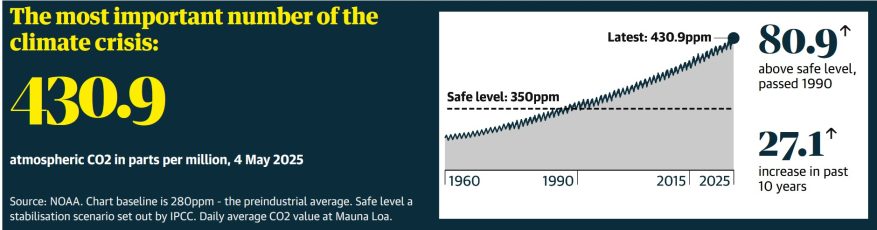
What I’m going to call “magical tree sermons” and “fetishized CCS bad math” are distracting us from real climate solutions. And that’s their biggest danger. While Ottawa flusters over flashy carbon removal schemes, our emissions are only going up and up. We have spent 30 years saying we just need to regulate emissions and watching the parts-per-million of carbon trapped in the atmosphere tick upward. As the National Oceanic and Atmospheric Administration revealed in June, carbon dioxide is accumulating in the atmosphere faster than ever before.

Focusing on capturing emissions is clearly failing us. What we produce today will be what we use tomorrow. This doesn’t mean turning off the taps overnight but it does mean stopping expansion of fossil fuels, and managing a planned wind down that leaves no one behind.

We have to stop pretending we are “in a transition” and “phasing out fossil fuels” while we are building more of the problem. The obvious solution is to stop expanding fossil fuels in a world on fire. That is, it’s time to cut with both halves of the scissors: emissions and production. That means, as both the International Energy Agency and the Intergovernmental Panel on Climate Change have confirmed, no new oil, gas or coal projects and a robust plan to decommission existing infrastructures. It means divesting from fossil fuels. It means absolute limits to emissions and a production decline. It means having the courage to break rank and lead with a new climate mantra, one that represents rather than buries the urgency of the crisis.

Decades of oil and gas lobbying, PR and ads have misled our leaders into believing we can endlessly expand fossil fuel production because unproven technologies or sublime trees will simply clean up after us, will save us.

Emissions linked to hundreds of deaths

Study examines ultra-tiny particles produced when things are burned

This article was written by Moira Welsh and was published in the Toronto Star on August 6, 2024.

Ultrafine — and unregulated — air particles from vehicle emissions and industries in Canada’s two largest cities are linked to an estimated 1,100 premature deaths each year, a new study found, with 600 of those deaths in Toronto.

In Toronto and Montreal neighbourhoods near airports or heavy traffic, nanosized particles from burning fuels such as diesel are so small they have escaped significant research and oversight, said a “first of-its kind” study, published in the American Journal of Respiratory and Critical Care Medicine.

Led by researchers at McGill University, the study found that the ultra-fine particles are associated with 7.3 per cent increase in the risk of non-accidental deaths. The paper calls for more study and regulation.

Scott Weichenthal, of McGill, said the particulates examined in the study are “small particles that are produced when you burn things that are not regulated, that can be inhaled deep inside the lungs and get into the systemic circulation that reach all throughout your body.”

Researchers found a “very consistent” relationship between the ultra fine particles and premature mortality, said Weichenthal, an associate professor in McGill’s Department of Epidemiology, Biostatistics, and Occupational Health.

“Where you live determines how much of this exposure you have. And people who are more exposed to these kinds of particles die sooner from non-accidental mortality but also cardiovascular mortality, respiratory mortality and cancer mortality,” he said.

Respiratory deaths accounted for the highest increase in mortality, at 17.4 per cent, followed by a 9.4 per cent rise from coronary artery disease, the study found.

The ultrafine particulates, for example, have an adverse effect on blood vessels, contributing to coronary artery disease, he said. The paper noted that these particles also “contribute to oxidative stress and trigger inflammation leading to possible tissue damage, DNA modification and disruption of cell growth.”

Environmental regulations have reduced air pollution in North America, researchers say, but are not controlling the ultrafine particles. In New York, the study said that the ultra fine particulate levels have risen, even as the larger particulate levels have dropped.

The size of these tiny particle is important when considering health impacts, since earlier studies that did not take the particle size into account and may have missed or underestimated serious health risks,” a McGill press release said.

As part of the study, the team of researchers from several universities tracked air-pollution levels for a 15-year period starting in 2001. They looked at neighbourhoods that were populated by 1.5 million adults.

“Anytime you burn anything,” said Weichenthal, “it could be gasoline, it could be diesel, anytime you’re burning an organic material, you are increasing these particles.”

‘‘ People who are more exposed to these kinds of particles die sooner from non-accidental mortality.”

SCOTT WEICHENTHAL MCGILL RESEARCHER