This article was written by Marco Chown Oved and was published by the Toronto Star on May 28, 2023.
The twin smokestacks at the Portlands will be belching out more smoke more often in the coming years, increasing air pollution in downtown Toronto and ramping up carbon emissions, as the gas plant has been given the go-ahead to boost its electricity generation.
And it’s happening in the face of city council’s opposition, despite a provincial pledge to obtain local permission before proceeding. Council passed a motion opposing any new natural-gas generation in the city only days before last week’s provincial announcement.
“It’s really unfortunate that they’re just proceeding anyway,” said Coun. Paula Fletcher, who co-wrote the motion. “This is a very large plant and it will be running far more frequently. It’s not really the direction we should be going in the climate crisis.”
When the call went out for new power generation last fall, Energy Minister Todd Smith put an explicit requirement on all proposals, saying they could not proceed without permission from local municipal councils. “This municipality did not agree,” Fletcher said.
The province had put out an RFP (request for proposal) for more generation, and some existing plants were granted expanded generation under the RFP. But the resulting increased emissions at the Portlands plant — Toronto’s largest source of greenhouse gas emissions — will make it harder for the city to meet its TransformTO pledge to reach net zero by 2040.
Fletcher said it fits into a wider pattern of the province overruling Toronto, from Ontario Place to Ministerial Zoning Orders.
“By now we’ve learned that Premier Ford and his government treats Toronto as an extension of Queen’s Park, where they feel they can do whatever they want,” she said. “Everything that they do flies in the face of the direction that our city has taken.”
The Portlands is one of six gas plants with planned expansions and upgrades that will provide additional peaking power during the hottest summer days to help curb the province’s anticipated electricity shortfall. The plant has also extended its contract by five years, ensuring gas will remain on the Toronto waterfront until April 2034.
(In addition to the Portlands, two other GTA gas plants — in Brampton and Halton Hills — will also see capacity upgrades.)
In an email to the Star, Energy Minister spokesperson Michael Dodsworth said the plant expansions in Windsor and Sarnia received support from local councils as promised. But because the upgrades at the GTA plants, characterized as “tune ups,” do not require “new construction,” they’re “consistent with the Minister’s direction.”
The additional gas-fuelled power generation undermines efforts to reduce emissions across the province, said Sarah Buchanan, campaigns director for the Toronto Environmental Alliance.
“We are already facing an uphill battle to meet looming climate change targets,” she said. “One of the biggest hurdles really is just that the grid is getting dirtier when it’s supposed to be getting cleaner.
“It’s really frustrating to see Toronto’s climate plans completely undermined by these energy decisions.”
As demand for power rose and nuclear plants got taken offline, emissions from the Portlands plant rose from 188,000 tonnes in 2017 to 618,000 tonnes in 2021, according to the federal government’s national inventory of emissions.
The Independent Electricity System Operator (IESO) said it expects 200,000 to 400,000 additional tonnes of emissions per year from new gas generation provincewide.
It’s not just a matter of increased carbon emissions, but one of local air pollution, said Ontario Clean Air Alliance Chair Jack Gibbons.
“It’s a fossil fuel plant and it produces pollutants that are harmful to our health,” he said. “Because (the plant operates) to meet our peak demands, it will be ramped up on the hottest summer days, which are also the smoggiest days. It’s making air pollution worse on our worst air pollution days.”
Tom Patterson, director of energy management at Atura Power, a wholly owned subsidiary of Ontario Power Generation that runs the Portlands and Halton Hills gas plants, said the upgrades will make the plants more efficient.
“For substantially the same amount of fuel, we will be getting more power output from the facility,” he said.
Projections by IESO show an increased reliance on gas plants in the coming years, as nuclear plants are taken out of service for refurbishment or retirement.
Soon, they will run not just during peak demand, as they do currently. This year, gas plants are expected to operate 24 per cent of the time. By 2026, that is projected to be 81 per cent. In 2041, it’ll 100 per cent of the time, according to IESO.
Patterson acknowledged that gas plants create carbon emissions, but said they also let other sectors of the economy with bigger carbon footprints decarbonize by switching their operations to electricity.
Electrification of the steel smelters in Sault Ste. Marie, is a good example of this, because electric arc furnaces running on Ontario’s grid — 90 per cent of which comes from non-emitting sources — will replace coalburning coke ovens.
Patterson said gas peaker plants will likely continue to play a role, even in the federal government’s plan for a net-zero grid by 2035.
“Net zero is an ongoing conversation,” he said. “From our perspective, that doesn’t mean we go to absolute zero on the electricity grid.”
Bryan Purcell, vice-president of policy and programs at The Atmospheric Fund, says keeping gas on the grid as an emergency backup is reasonable, but that’s not what’s happening in Ontario.
“There’s a deepening commitment to ramping up natural gas generation, taking us in the wrong direction,” he said.
The advantages of fighting in-your-face effects of climate change simply don’t show up in public accounts
In Calgary this week the sky looked like something out of science fiction disaster movie as smoke turned the air people needed to breathe orange. (Leah Hennel/Reuters)
We can’t call these supercharged wildfire seasons our ‘new normal.’ There’s nothing natural about how we changed the Earth’s climate
This opinion was written by John Vaillant and was published in the Globe & Mail on May 19, 2023.
John Vaillant’s latest book is Fire Weather: The Making of a Beast.
We weren’t a week into May before 30,000 people had been evacuated because of dozens of fast-moving wildfires in Alberta. Structure losses were mounting, and politicians were trotting out words like “unprecedented.”
Unprecedented? Where were they in 2017, when British Columbia had its worst fire season on record and generated four simultaneous pyrocumulonimbus thunderstorms? Where were they in 2016, when Fort McMurray burned – for days – along with 6,000 square kilometres of forest? What about 2011, when Slave Lake lost its town hall, library, radio station and 500 houses in a few hours?
No, the current fire situation is not unprecedented, and calling it the “new normal” is offensive. There’s nothing “normal” about it. Do I sound angry? I have a right to be, and so do you. In the late 1970s, Exxon’s own scientists predicted that the effects of increased industrial CO2 would penetrate the “noise” of random climate fluctuations and become measurable in the form of rising global temperatures, especially at higher latitudes like ours.
Brown smoke envelops Fort McMurray in 2016, as seen from the ground on May 6 and from NASA’s Aqua satellite on May 9.JASON FRANSON/THE CANADIAN PRESS; NASA VIA REUTERS
I started working on my latest book, Fire Weather, in 2016, just days after Fort McMurray disappeared beneath a fire-borne pyrocumulus cloud 14 kilometres tall. I did so not because this was a once-in-a-lifetime fire (the intervening years have proven otherwise). I did it because I understood, way back in 2016, that if a fire could do that much damage to such a wealthy, well-equipped subarctic city when the lakes were still frozen and car-sized blocks of ice still lined the Athabasca River, imagine what it could do to more southerly towns filled with old, densely packed wooden houses? Places such as Vancouver, Moose Jaw or St. John’s? Imagine what such a fire could do in cottage country, or in the thousands of rural communities located in the wildland urban interface, where half of Canadians, and a third of Americans, now live.
I was scared, but I’m also angry: This situation was foreseen more than half a century ago, and it is now upon us with a vengeance. Wildfire seasons have been lengthening, and fires have been burning with a greater destructive intensity. I call it “21st-century fire” because that’s when fire really started to get weird. Before 2000, wildfire-generated pyrocumulonimbus thunderstorms were an extreme rarity. Now they are a common feature; Alberta generated several of them in the first week of May alone.
In Canada, and elsewhere, wildfires have traditionally been viewed as a rural problem. But as we’ve seen in recent years in Australia, the United States, Canada – and many other places – cities and towns are increasingly under threat. The area of greatest concern to Canadians is the wildland urban interface – a.k.a. the WUI (rhymes with “phooey”). The WUI is where the forest meets the built environment, i.e., those tree-lined subdivisions where so many new Canadian homes are being built. It’s a beautiful place to live, until it’s on fire. The bad news is: Whether you live in the suburbs of Victoria, Saskatoon or Calgary, your neighbourhood is more flammable than it used to be.
Here’s what else is different about 21st-century fire: In Fort McMurray on May 3, 2016, the temperature broke the record high for that date by 6 degrees Celsius, and the relative humidity plummeted to 12 per cent – drier than Death Valley. For fire, that’s as good as gasoline. The Fort McMurray fire grew so big, so fast, it overran the city in an afternoon and generated its own stratospheric storm system in the middle of what had been a bluebird Alberta day. As the city’s residents made their frantic escape, it was through apocalyptic conditions that recalled the seventh plague in the Bible’s Book of Exodus: “So there was hail, and fire mingled with the hail, very grievous, such as there was none like it in all the land since Egypt became a nation.”
There was none like it since Canada became a nation, either: The exodus of May 3 was the largest, most rapid displacement of people because of fire in modern times – anywhere on Earth. So profound was the damage, and so persistent were the flames (houses and work camps were still burning down two weeks later) that the city was closed for a full month. With the sole exception of New Orleans after Hurricane Katrina, no other North American city has been disinhabitedfor so long.
Few human beings alive have experienced what tens of thousands of our fellow citizens suddenly found themselves in the middle of on that blistering spring day. It was terrifying, and, as many survivors of the fire told me, hard to believe. Some things are just too big to fit in your head, and the Fort McMurray fire was one of those things. For some, it still is. A week into the fire, then-premier Rachel Notley tried to articulate the devastation she saw: “You go to a place where there was a house and what do you see on the ground? Nails. Piles and piles of nails.”
Fort McMurray homes lie in ruins on May 13, 2016, when Prime Minister Justin Trudeau took a tour of the damage. A year later, MacEwan University researchers estimated the overall cost of the disaster at more than $8.86-billion.JASON FRANSON/REUTERSThe latest fires have displaced thousands of Albertans. In Drayton Valley on May 8, Adam Norris surveys what is left of his house and farm; in Entwistle the next day, Cheryl Harris holds a damaged key board at her workplace, Pembina River Tubing.WALTER TYCHNOWICZ AND ANNE-SOPHIE THILL/AFP/GETTY IMAGESWildfire smoke envelops firefighters near Entwistle on May 15, and Leslie Kramer and her dogs in Calgary the next day, when shifting winds brought the smoke south.GOVERNMENT OF ALBERTA FIRE SERVICE/THE CANADIAN PRESS; LEAH HENNEL/REUTERS
In ancient times, the only things that could manifest this kind of annihilating End-Times energy were volcanoes, earthquakes and angry gods. Now, after two hundred years of relentless combustion, our fossil-fuel-driven civilization has become its own volcano.
What do I mean by that?
It’s easier to wrap your head around the impact of a fire-powered civilization when you get past euphemisms such as “fossil fuels,” “coal” and “oil and gas,” and call our prime mover by its true name: fire. In this historical moment, fire is what drives us, what empowers us, what enables and enriches us, and it raises a burning question: Who is empowering whom? Fires are now burning where they’ve never burned before: Greenland, the High Arctic, and in rainforests from B.C. to Brazil. In 2021, even the International Energy Agency – historically, a friend to the fossil-fuel industry – said: Enough! If we are to maintain any semblance of climate stability, we must stop building fossil-fuel projects right now.
If the IEA is freaked out, you know we’ve turned a corner.
Fire, and our slavish devotion to its force-multiplying power, lies at the root of our current situation. With our cars and stoves and central heating, hundreds of millions of us now live like emperors of old – only instead of enslaved people and draft animals serving us, we have fire-powered machines. Most Canadians command a vast invisible retinue. Just imagine how many horses it would take to move a two-ton minivan from Toronto to Ottawa at highway speed. Thanks to superb engineering, we remain blissfully unaware of the violent explosions taking place under the minivan’s hood with every turn of the crankshaft. Thanks to disingenuous advertising and lax laws, we are equally oblivious to the 100 kilograms of CO2 trailing behind us on that single Toronto-to-Ottawa run.
Billions of us are engaged in these activities. Lightning strikes the Earth millions of times a day, starting thousands of fires, but lightning’s got nothing on us. For starters, about three billion people are still cooking and heating with open fires. Meanwhile, in the developed world, you’ve got hundreds of millions of gas stoves, water heaters and home furnaces. The list of flammables goes on: Wars and trash generate a lot of fires; so does slash-and-burn agriculture, so do forest fires, and so does petroleum refining. According to the National Energy Board, Alberta’s bitumen industry uses more than 57,000,000 cubic metres (two billion cubic feet) of natural gas per day – the energy equivalent of 350,000 barrels of oil – for the sole purpose of separating bitumen from sand. Canada is the fifth-largest producer of natural gas in the world; in 2017, nearly a third of Canada’s total production was devoted to processing bitumen. Even after this colossal energy input, the rendered bitumen will still need further, fire-intensive upgrading to be actually burnable. Lest there be any confusion, natural gas is about 80 per cent methane, a greenhouse gas 50 times more potent than CO2.
Pumpjacks draw oil and gas from well heads near Calgary this past April.JEFF MCINTOSH/THE CANADIAN PRESS
Already, we’re into the billions of daily human-caused fires, but it’s when I started looking at engines that the numbers really took off. Globally, you’ve got well over a billion cars, a quarter-billion trucks, 200 million motorcycles, 25,000 passenger jets, and 50,000 ocean-going freighters (a third of which are devoted to transporting more fuel to burn). A single six-cylinder minivan running at driving-to-school speed – 2,500 RPM – will generate around 10,000 combustions a minute, more than half a million per hour. That’s a lot of fires. Add them all up and you get tens of trillions of individual combustions.That, roughly speaking, is the number of fires humans make every day – uncountable as stars in the universe.
(Nature: “Behold my mighty volcanoes and wildfires!” Humans: “Hold my beer.”)
Every single one of those fires generates CO2 emissions, and all of it stays here on Earth (no, carbon capture will not make a dent in this). A certain amount is absorbed into limestone by chemical weathering, but the bulk of anthropogenic (human-caused) CO2 is absorbed by our oceans, or set loose in our atmosphere where it remains active for decades, if not centuries. Findings published Tuesday in the journal Environmental Research Letters revealed that, over the past 40 years, roughly 40 per cent of the area burned in wildfires in the western U.S. and southwestern Canada can be traced to industrial CO2 emissions.
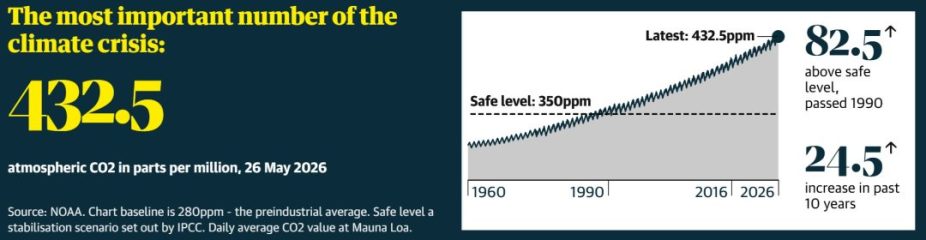
Bottom line: When you extract, upgrade, refine and burn toxic substances such as coal, bitumen, oil and gas at the rate we are burning them, decade after decade, you’re going to see changes. Atmospheric CO2 levels are now fully 50 per cent higher than preindustrial times, and it affects everything we care about, from fetuses to phytoplankton, from water to winter. “Fire weather” is not just a book title, it’s a technical term. Natural Resources Canada uses a Fire Weather Index to gauge fire risk, and when the index is high, things we care about and depend on ignite much more easily. When Fort McMurray burned, the Fire Weather Index peaked at 42 – record territory, well beyond “Extreme.” In B.C., during the heat dome of 2021, it went far higher. Now, that was “unprecedented.”
This is not unique to Canada; weather services around the world are scrambling to find new names and colours to account for these off-the-charts extremes in temperature, flammability, rainfall, ocean surge – you name it. It’s like the Spinal Tap amp that goes up to 11, only not funny: Australia’s new Fire Danger Ratings System goes from High to Extreme to Catastrophic.
This is fire weather for a new planet. A planet we have made.
The world has been inching closer to the 1.5-degree threshold due to human-caused climate change for years.
This article was written by Seth Borenstein of the Associated Press and was published in the Toronto Star on May 17, 2023.
There’s a two-out-of-three chance that the world will temporarily hit a key warming limit within the next five years, the United Nations weather agency said Wednesday.
But it likely would only be a fleeting and less worrisome flirtation with the internationally agreed upon temperature threshold. Scientists expect a temporary burst of heat from El Nino — a naturally-occurring weather phenomenon — to supercharge human-caused warming from the burning of coal, oil and gas to new heights. Temperatures are expected to then slip back down a bit.
The World Meteorological Organization forecasts a 66% likelihood that between now and 2027, the globe will have a year that averages 1.5 degrees Celsius (2.7 degrees Fahrenheit) warmer than the mid 19th century.
That number is critical because the 2015 Paris climate agreement set 1.5 degrees Celsius as a global guardrail in atmospheric warming, with countries pledging to try to prevent that much long-term warming if possible.
Scientists in a special 2018 United Nations report said going past that point would be drastically and dangerously different with more death, destruction and damage to global ecosystems.
“It won’t be this year probably. Maybe it’ll be next year or the year after” that a year averages 1.5 degrees Celsius, said report lead author Leon Hermanson, a climate scientist at the United Kingdom’s Met Office.
But climate scientists said what’s likely to happen in the next five years isn’t the same as failing the global goal.
‘We need to be prepared’: El Niño and greenhouse gases could make the next 5 years warmest on record
“This report does not mean that we will permanently exceed the 1.5 C level specified in the Paris Agreement which refers to long-term warming over many years. However, WMO is sounding the alarm that we will breach the 1.5 C level on a temporary basis with increasing frequency,” WMO Secretary-General Petteri Taalas said in a statement.
“We haven’t been able to limit the warming so far and we are still moving in the wrong, wrong direction,” Taalas said at a Wednesday press conference.
Hermanson cautioned that “a single year doesn’t really mean anything.” Scientists usually use 30-year averages.
Those 66% odds of a single year hitting that threshold in five years have increased from 48% last year, 40% the year before, 20% in 2020 and 10% about a decade ago. The WMO report is based on calculations by 11 different climate science centers across the globe.
The world has been inching closer to the 1.5-degree threshold due to human-caused climate change for years. The temporary warming of this year’s expected El Nino — which starts with a warming of parts of the central Pacific Ocean and then sloshes across the globe — makes it “possible for us to see a single year exceeding 1.5 C a full decade before the long-term average,” said climate scientist Zeke Hausfather of the tech company Stripe and Berkeley Earth, who wasn’t part of the WMO report.
“We don’t expect the longer-term average to pass 1.5 C until the early-to-mid 2030s,” Hausfather said in an email.
But each year at or near 1.5 matters.
“We see this report as more of a barometer of how we’re getting close, because the closer you get to the threshold, the more noise bumping up and down is going to bump you over the threshold randomly,” Hermanson said in an interview. And he said the more random bumps over the mark occur, the closer the world actually gets to the threshold.
The La Nina somewhat flattened the trend of human-caused warming so that the world hasn’t broken the annual temperature mark since 2016, during the last El Nino, a super-sized one, Hermanson said.
And that means a 98% chance of breaking the 2016 annual global temperature record between now and 2027, the report said. There’s also a 98% chance that the next five years will be the hottest five years on record, the report said.
Because of the shift from La Nina to El Nino “where there were floods before, there will be droughts and where there were droughts before there might be floods,” Hermanson said.
The report warned that the Amazon will be abnormally dry for a good part of the next five years while the Sahel part of Africa — the transition zone between the Sahara on the north and the savannas to the south — will be wetter.
That’s “one of the positive things coming out of this forecast,“ Hermanson said. “It’s not all doom-and-gloom and heat waves.”
University of Pennsylvania climate scientist Michael Mann said reports like this put too much emphasis on global surface temperature, which varies with the El Nino cycle, even though it is climbing upward in the long term.
“I think it’s important to realize that if we pass 1.5 degrees it’s not a reason to give up,” Hermanson said at a Wednesday news conference. “We have to continue working out how much we can reduce emissions of greenhouse gases as much as possible, even after that, because it will make a difference.”
Earth likely to breach warming threshold of 1.5 C above pre-industrial levels
This article was written by Kevin Jiang and was published in the Toronto Star on May 18, 2023.
In a new, dire warning, the World Meteorological Organization said we’re stepping into “uncharted territory,” with temperatures probably surpassing 1.5 C in the next five years.
Human-induced climate change and the natural arrival of weather system El Niño almost guarantees the next five years will be sweltering — and temperatures are expected to shatter global records, according to the United Nations.
A new, dire update from the World Meteorological Organization, a specialized agency of the United Nations, on Wednesday finds we’re stepping into “uncharted territory,” with temperatures likely surpassing 1.5 C of warming by 2027.
El Niño coupled with climate change will “push global temperatures into uncharted territory,” WMO Secretary-General Petteri Taalas said in a release Wednesday. “This will have far-reaching repercussions for health, food security, water management and the environment. We need to be prepared.”
According to the report, there is a 98 per cent chance at least one year in the next five years, and the fiveyear period as a whole, will be the warmest ever recorded. In this time span, there’s a 66 per cent chance temperatures will be 1.5 C warmer than pre-industrial levels for at least one year.
That means we’re on track to breach the long-term warming threshold of 1.5 C above pre-industrial levels set by the 2015 Paris Agreement — at least temporarily.
“This report does not mean that we will permanently exceed the 1.5 C level specified in the Paris Agreement which refers to long-term warming over many years,” Taalas said. “However, WMO is sounding the alarm that we will breach the 1.5 C level on a temporary basis with increasing frequency.”
Case in point, there’s only a 33 per cent chance the five-year temperature mean will exceed the 1.5 C limit, the report states.
The world has been heating up across the board; in January, the WMO found the past eight years to be the warmest ever recorded. Global warming has already wreaked havoc across the globe, contributing to record-breaking heatwaves, the increased prevalence of storms and natural disasters, extreme droughts and more.
Recently, Canada has seen devastating wildfires grow in frequency and intensity, with fire seasons stretching in length. Experts say the rise in forest fires has also contributed to increasing greenhouse gas and air pollution emissions.
The last global temperature record was set in 2016, partly resulting from an especially strong El Niño event. At the time, average temperatures were measured at 0.94 C above pre-industrial levels.
El Niño and its counterpart, La Niña, describe the respective warming and cooling of surface waters in the eastern Pacific Ocean. The events typically last nine to 12 months and occur roughly every two to seven years.
When El Niño strikes, trade winds falter and the warm waters are pushed back east toward the west coast of the Americas. This may lead to warmer temperatures in general, and generate especially hot and dry conditions in northern Canada.
According to the WMO, El Niño is expected to arrive in the coming months, with an 80 per cent chance of hitting between July and September.
This Letter to the Editor was published in the Toronto Star on May 18, 2023.
Re: Wildfire officials warn of heat in Alberta’s south, May 15th, 2023
According to this latest article, there are 19,300 Albertans that have been evacuated and over 1,500 Albertans fighting the wildfires. There have been daily articles describing the conditions and the hardship being experienced by both caused by “hot and dry conditions.”
What is ironic is that the very province which emits the most heat-trapping pollutants in Canada, not only from its fossil fuel production, but from the burning of its products shipped to other parts of the world, is now suffering the most from climate change (in Canada).
What is puzzling is that there is no mention of climate change, nor the burning of fossil fuels, the primary cause of climate change, in these articles, nor in the rest of Canadian mainstream media.
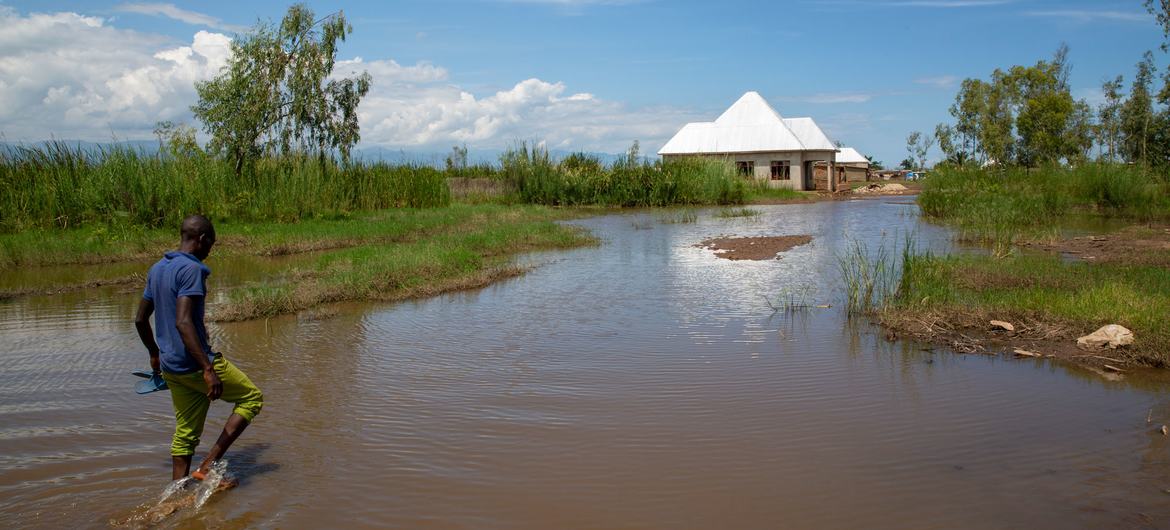
A man walks in floodwaters in Gatumba, Burundi an area which is receiving unpredictable rainfall due to climate change.
Global temperatures are likely to surge to record levels in the next five years, fuelled by heat-trapping greenhouse gases and a naturally occurring El Niño weather pattern, according to a new update issued by the World Meteorological Organization (WMO) on Wednesday.



:format(jpeg)/cloudfront-us-east-1.images.arcpublishing.com/tgam/MVHROMSXE5BODHG7UYOG6IKCKQ.jpg)
:format(jpeg)/cloudfront-us-east-1.images.arcpublishing.com/tgam/3TBXET5RBJAALGR6F7IR7H4F6M.jpg)

:format(jpeg)/cloudfront-us-east-1.images.arcpublishing.com/tgam/QE7DWAWZHZBI5NSBON24XZ4TBU.JPG)
:format(jpeg)/cloudfront-us-east-1.images.arcpublishing.com/tgam/CI2MWMZ2Z5DZPGOMSPX5WSB5SE.jpg)
:format(jpeg)/cloudfront-us-east-1.images.arcpublishing.com/tgam/U6HEXAAGXNELXIYRRDRTRWWZ6M.JPG)
:format(jpeg)/cloudfront-us-east-1.images.arcpublishing.com/tgam/KFVSABM3JRGNPIFVIE6FEYRQX4.JPG)
 Mobilize, Canada!