Ontario worried about ‘substantial’ costs to Enbridge Gas in deciding to overrule energy board: docs

When the Ontario Energy Board said Enbridge Gas and developers should pay for new fossil fuel connections, the province’s rebuke focused on housing costs. Internal documents show other priorities were at play

This article was written by Fatima Syed and was published in Canada’s National Observer on April 17, 2024.

A hot take

Global warming to cost world’s economy $38T, study says

This article was written by Seth Borenstein and was published in the Toronto Star on April 18, 2024.

A thermometer reads 39 C in Sao Paulo, Brazil, last month. A new study finds the world’s poorest countries will suffer 61 per cent bigger income loss than the richest ones from climate change.

Climate change will reduce future global income by about 19 per cent in the next 25 years compared to a fictional world that’s not warming, with the poorest areas and those least responsible for heating the atmosphere taking the biggest monetary hit, a new study said.

Climate change’s economic bite in how much people make is already locked in at about $38 trillion (U.S.) a year by 2049, according to Wednesday’s study in the journal Nature by researchers at Germany’s Potsdam Institute for Climate Impact Research. By 2100, the financial cost could hit twice what previous studies estimate.

“Our analysis shows that climate change will cause massive economic damages within the next 25 years in almost all countries around the world, also in highly developed ones such as Germany and the U.S., with a projected median income reduction of 11 per cent each and France with 13 per cent,” said study co-author Leonie Wenz, a climate scientist and economist.

These damages are compared to a baseline of no climate change and are then applied against overall expected global growth in gross domestic product, said study lead author Max Kotz, a climate scientist. So while it’s 19 per cent globally less than it could have been with no climate change, in most places, income will still grow, just not as much because of temperatures.

For the past dozen years, scientists and others have been focusing on extreme weather such as heat waves, floods, droughts, storms as the having the biggest climate impact. But when it comes to financial hit the researchers found “the overall impacts are still mainly driven by average warming, overall temperature increases,” Kotz said. It harms crops and hinders labour production, he said.

“Those temperature increases drive the most damages in the future because they’re really the most unprecedented compared to what we’ve experienced historically,” Kotz said. Last year, a record-hot year, the global average temperature was 1.35 C warmer than preindustrial times, according to the U.S. National Oceanic and Atmospheric Administration.

The globe has not had a month cooler than the 20th-century average since February 1979.

In the U.S., the southeastern and southwestern states get economically pinched more than the northern ones with parts of Arizona and New Mexico taking the biggest monetary hit, according to the study. In Europe, southern regions, including parts of Spain and Italy, get hit harder than places like Denmark or northern Germany.

Only Arctic adjacent areas — Canada, Russia, Norway, Finland and Sweden — benefit, Kotz said. It also means countries which have historically produced fewer greenhouse gas emissions per person and are least able to financially adapt to warming weather are getting the biggest financial harms too, Kotz said. The world’s poorest countries will suffer 61 per cent bigger income loss than the richest ones, the study calculated.

“It underlies some of the injustice elements of climate,” Kotz said.

The study examined 1,600 global areas that are smaller than countries, took several climate factors into account and looked at how long climate economic shocks last, Kotz said. The study examined past economic impacts on average global domestic product per person and uses computer simulations to look into the future to come up with their detailed calculations.

Why is Ontario taking from homeowners to subsidize gas companies?

This opinion was written by Kent Elson, an energy lawyer, and was published in the Globe & Mail on April 10, 2024.

Kent Elson says that if Ontario plans to build 1.5 million houses that are mostly heated with gas by 2031, the costs and financial risks associated with those new pipelines will be hefty.

Gas customers across Ontario should be paying close attention to Bill 165, which is up for debate this week at committee hearings at Queen’s Park.

Among other measures, the bill incentivizes new natural gas infrastructure by subsidizing the costs for developers. By doing so, the bill will not only raise gas rates for customers today, it also creates huge risks that will leave energy customers swamped in debt and undermine Ontario’s industrial competitiveness in the coming decades.

All that doesn’t even touch upon the serious political issues behind the bill: Energy Minister Todd Smith is directly overruling an independent regulator that had blocked such a practice for Enbridge Gas. (I represented Environmental Defence, an intervenor, in that hearing.)

Bill 165 deals with what is commonly known as natural gas – a potent fossil fuel that is more accurately referred to as methane gas. A third of Ontario’s carbon emissions come from burning methane gas. We need to stop burning it, and fast, but Bill 165 makes the risky assumption that methane gas use can keep increasing, in direct opposition to steep declines projected by the federal government and climate science.

Bill 165 is called the Keeping Energy Costs Down Act – part of a sad trend in dishonest naming, as it will increase energy costs. Most importantly, the bill will reinstate free or highly discounted methane gas pipelines for new developments, subsidies that were slated to end in January, 2025. Reinstating those subsidies will cost more than $250-million a year, which will be added to the accumulated capital costs that all customers are paying off via their gas bills. If you own a gas furnace in Ontario, you will be subsidizing the cost of installing pipelines to and throughout residential developments.

Getting existing customers off methane gas is a challenging project for all provinces as we fight climate change. But for new construction, it is a no-brainer. Although heat pumps are somewhat more expensive upfront, that is not the case if you account for the cost of the methane pipes in new developments. That is one reason why New York State and many other jurisdictions are banning gas in new developments.

Ontario is doing the opposite by hugely incentivizing methane gas pipelines for developers. This will saddle new homebuyers with higher energy bills, because electric heat pumps cost much less to operate than gas furnaces. And if we build 1.5 million houses by 2031, as Ontario plans to do, mostly heated with gas, the costs and financial risks associated with all those new gas pipelines are huge.

This is financial insanity. Gas pipelines are paid off over roughly 60 years (i.e. depreciated), so a pipeline built today will be paid off in the 2080s. This is long beyond the point at which fossil fuel use is set to drastically decline. Investments in new gas pipelines today will almost certainly go bad, and Bill 165 forces Ontario’s gas customers to make that bad investment.

As customers increasingly leave the gas system through electrification, the remaining ones must pay more to cover the accumulated capital costs, which will raise rates, causing more customers to leave, which will raise rates further, and so on. Energy wonks call this a death spiral.

In a Dec. 21 decision regarding Enbridge’s rates, the Ontario Energy Board found that funding gas pipelines in new construction was a bad investment for Ontario’s gas customers. That finding was based on a year-long hearing, many expert witnesses and tens of thousands of pages of evidence.

This is the decision Mr. Smith is now overturning with Bill 165.

Enbridge has been lobbying the government to follow through with Bill 165 (despite opposition from municipalities and ratepayer groups) and take additional steps to overturn a $250million annual capital budget reduction resulting from the OEB’s Dec. 21 decision. It has been arguing that the decision “sets a deliberate course to eliminate natural gas from Ontario’s energy mix.”

The opposite is true: The decision aims to avoid bad investments and maintain the affordability of gas as an important part of Ontario’s energy mix during the energy transition.

The OEB’s mandate is to protect energy consumers. That is exactly what it did with its recent decision – and exactly what the government is undoing with Bill 165.

Enbridge has won through government lobbying what it could not get from an evidence based independent process. All energy customers should be very worried – especially the ones, like industry, that will find it hard to jump ship in the decades ahead.

Broken record: March is 10th straight month to be hottest on record, scientists say

Another month, another heat record for the planet. Earth just had its warmest March ever recorded, the 10th month in a row to set such a record, according to the European Union climate agency Copernicus. (AP Photo/Mahesh Kumar A., File)

File - A volunteer distributes drinking water next to a bus stand on a hot summer day in Hyderabad, India, Thursday, March 21, 2024. Another month, another heat record for the planet. Earth just had its warmest March ever recorded, the 10th month in a row to set such a record, according to the European Union climate agency Copernicus. (AP Photo/Mahesh Kumar A., File)

1 of 4 | 

File – A volunteer distributes drinking water next to a bus stand on a hot summer day in Hyderabad, India, Thursday, March 21, 2024.

This article was written by Suman Naishadham and was published by the Associated Press on April 9, 2024.

Carbon dioxide, methane levels in air spike to record highs again in 2023

This article was written by Seth Borenstein and was published in the Globe & Mail on April 6, 2024.

The levels of the crucial heat-trapping gases in the atmosphere reached historic highs last year, growing at near-record fast paces, according to the U.S. National Oceanic and Atmospheric Administration.

Carbon dioxide, the most important and abundant of the greenhouse gases caused by humans, rose in 2023 by the third highest amount in 65 years of record keeping, NOAA announced Friday. Scientists are also worried about the rapid rise in atmospheric levels of methane, a shorter-lived but more potent heat-trapping gas. Both jumped 5.5 per cent over the past decade.

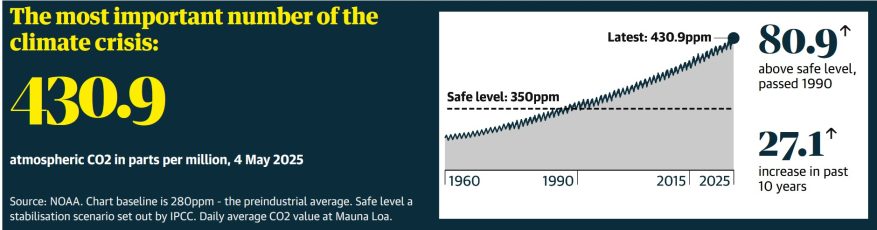
The 2.8-parts-per-million increase in carbon-dioxide airborne levels from January of 2023 to December wasn’t as high as the jumps were in 2014 and 2015, but they were larger than every other year since 1959, when precise records started. Carbon dioxide’s average level for 2023 was 419.3 parts per million, up 50 per cent from preindustrial times.

Last year’s methane’s jump of 11.1 parts per billion was lower than record annual rises from 2020 to 2022. It averaged 1,922.6 parts per billion last year. It has risen 3 per cent in just the past five years and jumped 160 per cent from preindustrial levels showing faster rates of increase than carbon dioxide, said Xin (Lindsay) Lan, the University of Colorado and NOAA atmospheric scientist who did the calculations.

“Methane’s decadal spike should terrify us,” said Stanford University climate scientist Rob Jackson, who heads the Global Carbon Project that tracks worldwide emissions of carbon dioxide but wasn’t part of NOAA’s report. “Fossil-fuel pollution is warming natural systems like wetlands and permafrost. Those ecosystems are releasing even more greenhouse gases as they heat up. We’re caught between a rock and a charred place.”

Methane emissions in the atmosphere come from natural wetlands, agriculture, livestock, landfills and leaks and intentional flaring of natural gas in the oil and gas industry.

Methane is responsible for about 30 per cent of the current rise in global temperature, with carbon dioxide to blame for about twice as much, according to the International Energy Agency. Methane traps about 28 times the heat per molecule as carbon dioxide but lasts a decade or so in the atmosphere instead of centuries or thousands of years like carbon dioxide, according to the U.S. Environmental Protection Agency.

Carbon dioxide and methane levels have been higher in the far ancient past, but it was before humans existed.

The third biggest human-caused greenhouse gas, nitrous oxide, jumped one part per billion last year to record levels, but the increases were not as high as those in 2020 and 2021. Nitrous oxide, which lasts about a century in the atmosphere, comes from agriculture, burning of fuels, manure and industrial processes, according to the EPA.

“As these numbers show we still have a lot of work to do to make meaningful progress in reducing the amount of greenhouse gases accumulating in the atmosphere,” NOAA Global Monitoring laboratory director Vanda Grubisic said in statement.

Companies across the globe last year pledged massive – almost complete – cuts in methane emissions from the oil and gas industry in a new initiative that could trim future rises in temperature by a tenth of a degree Celsius. And the EPA issued a final rule to reduce oil and gas industry generated methane emissions.

But the past five years, methane levels have risen faster than any time in NOAA record keeping. And recent studies have shown that government efforts to track methane are vastly underestimating the pollution going into the air from the energy industry.

Studies of the specific isotopes of methane in the air show much of the increased methane is from microbes, pointing to spiking emissions from wetlands and perhaps agriculture and landfills, but not as much from the energy industry, Dr. Lan said.

“I’m still mostly concerned about carbon-dioxide emissions,” Dr. Lan said.

Carbon-dioxide emissions, going into the air from burning fossil fuels and making cement hit, an all-time high last year of 36.8 billion metric tonnes, twice the amount spewed into the air 40 years ago, according to Global Carbon Project. But about half of what’s coming out of smokestacks and tailpipes are temporarily sucked up and stored by trees and oceans, keeping it out of the atmosphere, Dr. Lan said.

Methane doesn’t have that temporary carbon storage that carbon dioxide has, Dr. Lan said.

The shift last year from a three-year La Nina, the natural cooling of parts of the central Pacific that changes weather worldwide, to a warm El Nino, played a role in dampening methane’s increasing rate in the air and spiking carbon-dioxide levels, Dr. Lan said.

That’s because methane’s biggest emissions come from wetlands, which during a La Nina is wetter in much of the tropics, creating more microbes in the lush growth to release methane, Dr. Lan said. The La Nina ended mid-year last year, giving way to a strong El Nino.

Carbon-dioxide levels in the atmosphere tend to rise higher during hotter El Ninos, but the current one is starting to peter out, Dr. Lan said.
What side of history do we want to be on?

This opinion was written by Claude Lavoie and was published in the Globe & Mail on April 4, 2024.

Claude Lavoie was director-general of economic studies and policy analysis at the Department of Finance from 2008 to 2023. He has represented Canada at Organization for Economic Co-operation and Development meetings.

An anti-carbon-tax protester carries a sign as demonstrators block a westbound lane of the Trans-Canada Highway near Cochrane, Alta., on Monday.

A carbon tax will hurt the economy, and Canada reducing its emissions won’t do much for climate change – but we should do our part nonetheless

Let’s be honest: A carbon tax will hurt the economy, and Canada reducing its emissions will not do much for climate change. But we should also do our part, and carbon pricing is the option that should appeal the most to conservative-minded people and be the least economically damaging.

Canada, along with many countries, signed the Paris agreement and committed to reduce its greenhouse gas (GHG) emissions by 40 to 45 per cent below 2005 levels by 2030. Carbon pricing was adopted as the main instrument to fulfill this commitment, as economists think it is the most growth-friendly way to reduce emissions.

Under carbon pricing, emitters either buy permits or pay a tax for each ton of GHG emissions. The permit and tax systems each have pros and cons, but both result in fees for purchasing fossil fuels. Carbon fuel purchasers pass this fee to consumers through higher prices for electricity, gasoline, and for the products and services that use them.

As carbon price increases, goods delivered with electric vehicles or produced with renewable energy will become cheaper than goods delivered or produced using fossil fuels. Higher emitting firms will want to use less fossil fuel to keep their prices low and remain competitive. This may mean changes such as using more efficient boilers or better insulation. On the consumer side, savings may mean driving less (or slower) and more fuel-efficient cars.

Carbon pricing should appeal to those who prefer small government, as it’s less administratively complex to operate than regulations or subsidies, and gives Canadians full freedom of choice. Regulations or subsidies (for example, strongly incentivizing firms or consumers to buy a particular piece of equipment or vehicle) wrongly assume that civil servants know better what households and firms should do.

Carbon pricing should please fiscal conservatives, as it generates revenues that can be redistributed or used to finance other policies. In contrast, subsidies give taxpayer money to large emitters and regulations need regulators to enforce them. Regulations also raise prices and hurt the economy more than taxes.

Carbon pricing does negatively affect some workers. For example, those who have no access to public transit have no alternative but to bear the tax.

However, without carbon pricing, people would have less incentive to replace their car with a more energy-efficient one or demand better public transit. Why continue to postpone the inevitable need to adapt? The money from the Canada Carbon Rebate and the gradual increase in the carbon price help alleviate the burden and give people time to adjust.

High carbon prices – or any emission regulation – will certainly hurt the oil and gas sector. Reducing emissions requires using less of those energy sources. Policies to reduce smoking also had negative effects on the tobacco industry. What is needed here are better policies to help workers transition to other industries.

Does carbon pricing work? It seems to, as studies show that emissions grow slower in countries with carbon pricing. But the price may need to reach a higher level to see an absolute decline in emissions. The carbon tax was effective in reducing emissions in Sweden, but it reached $170 per tonne of emissions last year, compared with $65 a tonne in Canada.

Some certainty on the future of the system is also necessary. No firm will make long-term investments in costly energy efficient technologies if they think carbon pricing will disappear. The current political divide is certainly not helping.

Does carbon pricing increase the cost of living? Not necessarily. The goal is to increase the relative cost of emissions-intensive goods and services. But if the Bank of Canada continues keeping inflation at its 2-per-cent target, increases in the price of emissions-intensive goods and services by more than 2 per cent will be countered by increases in other prices by less than 2 per cent. This would keep the cost-of-living increases at the same rate as it would have been without carbon pricing.

Although not perfect, carbon pricing seems to be a reasonable approach. But there is no denying it imposes costs on the economy. Why bear these costs? After all, until countries such as India, China and the U.S. do more, global warming will occur whatever Canada does.

But which side of history do we want to be on? How could we continue to put pressure on these countries if we abandon our commitment? What trade barriers will our exports face? How will it affect our reputation and ability to join other international agreements?

Anybody advocating to “axe the tax” needs to propose a viable alternative or admit wanting to renege on our international commitments. Canadians deserve a clear and frank debate.

Enough slogans. It’s time for real talk

This opinion was written by Susan Delacourt and was published in the Toronto Star on April 3, 2024.

A crowd protests the carbon levy in Alberta on Monday. So far, this issue is being fought largely through slogans at rallies and rants at press conferences, Susan Delacourt writes, and no side is talking to the other.

Newfoundland and Labrador Premier Andrew Furey has asked Justin Trudeau to call an emergency meeting on the carbon levy. It’s a good idea and the prime minister should take him up on it, as soon as possible.

It is definitely a much better idea than the alternative, currently unfolding all over the country, quickly approaching the level of an all-out tax revolt. On Tuesday, it was Ontario Premier Doug Ford, warning Trudeau to lose the levy or lose the next election.

In some quarters, this carbon price debacle is looking like what happens when convoy protests meet climate change — a new form of populist rebellion against government measures that many citizens find hard to swallow.

That brand of protest will tempt Trudeau to push on past the public outcry, as he did with the protests against vaccine mandates during the pandemic. Moreover, the prime minister won’t want to be seen caving to a cause that Conservative Leader Pierre Poilievre is trying to ride to victory in the next election.

But the unravelling of the carbon levy is worth a full-blown first ministers meeting, just like all those ones Trudeau held with premiers regularly during the early days of COVID.

I’ve been thinking about the necessity of a first ministers meeting for a couple of weeks now, ever since attending an event of Carleton University’s school of political management, featuring former CBC anchor Peter Mansbridge in conversation with journalist Chantal Hébert and columnist Bruce Anderson.

Mansbridge recalled for students how, back in the olden days, prime ministers such as Brian Mulroney and Pierre Trudeau held first ministers meetings out in the open, where the public could witness the impassioned back-and-forth between Ottawa and the provinces. He lamented how those meetings have now disappeared behind closed doors, producing bland communiqués and cash transfer deals.

It might do the country good, Mansbridge suggested, for Canadians to see their prime minister and provincial and territorial leaders grappling with the big issues of the day.

Canada, indeed the planet, has two of those big issues casting huge shadows these days — affordability and climate change. The carbon levy is where they meet. If those issues don’t deserve a serious, transparent discussion among the country’s top politicians, what does?

So far, this is a conversation being waged largely through slogans shouted at rallies and diatribes launched from press conference podiums. No side is really talking to the other.

My colleague Aaron Wherry over at CBC has also been musing about how a first ministers meeting could be what the country needs right now. Wherry was writing after some of the premiers descended on a Commons committee meeting last week to publicly vent against the carbon levy in surprise testimonial appearances.

“With the premiers apparently so eager to discuss climate policy, it’s tempting to wonder what might be clarified and accomplished if they were all invited to Ottawa for a televised meeting — with the expectation that they would arrive with a fully costed and independently analyzed plan for how their province would reduce its emissions in line with Canada’s national targets.”

Open first ministers meetings are high-risk events, especially for prime ministers crazy enough to paint a target on their backs and have the premiers pile on in public. But at this point, what does Trudeau have to lose? It would be a chance for him to show a side of him the public rarely sees — convening and leading a discussion as he does in cabinet or at those closed first ministers gatherings.

I picture it as a meeting held over two or even three days. One day can focus on the carbon levy as a climate measure; another day can focus on what the carbon levy is doing to affordability.

It could work like those old constitutional conferences — opening statements before the cameras, some haggling afterward in closed sessions, and then back in public to report on what their conversations yielded by way of compromise or concession.

Then on the third day, the leaders can find bridges to build between those two aspects to the debate — are we talking affordability or climate, or both? And what are we going to do about them?

There’s one other not-insignificant reason to hold such a meeting. At the moment, we have a jarring mismatch in the federation: a Parliament in which the majority of MPs support the carbon levy, and a nation in which the majority of premiers do not. Why is that the case? Aren’t these politicians representing the same citizens?

Poilievre and some of the premiers are keen for a carbon levy election.

But that’s more than a year away. In the meantime, Canada would be well served by a carbon price first ministers meeting, held out in the open, as the debate — and, you could argue, the planet and the country — deserves.

POILIEVRE STOP TRIVIALIZING MUST CARBON PRICING FOR POLITICAL GAIN AND CREATE A PLAN

This article was written by Liz Armstrong and was published in the Toronto Star on April 2, 2024.

LIZ ARMSTRONG LIZ ARMSTRONG IS WRITING ON BEHALF OF GRANDMOTHERS ACT TO SAVE THE PLANET , A GRASSROOTS, NON-PARTISAN GROUP OF GRANDMOTHERS — AND GRAND OTHERS — WHO CARE DEEPLY ABOUT THE WORLD OUR DESCENDANTS WILL INHERIT. MORE INFORMATION AT GASP4CHANGE

Last month, the federal Conservative party tried to force a federal election over the carbon tax that it loves to hound and harass Prime Minister Justin Trudeau about.

Claiming “everything has become more expensive” under Trudeau’s leadership, but never telling the whole truth — and more often none of it — about carbon pricing rebates that pay back more to 80 per cent of Canadians than the tax costs them, the Conservative attacks are relentless. Even more disturbing, they eclipse the real issue this carbon pricing policy targets: the need to sharply reduce Canada’s greenhouse gas emissions.

Conservative Leader Pierre Poilievre, also the party’s chief attack dog, wasn’t in the House of Commons for the non-confidence vote he knew was bound to fail. But his timing was eerie and terrifying.

This latest gambit by Poilievre to “Axe the Tax” came just two days after the World Meteorological Association broadcast a deeply disturbing red alert about global warming. Officially certifying last year as the hottest in recorded history by a shockingly “clear margin,” the UN weather agency put it this way: “The state of the climate in 2023 gave ominous new significance to the phrase ‘off the charts.’ ”

The same day, March 19, climatologists confirmed this winter was the warmest in Canada since 1948, when official records began. Despite a few bouts of extreme cold and snow, our winter temperature records weren’t just broken, they were shattered and “it wasn’t even close,” commented senior climatologist David Phillips of Environment and Climate Change Canada.

Still, it’s been Poilievre’s simplistic rhyming slogans, repeated endlessly — Axe the Tax, Spike the Hike — that has captured most media and public attention, not the dire state of the global climate, or Canada’s oversized contribution to wrecking it more.

Provincial Conservative leaders have piled on the Axe the Tax bandwagon, including Premier Doug Ford, who warned Trudeau in midMarch that his Liberals will be “annihilated” in the next federal election if they raise the carbon price on April 1 as scheduled. (Aside to Ford: Annihilation is what burning fossil fuels is doing to our planet by heating it far beyond safe limits.)

As climate writer Chris Hatch points out, in Canada, “Somehow we manage to debate climate policy while ignoring the climate itself.” On average, the world’s richest countries have cut fossil fuel emissions, with European carbon emissions falling to 60-year lows last year. “But Canada’s carbon spew diverged from the pack since the 1990s — and the gap keeps growing,” Hatch adds.

The Liberal’s carbon tax and rebate policy alone can’t overturn our abysmal track record, but it can contribute a significant share to course correcting, then reducing Canadian emissions 40 to 45 per cent by 2030 — but only if we Max the Tax. As a reminder to federal Conservatives, that also means higher rebates for the majority of Canadians as well. The less we pollute by burning fossil fuels, the more cash that lands back in our bank accounts.

Mr. Poilievre, if you want to give your two children — all children — a better chance to inherit a livable planet, then start by creating a credible climate action plan for Canada, better than any other federal party’s. Then stop trivializing carbon pricing to score short-term political points — Max the Tax!