This article was written by Reuters and was published in the Globe & Mail on November 16, 2023.
Heat-related illnesses and deaths are rising as the world warms, an international team of health experts said on Tuesday, forecasting a 370-per-cent surge in yearly heat deaths by midcentury if the world warms by two degrees Celsius above preindustrial levels.
Already, at roughly 1.1 degrees of warming, people experienced about 86 days of health-threatening high temperatures on average in 2022, the report from the Lancet medical journal found.
The findings, assembled by more than 100 experts from 52 different research institutions and United Nations agencies, deepen concerns over the health effects posed by heat.
“We are paying in lives,” report executive director Marina Romanello said of the world’s inaction on climate change.
The United Nations’ annual climate change conference, COP28, in Dubai will focus in part on health effects for the first time.
Some 46 million health professionals have called on the COP28 presidency to push for a phase-out of fossil fuels.
This article was written by Ivan Semeniuk and was published in the Globe & Mail on November 16, 2023.
A deforested area of the Amazon rain forest in Brazil is pictured. Evidence suggests a portion of the rain forest has become a net emitter of carbon dioxide.
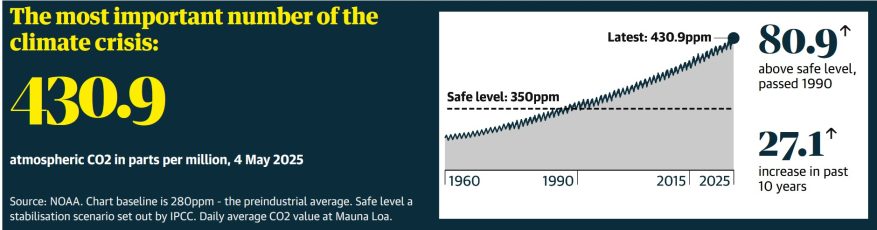
Released two weeks before international climate talks, data show carbon dioxide in atmosphere hit 50% above preindustrial level
The amount of heat-trapping gases in Earth’s atmosphere continued to grow at a relentless pace last year, a sign that efforts to reduce fossil-fuel emissions have yet to make a dent in the principal cause of global climate change.
The latest tally, issued on Wednesday by the World Meteorological Organization, underscores the challenge that countries face when they gather in two weeks for a new round of international climate talks.
While moves toward climatefriendly energy sources and lowcarbon technologies such as electric vehicles offer some hope for future emissions reductions, “what matters is what happens in the real atmosphere, and in the real atmosphere we haven’t seen any positive change so far,” said Petteri Taalas, the organization’s secretary-general, at a news conference in Geneva.
According to the WMO’s Greenhouse Gas Bulletin, atmospheric concentrations of carbon dioxide, methane and nitrous oxide – the three gases that collectively account for close to 90 per cent of global warming – all reached record highs in 2022.
Carbon dioxide, which is by far the most significant contributor to climate change, exceeded its historic, preindustrial level by 50 per cent for the first time.
The bulletin, which is published annually, quantifies atmospheric levels of greenhouse gases measured during the previous year.
Over the years, it has chronicled a steady climb in carbondioxide emissions, occasionally punctuated by slight downturns during times of global economic upheaval, such as the during the height of the COVID-19 pandemic or the 2008 financial crisis.
But these are minor blips in what has otherwise been the growing accumulation of the gas, which is produced by fossil-fuel combustion in power plants and vehicle engines and then persists in the atmosphere for thousands of years after its release.
The latest bulletin also shows a slight decrease in the rate at which carbon dioxide is accumulating in the atmosphere compared with the past decade, but this can be accounted for by natural variations in the global carbon cycle.
The data supporting the findings were drawn from a global network of dozens of atmospheric sensors located on land, on ships at sea and on aircraft.
A key concern for authors of the bulletin is the risk that tropical forests and the global ocean, which absorb much of the carbon dioxide emitted through human activity, will become less effective at doing so as the climate warms. Evidence already suggests a portion of the Amazon rain forest has become a net emitter of carbon dioxide.
The ocean is less well-understood because current observations only cover about 3 per cent of Earth’s marine waters, said Oksana Tarasova, who leads the WMO’s global atmosphere watch program.
“It’s very important to understand how those things will behave, because if we have a reduced uptake by the ocean and if we have reduced uptake by the forest, then everything will stay in the atmosphere and the impact will be much stronger on climate,” Dr. Tarasova said.
The other two gases tracked by the bulletin are also on the rise. Nitrous oxide, the bulk of which is emitted through agricultural activity, saw its highest ever yearon-year rise from 2021 to 2022.
Collectively, human-caused emissions of greenhouse gases have raised the average global temperature by approximately 1.1 degrees, a change that has been linked to an increase in extreme weather events, including forest fires, droughts and floods.
Countries, including Canada, that are signatories to the Paris Climate Agreement have pledged to try to hold the global rise in temperature to 1.5 degrees in order to avoid more severe effects of climate change.
Canada is among the countries falling short on key climate targets as emissions continue to climb.
A recent assessment by the Canadian Climate Institute found that rising emissions from the oil and gas industry are undercutting Canada’s progress made in other sectors. The result is reduced credibility at the negotiating table.
“Despite significant climate policy in the country, other countries have a hard time looking beyond Canada as a major oil producer,” said Dave Sawyer, principal economist for the Ottawabased institute.
The bulletin comes just days after Canadian company GHGSat launched the first commercial satellite to monitor industrial sources of carbon dioxide, a development that could lead to greater accountability for emitters.
In global terms, experts say there is little time left to change course on emissions without the planet experiencing significantly higher temperatures in the coming decades.
In a study published last month in Nature Climate Change, a British-led team found that the remaining carbon available to be burned without exceeding 1.5 degrees of warming will be used up in just six years at current emission rates.
Dr. Taalas said there remains some hope of achieving the 1.5 goal through dramatic emissions’ reductions, “but to reach that we should really raise our ambition level.”
He said that while world events, including continuing wars in Ukraine and Gaza, frequently command media headlines, “climate change is still the biggest challenge for the welfare of mankind this century.
“It’s not the problem tomorrow – it’s long term. And it’s a persistent challenge if we are not able to tackle it.”
Greenhouse gas emissions reached a record high in 2022 with “no end in sight to the rising trend”, the World Meteorological Organization (WMO) said in a report published on Wednesday.
Reports say rising temperatures lead to more sickness
This article was written by Seth Borenstein and was published in the Toronto Star on November 15, 2023.
Humanity’s fight to curb climate change is failing in dozens of ways with people getting sicker and dying as the world warms and the fossil fuels causing it get more subsidies, according to two global reports issued Tuesday.
The health journal Lancet’s annual Countdown on climate and health found more people, especially the elderly, dying because of heat waves in recent years and it projects that will soar as temperatures keep rising. The international team of doctors, scientists and economists looked at 47 measurements, many outside health, to diagnose a sick Earth, emphasizing harms they attribute directly to the fossil fuel industry.
Earlier in the day, the World Resources Institute, Climate Action Tracker, the Bezos Earth Fund and others issued their State of Climate Action report, which found the world off track in 41 of 42 important measurements. It said six indicators are heading in the wrong direction, including fossil fuel subsidies. Also Tuesday, the United States government issued its more than 2,200-page National Climate Assessment that looked at hundreds of measurements for what warming is doing to America.
Worldwide heat deaths for people over 65 were 85 per cent higher in the last 10 years compared to 1991 to 2000, the study found. Researchers compared the death increase to computer simulations for the same population but in a world that hadn’t warmed and found they could attribute most of those deaths to climate change, not population growth.
In the U.S., heat deaths for the elderly increased 88 per cent in the past five years compared to 2000 to 2004 with most of that attributable to climate change, the study found. There were 23,200 elderly heat deaths in 2022, the report found.
“We are already seeing climate change claiming lives and livelihoods in every part of the world,” said Lancet Countdown executive director Marina Romanello. “However, these impacts that we’re seeing today could be just an early symptom of a very dangerous future unless we tackle climate change urgently.”
Romanello said people self-reporting hunger because of heat waves and drought has also soared, adding “this could be just an early glimpse into what we now know could be a very dangerous future.”
“These findings are stark and — coming from the most thorough annual scientific assessment at the nexus of climate change and health — should be considered accurate,” said Dr. Jonathan Patz, formerly of the University of Wisconsin-Madison, who wasn’t part of the study. “Worrisome is our sluggish response to depart from fossil fuels, which the authors show offers enormous immediate health benefits.”
Report authors directly blasted the fossil fuel industry, comparing it to tobacco companies, and the banks that loaned them money.
“All our indicators on the fossil fuel industry are extremely relevant because this is an industry that is actually killing people in large numbers and making them ill in even larger numbers,” said report co-author Paul Ekins, an economics professor at the University College of London.
This opinion was written by Martin Olszynski, a law professor at the University of Calgary, and was published in the Globe & Mail on November 14, 2023.
Despite repeated commitments over almost two decades, Alberta’s oil sands are still 35 per cent more GHG-intensive than average oil production globally.
‘Tell the Feds,” says the Government of Alberta’s recent $8-million ad campaign opposing federal clean electricity rules. If you’re a resident of Alberta, Saskatchewan, Ontario or Nova Scotia, you’ve likely heard or seen them.
Who could disagree with statements like “No one wants blackouts. What Canadians want is reliable and affordable power”? Nor does anyone want “to freeze in the dark.”
These messages seem sound, but they are grossly exaggerated if not outright false. Independent experts have already debunked the campaign’s central claims. With some effort and planning, the transition to a cleaner power grid could actually save Canadians hundreds of dollars in power bills annually, all while providing reliable and climate-friendly electricity.
But in this misinformation age, even the most engaged citizens will struggle to stay on top of the continuous need for fact-checking and claim-debunking. Instead, Canadians should consider a government’s policy track record as a handy shortcut – especially when that government wraps its arguments in feasibility, affordability and protecting the public purse. Alberta’s actual track record undermines each and every one of these arguments.
Alberta insists that carbon capture and storage (CCS) for natural gas power isn’t feasible under the proposed federal clean electricity rules. But it is clamouring for the federal government to spend billions on the same technology in the oil sands, where industry insists it’s proven and reliable. So much for infeasibility!
Alberta says Ottawa’s clean-electricity rules will lead to unaffordable power, but the province’s own electricity market is so dysfunctional that it has the most expensive electricity in the country, the predictable – and predicted – result of market power being concentrated among a handful of companies. So much for affordability!
In fact, you may recall that Alberta had a booming solar and wind business, which was undoubtedly tempering some of that market power concentration, until Premier Danielle Smith shut it down this past summer. In announcing a public inquiry and accompanying six-month moratorium, the government expressed grave concern about the future cleanup costs of renewable energy projects. Meanwhile, the oil and gas sector’s cleanup costs sit at more than $100-billion officially – with internal regulator estimates as high as $260-billion – and calls for meaningful reform are systematically ignored (to say nothing of any kind of inquiry or moratorium).
How much money has the province required the oil and gas industry to set aside for this cleanup? Roughly $1.3-billion, or 1 per cent of what is needed. The province has even mused about giving companies royalty holidays on future production if they clean up some wells, even though doing so is already a legal obligation. So much for the public purse!
Worse still, this state of affairs is no accident. A recent paper from the University of Calgary School of Public Policy, of which I was a co-author, makes painfully clear that this massive regulatory failure is the predictable consequence of decades of policy choices that consistently put the oil and gas industry’s desire to minimize its costs above the public interest in cleaning up wells and related infrastructure.
The same approach has stalled progress on greenhouse gas emissions as well. Despite repeated commitments over almost two decades, Alberta’s oil sands are still 35 per cent more GHG-intensive than average oil production globally. And while most provinces’ emissions have declined since 2005, Alberta’s have risen by 8.5 per cent, making them the highest among all provinces and territories – by a wide margin.
So of course Alberta’s Premier opposes federal clean-electricity rules – and will oppose an oil and gas GHG emissions cap if and when it is announced. When a provincial government appears intent on picking up the tab on hundreds of billions of the sector’s cleanup liabilities, with the potential to double, triple or quadruple Alberta’s current debt of $80-billion, it’s no surprise that same government is unwilling to impose the costs associated with meaningful climate regulation – and will oppose such efforts from others.
Viewed this way, the “Tell the Feds” campaign isn’t about feasibility, affordability or reliability, but rather a thinly disguised attempt to enlist ordinary Canadians in Alberta’s unyielding service to the fossil fuel industry. But as year after year of extreme weather and fire seasons have made clear, climate inaction and delay come with their own significant – sometimes immeasurable – costs for the rest of us. Canadians would be justified in telling Alberta those are costs they’re no longer willing to bear.
Environment Canada’s 30-year data shows average temperatures on rise
This article was written by Patty Winsa and was published in the Toronto Star on November 13, 2023.
When it comes to the weather, what does “normal” mean anymore?
It’s a question that Environment and Climate Change Canada answered recently, releasing the latest round of “normals” — data that includes averages of temperature and precipitation over a 30-year period, in this case from 1991 to 2020, for a number of weather stations across Canada.
What the new data shows is that, in many cities and towns, average monthly temperatures have increased, in some cases by more than three degrees Celsius.
In Toronto, the most recent normals show that average temperatures are half a degree to one degree higher most months compared to what was considered normal for the period between 1961 to 1990.
In northern cities such as Whitehorse, the changes are more pronounced.
The latest average (“normal”) for the city in January is -15 C, 3.7 degrees Celsius warmer than it was in the normals released 30 years ago. In December, it’s 3.1 degrees Celsius higher.
Experts say those degrees matter. “Every degree of temperature change can have exponential impacts on climate conditions,” said Dan Henstra, a political science professor and co-lead of the Climate Risk Research Group at the University of Waterloo. “Warmer air carries more moisture, meaning more potential for more extreme rainfall and even extreme snowfall. Average temperatures, even one degree warmer, can exacerbate heat waves in the summer months, which are already unbearable for many residents in cities like Toronto and other dense urban areas who don’t have access to air conditioning.”
Residents in cities can be especially vulnerable because concrete and other materials absorb the warmth and re-emit it, leading to heat islands — areas that are hotter than those with more natural vegetation.
In northern areas of the country, the warmer temperatures can lead to permafrost thaw, which can cause roads to heave in the freeze and thaw cycle.
The new normals have been released at the same time Environment Canada modelling is predicting the entire country can expect a fall and winter that is warmer than even the new 30-year normals.
Part of that warmth could come from El Niño, a warmer weather pattern in the Pacific, which the National Oceanic and Atmospheric Administration confirmed began in June and could be moderate to strong by late fall or early winter.
The World Meteorological Organization (WMO) predicts a high probability that one of the next five years will be the hottest on record due to El Niño, which could result in a rise in the annual mean global temperature of between 1.1 to 1.8 C in the next five years.
The weather pattern is expected to lead to an increase in temperatures over Alaska, Yukon, B.C. and, to some extent, the Prairies, as well as an increase in precipitation on the U.S. West Coast.
It’s less certain if it will bring more precipitation to Canada’s West Coast, because El Niño doesn’t typically have the same impact as it does further south, said Greg Flato, director of the Climate Research Division of Environment and Climate Change Canada (ECCC).
Modelling by ECCC didn’t show a high probability the next six months would be wetter, or dryer, than normals for most of Canada.
Currently, the global average temperature is 1.1 C above the pre-industrial average. The global average is used because warming won’t occur everywhere at the same rate.
Under the Paris Agreement, countries have pledged to try to keep the global long-term average temperature from increasing much more than 1.5 C, and ideally well belo 2 C relative to pre-industrial temperatures, said Flato.
The new normals from ECCC show some Canadian cities have warmed close to a degree or more compared to normals 30 years ago.
“From that point of view, one degree is big because that’s kind of the same target that we’re trying to not let the global average temperature get too much above,” said Flato.
The normals released by ECCC are calculated once a decade using data from the preceding 30 years, a time period defined by the WMO as a kind of standard that averages out “the day-to-day, year-to-year variability that is the weather we experience,” said Flato.
It “gives you an indication of the average conditions over that 30year time frame,” he said. “And we refer to those as climate normals.”
Unlike weather predictions, which provide an actual value for temperature or precipitation, the normals are used for comparison to indicate whether temperature or precipitation will be above or below normal.
There is data going back to 1850, but more recent data is used for the normals because “nobody alive today has any recollection of what the 1850 to 1900 average was like,” said Flato. “So it’s not so compelling.”
However, when it comes to climate change, it’s the historical data that is used as the marker to measure the increase in the average global temperature because it predates the emission of greenhouse gases from human and industrial activities, according to the WMO.
And Canada has been warming more quickly than the global average because the country’s land mass is large and warms more quickly than ocean areas.
And, in the higher latitudes of the country, particularly in the Arctic, warming is happening more quickly because of the loss of snow and sea ice, creating larger areas of open ocean, a darker surface that absorbs more solar radiation.
Flato said data already shows the snow cover season is getting shorter over most places in Canada, aside from a few areas in the mountainous parts of the Rockies. “The snow doesn’t stay on the ground until later in the fall and it melts away earlier in the spring,” he said.
In northern areas of the country, the warmer temperatures can lead to permafrost thaw, which can cause roads to heave in the freeze and thaw cycle
This article was written by Gideon Forman and was published in the Toronto Star on November 11, 2023.
GIDEON FORMAN IS A CLIMATE CHANGE POLICY ANALYST AT THE DAVID SUZUKI FOUNDATION.
Renewable energy such as solar and wind power have never been cheaper, and make great business sense, writes Gideon Forman.
This is an extraordinary moment for renewable electricity.
Solar and wind power have never been cheaper, they’re enjoying technological breakthroughs that greatly boost their efficiency and their worldwide growth is astounding. Smart money in Ontario and around the globe is abandoning fossil fuels not just because of the climate crisis, but because renewables make so much business sense.
The Pembina Institute says that, in many places in Canada, clean energy (including wind, solar, demand-side management, energy efficiency and storage) is now less expensive than gas-fired. In Alberta, for example, the cost of power at a combined-cycle gas plant is $57 per MWh, while the cost for clean energy is just $48.
These findings are consistent with data from other experts. The think tank Clean Energy Canada found that, “In Alberta and Ontario, wind can now produce electricity at lower costs than natural-gas-fired power.” In a statement released in May, the Atmospheric Fund said that in Ontario, wind and solar are “the cheapest sources of new supply.”
Not surprisingly, solar cells are becoming more efficient. A recent article in the Guardian says scientists working in the field have just made an important breakthrough. Stefaan De Wolf of Saudi Arabia’s King Abdullah University of Science and Technology calls 2023 a “revolutionary year.”
The Guardian explains the advance in solar efficiency this way: “The breakthrough is adding a layer of perovskite, another semiconductor, on top of the silicon layer. This captures blue light from the visible spectrum, while the silicon captures red light, boosting the total light captured overall. With more energy absorbed per cell, the cost of solar electricity is even cheaper, and deployment can proceed faster.”
In a report tracking progress in 2022, the International Energy Agency found renewables just keep breaking growth records: “Renewable electricity capacity additions rose to 340 gigawatts (GW), their largest ever deployment … Investment in clean energy reached a record USD 1.6 trillion in 2022.”
And the IEA’s “Electricity Market Report,” released in July, proclaimed that, “depending on weather conditions, 2024 could well become the first year in which more electricity is generated worldwide from renewables than from coal.” What an extraordinary milestone that would be!
Especially impressive, says the IEA, is the growth in solar: “Solar PV generated a record of nearly 1,300 terawatt-hours (TWh) in 2022, up 26 per cent from 2021 and logging the largest absolute generation growth of all renewable technologies in 2022.”
If Ontario wants to enjoy this upsurge in renewable electricity, it’s crucial that fossil-fuelled generation doesn’t get in the way. The federal government is now working on its clean electricity regulations — supported by 71 per cent of Canadians — and we need to ensure they phase out all gas- and coal-fired power by 2035.
Ontario is planning to expand its gas plants and build new ones. This is a massive threat to the affordability and economic benefits that renewables could provide. Every resident — especially members of the business community — should urge Ottawa to put the brakes on Ontario’s gas-plant build out and require winding down of fossils on the grid. As the IEA said in July, “Now is the time for policymakers and the private sector to build on this momentum (of renewables) to ensure emissions from the power sector go into sustained decline.”
If we care about saving money — not to mention saving the planet — we must insist that Ontario be powered by wind, water and sun in short order.
Canada’s commitment to cutting emissions outweighed by its support for oil and gas, experts say
This article was written by Suman Naishadham and Victor Caivano, and was published in the Toronto Star on November 10, 2023.
Happy Cardinal, right, looks at what remains of his cabin, destroyed by wildfires, near Fort Chipewyan, Alta., in September. “That was our dream home,” said his wife, Julie Cardinal. “It’s like a displacement.”
During a May wildfire that scorched a vast swath of spruce and pine forest in northwestern Canada, Julia Cardinal lost a riverside cabin that was many things to her: retirement project, gift from her husband and somewhere to live by nature, as her family had done for generations.
“That was our dream home,” said Cardinal, a member of the Athabasca Chipewyan First Nation, as she scanned the cabin’s flattened, charred remains in September. “It’s like a displacement.”
Thousands of wildfires in Canada this year have incinerated an area larger than Florida, releasing into the atmosphere more than three times the amount of carbon dioxide that is produced by Canada in a year. And some are still burning.
Home to dense forests, sweeping prairies and nearly a quarter of the planet’s wetlands, Canadian leaders, including Prime Minister Justin Trudeau, have long insisted the country can exploit its natural resources while protecting biodiversity and leading the global fight against climate change.
But the seemingly endless fire season, which created hazardous air in many U.S. states thousands of kilometres away, is putting a spotlight on two aspects of Canada that increasingly feel at odds: the country’s commitment to fighting climate change and its status as the world’s fourth-largest oil producer and fifth-largest gas producer — fuels that when used release carbon dioxide, a greenhouse gas that traps heat in the atmosphere and intensifies the dry conditions for wildfires to swallow millions of acres.
“They’re portraying Canada as environmental,” said Jean L’Hommecourt, an environmental advocate belonging to the Fort McKay First Nation. “But the biggest source of the carbon is here.”
Oil focus and advocacy
Canada is among roughly 100 nations that have pledged by midcentury to reach “zero emissions,” or take as much greenhouse gas out of the atmosphere as it contributes. At last year’s UN climate conference, known as COP27, it also joined other rich nations to promise more money for developing countries to fight climate change.
Yet to the same conference, Canada brought the second-largest delegation of fossil fuel executives of any country in the world, an analysis by The Associated Press found. Eleven executives from major Canadian oil, gas and steel companies, including Enbridge and Parkland Corporation attended COP27 — where countries set climate priorities and timelines for reducing emissions of greenhouse gases. The only country to send a larger delegation of fossil fuel executives was Russia, AP found.
“We’re not there to drive an agenda, but we do have a perspective to offer,” said Pete Sheffield, chief sustainability officer at pipeline and natural gas giant Enbridge Inc., echoing what other Canadian energy executives told the AP about their attendance at COP27.
One such perspective is that Canadian oil producers can keep extracting oil at current rates, and with the help of technology, clean up their own operations so the country can still hit its climate targets. But even if Canada’s oil producers manage to do so, their plans don’t consider the greenhouse gas emissions that result from when customers use their products to power cars, heat homes, take flights and so forth.
Sustainable future?
Scientists at Climate Action Tracker, a group that scrutinizes nations’ pledges to reduce emissions, label the country’s progress as “highly insufficient,” stressing Canada needs to implement its climate policies much faster to reach its own targets. For the high-carbon energy sector, much of the plan rests on the build-out of carbon capture, a technology that pulls in carbon dioxide, either at the source of emissions or from the air. But carbon capture is energy intensive, expensive and years away from operating at scale.
“There’s no way Canada can reach our 2050 target if oil and gas doesn’t do its fair share,” said Steven Guilbeault, Canada’s minister of environment and climate change.
The wildfires, which scientists say will burn more and longer as the planet warms, will add to the challenge of cutting emissions. They also pose significant health risks to Canadians and anyone who comes in contact with the smoke.
In June, a fire got close to the subarctic, mostly Indigenous hamlet of Fort Chipewyan, in northern Alberta. A former fur trading settlement, it abuts one of the world’s largest inland deltas. In warmer months, the village can only be reached by boat or plane, since the main road into town is made of ice that melts in the spring. When the wildfires approached, residents first tried fleeing by boat, only to realize that water levels at the massive Athabasca Lake had gotten so low, they couldn’t leave. Soon after, the Canadian military sent its aircraft to evacuate people to Fort McMurray, where hundreds of people stayed for weeks.
In the blaze, Julia Cardinal and her husband Happy Cardinal would lose their cabin, which was about a 45-minute boat ride from Fort Chipewyan. Several months later, the trauma of the fire is still vivid.
“That was our home,” said Julia Cardinal, as she walked over the burned cabin, identifying the pots, pans and nails that survived the blaze. “There are some things we will never, ever replace.”
This article was written by Aaron Cosbey and was published in the Toronto Star on November 10, 2023.
AARON COSBEY IS A SENIOR ASSOCIATE WITH THE INTERNATIONAL INSTITUTE FOR SUSTAINABLE DEVELOPMENT.
Every two years, a group of analysts from around the world join together to work through a straightforward calculation. They add up all the planned future production of oil, gas and coal worldwide, add up how much carbon it would emit when burned, and then calculate how far that would push us past the Paris Agreement targets of 1.5 and 2 C of warming.
Given this year’s wave of global climate-related disasters even at 1.2 C, that’s an important question.
The 2023 version of the Production Gap Report — compiled by five leading research organizations worldwide, including Canada’s International Institute for Sustainable Development — is not happy reading. Projections call for more than twice as much fossil fuel production by 2030, as would be consistent with the 1.5 C target, and roughly 70 per cent too much for 2 C of warming.
From an environmental perspective, this is unsettling. The global fossil fuel sector is collectively betting that the world will not make significant progress toward the targets that the countries of the world have set in order to spare us from the worst climate change impacts. If they are right, one of Canadians’ most climate-impacted years in history, replete with wildfires, floods, storms, droughts, and extreme heat events, will become the baseline from which things just get worse.
From an economic perspective, the news for Canada’s oil and gas producers is also unsettling. There is a huge disconnect between those projected production increases and what every credible analyst projects for the future of demand for fossil fuels. The International Energy Agency (IEA) projected this year, for the first time ever, that even their most lax climate policy scenario will see global demand for oil, gas, and coal peak before 2030.
To illustrate the disconnect: the Production Gap Report projects production of oil in 2050 at 116 million barrels per day and IEA predicts that under announced policies demand will be 55 million barrels.
Some in Canada’s oilpatch dismiss these concerns, arguing that ethical, low-cost, low-emission Canadian producers will be among the last global producers standing, arguments I have rebutted elsewhere.
But those arguments are a sideshow. The real question is: should Canadians care whether we sell the proverbial last barrel of oil, the last cubic metre of gas?
Long before we get there, our producers will be selling into a lowprice market, making low profits, and remitting few royalties and taxes. Investment in new production will tank, with employment in the sector following (accelerating existing trends).
The post-peak survivors may still be selling oil and gas, but we will not be getting the government revenues and employment that are the reason we want them to sell it in the first place.
What does all this mean for Canada?
First, it means we should stand firm on our emissions targets — 40 to 45 per cent reductions by 2030, and net zero by 2050 — even if they contradict the expansion plans of our oil and gas producers. We can’t allow the fossil fuel sector’s bet against climate policy to be proven right.
Second, we should stop using public funds to support fossil fuel production. Oil and gas are ultimately sunset sectors and will not contribute to Canadian prosperity in the future as they have done in the past, so our support will not pay off in jobs or government revenues. In fact, if support encourages those sectors to grow, it will just set up fossil fuel dependent workers, communities, provinces, for a more painful post-peak crash.
Third, we should invest public dollars instead into cushioning the crash as much as we can, helping workers shift to more promising sectors, and helping to grow those new sectors, many of which can build on oil and gas sector skills and resources.
The Production Gap Report paints a picture of a world we can’t afford to see come true. Canadian policy can help craft a more livable, prosperous alternative.
 Mobilize, Canada!