This article was written by Meshall Awan and Maham Kaleem, and was published in the Toronto Star on October 8, 2023.
MESHALL AWAN AND MAHAM KALEEM ARE THE COMMUNICATIONS AND WELL-BEING ENGAGEMENT SPECIALISTS FOR THE DAVID SUZUKI FOUNDATION.
As communities around the world grapple with increasingly frequent and severe climate disasters — from raging wildfires to catastrophic hurricanes — an aspect of this crisis that often goes unmentioned is the toll on our mental well-being.
Tuesday is World Mental Health Day. We can’t overlook the anxiety, grief and trauma caused by this environmental degradation.
As wildfires and hurricanes overwhelm communities, , people are feeling fear, loss and despair. Reports show that more people, particularly among younger generations, are struggling with eco-anxiety and climate grief. This isn’t surprising, considering they will be facing the long-term consequences of the climate crisis.
The impacts go beyond natural disasters and individual stress. Climate change has made life even harder for people who are already struggling. Unstable living conditions have exacerbated chronic stress and increased risks of depression, anxiety and physical health issues. Losing one’s home to a wildfire or flood can cause lasting trauma.
Our current economic system, which puts profit before people, is making this mental health crisis worse. Prioritizing profits has led to the environmental destruction driving climate change. It also deepens inequities through privatization of essentials like housing and health care, cutting off support for those struggling most in this crisis, whether from pollution, displacement or unaffordable treatment.
To truly address these issues and protect mental well-being requires big structural changes, not just individual coping strategies. Affordable, climate-resilient public housing must be recognized as a health-care priority. Getting ahead of the climate disaster is itself an intervention when it comes to the mental-health crisis.
Current climate policies emphasize infrastructure upgrades, but psychological impacts demand equal consideration. Resilience planning must involve health experts to develop trauma-informed disaster responses and accessibility to mental-health services. Plans to transition from fossil fuels to cleaner energy should include mental-health literacy to empower communities with knowledge and agency.
Most vulnerable populations, especially those facing disproportionate environmental hazards and lack of resources, require focused support. Investing in affordable housing that can withstand increasing climate shocks represents a public health and moral priority. Meeting basic needs stabilizes lives and well-being for all.
Honouring World Mental Health Day demands acknowledging the immense impacts of the climate emergency on our collective mental well-being. Laying the groundwork for a livable future depends not just on infrastructure upgrades, but also on recognizing how interconnected environmental health and mental health are. A well-being economy can help us embrace holistic, communitydriven, equitable policy approaches that tie climate resilience to universal health care and social supports. We can emerge from this ongoing global crisis better prepared to face challenges with resilience in our infrastructure and in our hearts and minds.
To honour World Mental Health Day’s aim of raising awareness of mental-health issues and mobilizing efforts in support of mental health, we must prioritize solutions that include building communities with sustainability and well-being in mind.
Portlands gas plant operators mum on usage increase in tightly controlled online public meeting
This article was written by Marco Chown Oved and was published in the Toronto Star on October 7, 2023.
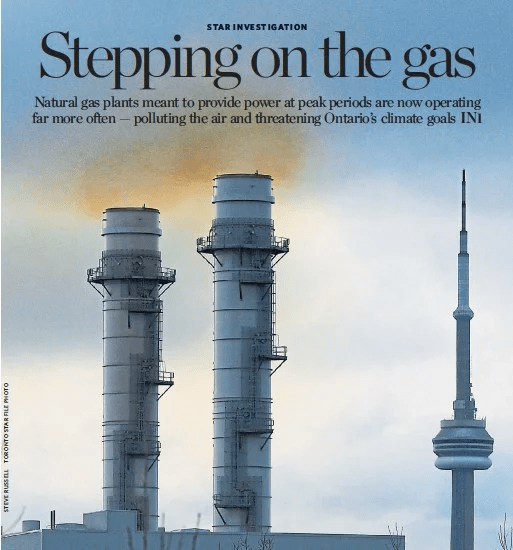
The Portlands Energy Centre on Unwin Avenue. Although it and other gas-powered plants are meant to be so-called peaker plants, they’re actually needed most of the time, which causes more air pollution in a heavily populated area.
After its proposed upgrade, the Portlands gas plant will produce fewer emissions to generate the same amount of electricity, people were told at a public meeting Thursday evening.
But Atura, the publicly-owned company that operates the downtown Toronto plant, could not say whether it would be fired up more often in the future, cancelling out those efficiency upgrades.
“We take direction from the (Independent Electricity System Operator) to run the plant,” said Don Tiffney, plant manager at the Portlands Energy Centre.
“The upgrade is more for efficiency,” he said. “The way the plant operates will not change going forward just based on the expansion of our capacity. It will still be dictated by the supply and demand balance.”
The IESO’s projections, however, show gas plant use more than tripling in the next three years, which will produce far more greenhouse gas emissions and local air pollution, despite the 9 per cent increase in efficiency the Portlands plant is proposing.
Last weekend, the Star published an investigation that revealed the Portlands gas plant, which is a “peaker plant” and is only supposed to run when electricity demand peaks, actually ran almost 21 hours a day this summer.
Along with the Halton Hills Generating Station and the Goreway Power Station in Brampton, the three gas plants in the GTA are all running more than 14 hours a day this year, producing air pollution that has been shown to cause adverse health effects in the densest urban area in the country, the investigation found.
To meet growing demand for electricity, and compensate for nuclear facilities offline for refurbishment, the province has put out a call for 4,000 megawatts of more peaking power, to be met with grid-scale batteries and additional gas-fired generation.
Local consent is required to build a new gas plant, which has proved difficult to obtain. But upgrading existing gas plants can go ahead even if the host community votes against it, as Toronto City Council did earlier this year.
Atura, a wholly-owned subsidiary of Ontario Power Generation, runs four gas plants in the province and is planning upgrades at all of them. As part of the Environmental Assessment Act, Atura must hold public meetings and consult widely before it can start work. The company held what it calls “virtual public meetings” for the Halton Hills upgrade in June and the Portlands plant this week.
The tightly controlled online exercise Thursday evening bore little resemblance to public meetings pre-pandemic. Attendees could not see each other or talk. To ask a question, people had to type it into the chat, where a moderator would approve it before it was visible to others. The only voices allowed were those of people who work for Atura.
The Portlands upgrade will involve swapping out parts of the gas turbines with new ones made from materials more resistant to heat, which will allow more of that heat to be converted into electricity.
“That will result in a 50 megawatt increase in output capacity. That’s about 9 per cent,” said Darius Sokal, senior communications adviser at Atura.
“I’d like to stress that this project is not an expansion of the Portland Energy Center. It is simply the replacement of its existing turbine parts with newer upgraded parts. There’s no physical change to the size of the facility.”
Many of the questions typed in by the public concerned potential increases in air pollution, carbon emissions and runtime. Asked why burning more gas during a climate crisis was a good idea, Stephen Smith, an environmental specialist with Atura, responded:
“Portlands upgrade project is critical in supporting Ontario’s environmental targets and electricity needs as the economy, businesses and individuals invest in electrification in support of net zero emissions. Additionally, our planned project will improve the efficiency of the plant and as a result, the gas consumption rates per unit of electricity will be reduced after the upgrade.”
The current contract for the Portlands plant ends in April 2034, several months before the federal government’s Clean Electricity Regulations come into effect. The regulations, currently in draft form, would limit gas plants to operating 450 hours a year.
This year, the Portlands plant ran more than that in the first three weeks of July alone.
Attendees could not see each other or talk. To ask a question, people had to type it into the chat, where a moderator would approve it before it was visible to others
This article was written by Linda McQuaig and was published in the Toronto Star on October 5, 2023.
James Robson, left, a citizen engagement adviser with the Canadian Association of Petroleum Producers, hands out lawn signs promoting pipelines in Edmonton in 2019.
As Chinese officials went about trying to influence the Canadian federal election in 2019, they could have learned from another set of foreigners who know a thing or two about influencing our elections — the foreign interests that own most of our big oil companies.
Both sets of foreigners — the Chinese and the oil interests (American and others) — are very keen to shape our politics and both took specific actions to influence the 2019 Canadian election.
But the actions taken by China — which we know about from Canadian intelligence sources — led to weeks of political fury and outrage in our Parliament and prompted the establishment of a public inquiry, headed by Quebec Court of Appeal Justice Marie-Josée Hogue.
Meanwhile, the actions taken by foreign oil interests — which are arguably as far-reaching in terms of determining the shape of important Canadian policies — aroused no outrage or even attention in Parliament.
Yet, surely, if we care about Canadian elections being decided by Canadians, then the clear attempt by foreign oil interests to determine the election outcome should figure prominently in this inquiry — something far from certain at this point.
Of course, the U.S. oil interests are harder to spot, partly because they carefully disguise themselves as Canadian. One might easily assume, for instance, that the Canadian Association of Petroleum Producers (CAPP) is, well, Canadian.
It’s true that CAPP represents the major oil producers in Canada and many of the managers in these companies are Canadian. But, as political economist Gordon Laxer documents in a recent issue of the Canadian journal Policy Options, all the big oil producers on the CAPP board are either majority or entirely owned by foreigners. Indeed, of all the oil produced by companies on the CAPP board, only 2.8 per cent is by Canadian-owned companies.
The fact that its board is heavily dominated by foreign-owned companies didn’t stop CAPP from making a concerted effort to determine the outcome of the 2019 Canadian election — and in some devious ways. Its goal was clear: replacing the Trudeau government with the more oil-friendly Conservatives.
This was explicit at a closed-door retreat CAPP held at the luxurious Azuridge Estate Hotel in the foothills of the Rockies in April 2019. Topics on the retreat’s confidential agenda — which was leaked to the press — included using front groups to make the pro-oil case, silencing environmental groups by suing them and getting more government support for pipelines (that is, more than the billions Ottawa was already spending on the TransMountain pipeline expansion).
The retreat brought together business leaders, Conservative politicians and operatives. One session on using litigation to silence environmental critics featured Mike Roman, a former Trump campaign official who was recently indicted in Georgia for conspiring to overturn the 2020 U.S. election.
Interestingly, such a brazen attempt by foreigners to meddle in a Canadian election was theoretically banned when Canada passed the Elections Modernization Act in 2018.
The act bans foreign interference by governments and third parties —
including foreign-owned corporations. But Laxer maintains there’s a loophole: foreign-owned corporations are exempt from the ban if they list their headquarters in Canada.
Laxer notes that almost all CAPP members, no matter how heavily foreign-owned, list a Canadian headquarters.
Climate change is clearly one of the biggest threats we face, and after wildfires engulfed Canada this summer, the public appears willing to start tackling it. But oil interests vigorously oppose any serious action and lobby governments incessantly. They officially lobbied the Canadian government 11,452 times between 2011 and 2018.
We really need a public inquiry to investigate this massive effort to shape such a vital area of our politics during election campaigns — and all other times.
At least, the current public inquiry into election interference should look into foreign-owned oil companies seeking to influence our elections, despite Canadian election laws specifically banning such action. At the very least, Justice Hogue should recommend closing the loophole that allows them to do so.
By Marco Chown Oved Climate Change Reporter, Andrew Bailey Data Analyst
This article was published in the Toronto Star on Sunday, October 1, 2023. The article was updated Oct 2, 2023
It was called “the mistake by the lake.” Residents opposed it. Toronto council voted against it. The province built the Portlands gas plant anyway, saying it would only run during periods of peak energy consumption. Data shows it ran 21 hours a day this summer. And it’s not the only one.
Keith Brooks, programs director at Environmental Defense, said Ontario’s gas plant expansion plan has serious issues to resolve. Richard Lautens / Toronto Star
In a pink shirt and a satin blue tie, a representative of the company that wanted to build a new gas plant sat down in front of his webcam and started his presentation, the sound of his voice only slightly desynchronized with his picture.
Projected on large screens in city council chambers, and watched online by citizens concerned about air pollution and carbon emissions, he reassured everyone that the generator would only operate during periods of peak electricity demand — “two per cent of the time.”
Brampton’s Goreway Power Station is being used two and a half times more than it used to be
The Portlands plant, located on the waterfront in the heart of downtown Toronto, ran nearly 21 hours a day, all summer long. Richard Lautens / Toronto Star
The Halton Hills Generating Station has been in production for an average of 14 hours and 40 minutes a day this year. Bryan Myers/Torstar / Bryan Myers/Torstar
Gas plant pollution affects millions in the GTA
Medical studies link adverse health effects to people living as far as 20 km from a gas plant.
This editorial was written and published by the Toronto Star on September 28, 2023.
Premier Doug Ford’s stunning decision to reverse his government’s Greenbelt plans is a big win for Ontarians who were deeply opposed to the land swap deal. But it is also a big win for the Greenbelt itself: for the 78 species of plants and animals that exist on two million acres of protected farmland, wetlands, forests, rivers and lakes.
It is rare to read good news involving the natural environment in an era of climate change. Ford’s decision to scrap his controversial plan offers a glimmer of such news.
Now to extinguish that glimmer: news of a disturbing report detailing a future amid climate change in Ontario. Just weeks before Ford’s Greenbelt reversal, the provincial government quietly posted a report entitled “Ontario Provincial Climate Change Impact Assessment,” that paints a frightening picture of Ontario in a warming world.
According to the report — originally presented to government officials in January but released publicly in late August — the impacts of climate change on the province may be enormous and enormously detrimental in the coming decades. Increased flooding and drought will likely threaten our food crops, our aquatic ecosystems, as well as jeopardize storm water management.
However, after a summer of stifling temperatures and devastating wildfires in Canada and around the world, few details from the report may alarm Ontarians more than this one: “By the end of the century, Southwest, Central and Eastern Ontario are projected to experience an average of over 60 extreme hot days per year.” That is roughly two months of temperatures averaging above 30 C a year; a reality that could be disastrous for the health of people and the economy.
“Ontario’s general population may be indirectly impacted by climate change through macro level shifts such as economic downturns or losses in major local employment sectors,” the report reads.
“This would have cascading impacts related to the number of people experiencing housing insecurity, and who would therefore be more vulnerable to being exposed to severe weather as a result of potentially being rendered homeless or finding accommodations in poorly equipped shelter, such as housing with inadequate heating or cooling systems.”
The report finds that in the coming years most Ontario businesses will face increased risks due to climate change. Workers won’t be spared either, it said, nothing that the province’s large population of migrants workers who are vulnerable to heat stress and infectious disease due to the nature of their work.
Climate change will negatively impact every corner of the province from health care and infrastructure to food security and homelessness. And yet, there are things the provincial government can do to mitigate some disaster. As the report notes, “the province has the solutions and knowledge to act to lessen and avoid many of the climate risks Ontario’s people and communities are facing.”
One such solution the province says it is pursuing is the improvement of its flood and storm water management. This is welcome news but significantly more must be done if Ontario is to be halfway prepared for what awaits.
The report recommends several risk mitigating measures, among them: fast-tracking the building of green infrastructure, creating (and actually implementing) climate event emergency response plans, strengthening social safety nets and supporting Indigenous-led conservation.
In addition, we call on the provincial government to get real about building affordable housing en masse (and not, it should go without saying, on protected green spaces). Housing isn’t merely a human right; it’s shelter from the increasingly harsh elements.
Ford’s decision on the Greenbelt is significant, given that the ill-considered housing developments would have bulldozed wetlands, woodlands and prime agricultural lands. But as the report lays out, other critical steps are needed to gird the province for the fallout of the warmer planet.
At present, the Greenbelt has been given a reprieve from predatory developers and politicians. Unfortunately, neither it nor Ontario is safe from climate change.
This article was written by Adam Radwanski and was published in the Globe & Mail on September 28, 2023.
Research by the Canadian Climate Institute shows that the country’s total 2022 emissions were down 6.3 per cent from 2005, but that upstream oil and gas emissions went up by 21.2 per cent over the same period.
Canadian Climate Institute estimates show greenhouse gas emissions rose 2.1% in 2022
Momentum in most sectors toward meeting Canada’s climate commitments is being weighed down by the oil and gas industry, as well as the heating of buildings, according to a preliminary estimate of the country’s greenhouse gas emissions last year.
Estimates to be released Thursday by the Canadian Climate Institute show that total national emissions went up by 2.1 per cent in 2022 from the previous year, an increase that the independent government-funded think tank says is not overly discouraging, in and of itself.
The annual increase is “a lot smaller than we would have expected,” given an unusually high rate of economic growth during a bounce-back year as the COVID-19 pandemic eased, Climate Institute principal economist Dave Sawyer said in an interview.
The broader trajectory, Mr. Sawyer said, suggests that a combination of advances in clean technology and public policy measures has started to significantly bend the curve. He pointed to emissions being down 5 per cent from 2019, the last year before the pandemic caused temporary shutdowns of economic activity.
But the new data set the stage for contentious measures that Ottawa is planning to address the sectors holding back progress toward the national target of a 40 per cent reduction in emissions from 2005 levels by 2030. Most notable is a regulated cap on oil and gas emissions, which the government is aiming to table this fall, against the protests of Alberta and Saskatchewan.
The research shows that the country’s total 2022 emissions were down 6.3 per cent from 2005, driven by progress such as a 55-per-cent decrease from the electricity sector, mostly caused by the transition off coal power, and a 15.2-per-cent decrease from heavy manufacturing such as steel, cement and mining. But it also says upstream oil and gas emissions went up by 21.2 per cent over the same period.
That increase was caused almost entirely by the oil sands, which boomed and came to dominate Canadian fossil-fuel production after 2005, while emissions from conventional oil and from natural gas production have decreased. Emissions from all forms of oil and gas extraction went up from 2021 to 2022, for a total sectoral increase of 2.4 per cent, although that gain was partly attributable to economic factors specific to that year, including fallout from the Russia-Ukraine war.
According to the institute’s estimates, oil and gas is the country’s largest emitting sector, accounting for 26 per cent of all national emissions in 2022. By contrast, the transportation sector – which previously had a roughly equal share – has fallen to 22 per cent, which Mr. Sawyer attributed partly to electric vehicles beginning to take hold.
The country’s building stock, the other big cause for concern flagged by the institute, saw a sharper increase in 2022, rising 5.9 per cent from 2021. Buildings now account for 13 per cent of national emissions.
Mr. Sawyer emphasized that the yearover-year jump in building emissions, caused mostly by fossil fuels used for space heating, was largely due to a colder winter than the prior one. But the longerterm trajectory is also not encouraging, with an 8.8-per-cent increase since 2005.
While emissions from homes have gone down somewhat since then, those from commercial buildings have gone way up, which is prompting the Climate Institute to call for more aggressive federal policies, especially to encourage the installation of heat pumps.
Another sector identified by the research as going in the wrong direction is agriculture, as Ottawa has struggled to introduce climate-related policies without incurring backlash. Although nearly flat between 2021 and 2022, agricultural emissions are estimated to have risen 8.2 per cent since 2005, driven by on-farm fuel consumption and the use of fertilizers in crop production.
Further light will be shed on these and other sectors when Environment and Climate Change Canada releases official and more detailed 2022 emissions numbers, likely in the spring of 2024.
The institute’s estimates, which are based on Statistics Canada data, are intended to provide a more timely snapshot of the previous year, to inform policy decisions and debate.
Mr. Sawyer suggested in the interview that Ottawa needs to develop a more upto-date and comprehensive monitoring system, to help in the development of emissions-reduction pathways for each sector, and to prompt quicker policy responses if those strategies aren’t working.
For now, the latest numbers broadly suggest that, even with signs of progress in many sectors, emissions-reduction efforts need to dramatically pick up the pace – with drops of 5.4 per cent a year needed over the rest of this decade to achieve the country’s 2030 total emissions target.
They were nevertheless welcomed by Environment Minister Steven Guilbeault, who responded with a statement calling the institute’s findings encouraging, because they show that “we have decoupled economic growth from pollution,” through policies such as carbon pricing and the deployment of clean technologies.
“We also know the oil and gas and building sectors remain stubbornly high emitters,” he added, promising to advance targeted policies to address them.
This article was written by Stefan Pauer and Keri McNamara, and was published in the Toronto Star on September 27, 2023.
STEFAN PAUER IS MANAGER OF TECHNOLOGY AND ECONOMIC ANALYSIS AND KERI MCNAMARA IS MANAGER OF REPORTS AND OUTREACH AT CLEAN ENERGY CANADA.
Inflation. Extreme weather. The cost of living and climate change are top of mind for Canadians as they grapple with rising prices amid a summer defined by wildfire smoke and heat waves.
Fortunately, there is a common solution: clean energy. From electric vehicles to heat pumps, clean technologies have the power to fight climate change all while protecting your pocketbook.
A Toronto family living in a house in the suburbs that adopts a few common clean energy solutions could knock $800 off their monthly energy bills, compared to one that is largely reliant on fossil fuels, according to a new report from Clean Energy Canada, “A Clean Bill.” That’s even taking into account the costs of buying and installing the technology. Over a year, that adds up to almost $10,000 that can be saved, invested or spent on literally anything else.
A condo owner who was able to make similar changes could pocket an extra $5,000 a year. Not to mention the value added to their property in a market that is increasingly demanding fossil-fuel-free living or the health benefits of breathing cleaner air.
It’s worth noting that the Toronto Star’s own clean energy calculator produces similar results, while both Canadian and international studies have reached the same conclusion: the transition to clean energy will result in smaller energy bills.
By far, the single biggest money saver is an electric vehicle. Choosing a Chevrolet Bolt instead of a Toyota Corolla hatchback, for example, would save a typical Canadian $33,600 over a 10-year ownership period (or about $29,000 in Ontario given the province offers no provincial rebates).
When it comes to heating and cooling, fossil-fuel-free options also pack the best cost savings. Specifically, air source heat pumps — which can cool as well as heat — are the cheapest option for many Canadian households, even when the costs of installation are included. Installing a heat pump instead of a new natural gas furnace and central air conditioning can cut around $50 (including upfront costs) off the monthly bill of a detached family home in Ontario.
And lest you think heat pumps aren’t suited to Ontarian winters, heat pumps are most popular in some of the coldest countries: Finland, Norway, and Sweden, with new technologies comfortably working at temperatures as low at -30 C.
What’s more, switching to clean energy insulates households from certain price shocks. The cost of clean electricity is generally controlled by local market forces, while spiking oil and gas prices are forever at the whim of global geopolitics. With gas prices nearing $1.70 in the province, EV drivers have the luxury of driving right by the pump.
A continued reliance on fossil fuels is costing Canadians, but there are ways in which governments can make it easier for residents to make the shift.
For starters, they can help reduce the often higher upfront costs of the technologies — something many are already doing. The federal government offers $5,000 off the sticker price of the most popular electric vehicles. And while the Ontario government does not have its own rebates for electric vehicles, seven provinces and territories, representing 43 per cent of Canada’s population, have additional rebates that can be stacked.
The federal government also offers grants and zero-interest loans for home upgrades, including energy efficiency improvements or rooftop solar installation. And many provinces, municipalities and utilities have their own grants or loan programs, including for heat pumps.
The next steps are to improve accessibility so that all Canadians can benefit, regardless of their income or housing situation. That could include extending purchase incentives to cover used EVs, funding EV-ready retrofits in multifamily buildings or requiring minimum energy efficiency standards for rental housing.
Put simply, clean energy is a win win for climate and cost. It’s time to bring the benefits home.
A continued reliance on fossil fuels is costing Canadians, but there are ways in which governments can make it easier for residents to make the shift, such as rebates, grants and zero-interest loans



 Mobilize, Canada!