Exclusive: rapid analysis of extreme event by Stanford University shows worst day of exposure to such pollution since 2006
This article was written by Oliver Milman and was published in The Guardian on June 8, 2023.
This article was written by Oliver Milman and was published in The Guardian on June 8, 2023.
This article was written by Fiona Harvey and was published in The Guardian on June 8, 2023.
This article was written by Tonda MacCharles and was published in the Toronto Star on June 8, 2023.
At the best of times, Parliament reflects the country’s anxieties and ambitions. At the worst of times, it seems oblivious.
Wednesday was one of those days when the House of Commons seems somehow to barely pay lip service to what’s top of mind for just about everyone else in North America. Even as Canada’s worst ever wildfire season drove smoke into the halls of Parliament and caught in the throats of MPs, it did not drive political debate.
Instead, Opposition questions to the government were dominated by Conservatives demanding Liberals put forward a balanced budget plan; the Bloc Québécois pressing for a public inquiry into foreign elections interference; and the fourth party, the NDP, reaching for irony, as it accused the government of not taking the climate crisis seriously before moving on to demand greater taxes on the wealthy.
“Today is supposed to be Clean Air Day and at the same time, our country is burning,” said NDP Leader Jagmeet Singh. “We can even smell the smoke in this chamber. Our country is literally on fire and the current Liberal government thinks that business as usual is fine.”
The Liberal government had just an hour earlier underscored that it is anything but.
Prime Minister Justin Trudeau led a news conference on the wildfire response, noting Environment Canada has issued air quality warnings across the country.
Late Wednesday Trudeau spoke to U.S. President Joe Biden as the Canadian wildfire smoke obscured skies in New York City and across the northeast, discussing what additional resources might be needed, said a senior official.
Yet it was Conservative leader Pierre Poilievre and the Conservatives who reached for metaphors that seemed oddly jarring, talking about “fuel” on inflationary “fires” while ignoring the actual flames burning across the country.
On a day when the Bank of Canada raised the overnight interest rate again, Poilievre blamed Trudeau for pouring “gas on the fire” of inflation, promising to block “disastrous, risky and inflationary budget” bill until Trudeau introduces a balanced budget plan (never mind that in reality, only five hours of debate on the bill remained).
What Poilievre didn’t do, however, was underscore his second demand — touted with great fanfare two days ago — that the Liberal government must also “cancel planned carbon tax increases.”
On Wednesday, an exasperated Trudeau, after nearly 50 minutes of questions, retorted that if Poilievre “has a better plan” on climate change than carbon pricing, “let him say it, because we have been waiting a long time for it. He has no plan to fight climate change. He still questions whether it exists while Canada is burning.”
For hours afterward, the House of Commons voted on more than 900 budget amendments introduced by Poilievre’s Conservatives to stall the budget bill.
The cynics call it “silly season” but this year’s end-of-session legislative dash on Parliament Hill feels not silly but rather detached.
On Monday, Poilievre simply asked for an update on the wildfire response. On Tuesday, the NDP noted 15,000 firefighter vacancies across Canada, and asked the government to support a private member’s bill to increase a volunteer firefighter tax credit from $3,000 to $10,000.
Meanwhile, Environment Canada said the smoke from Canada’s wildfires didn’t just cover the skies over North America. “It reached as far as northern Europe, over Norway, Sweden and Denmark.” And worse may yet come. Much of the country is expected to be under high to extreme risk for most of the wildfire season, Ottawa warns.
Emergency Preparedness Minister Bill Blair told reporters while there’s been no direct loss of life in Canada yet, this year has been the most “challenging” since wildfire records have been kept, with 2,293 wildfires and 3.8 million hectares burned. Across the country, as of Wednesday there were 414 wildfires burning, 239 of which are determined to be out of control, with 20,183 people evacuated from homes and communities, he said.
Poilievre said Canada had the highest household debt in the entire G7, and demanded to know if Trudeau would “reverse his inflationary and high interest rate policies before people go broke?”
Trudeau said Canada has the best economic performance of the G7 emerging from the pandemic. He argued his government is delivering financial support in a “targeted” and noninflationary way, and accused the Conservative leader of stoking “erroneous fears” and ignoring “what is actually happening in Canada.”
This article was written by Allan Woods and was published in the Toronto Star on June 8, 2023.
If Canada were a colour, it would be orange.
The orange flames of the burning trees, from one end of this country to the other, pushing air quality readings in Toronto, across Ontario and elsewhere to their most hazardous levels.
The orange haze that this country’s wildfires have cast upon New York’s Empire State Building and other world-famous landmarks.
The haunting images of Canada’s flaming tinder leaving its mark on America have effectively captured the vast power of nature’s wrath, and have become the global face of an unfolding ecological and humanitarian disaster in this country.
It is a disaster that has burned nearly four million hectares of land so far this year, and which could see Canada on track to record its most damaging wildfire season since 1995 — outstripping the British Columbia fires of 2021 and the Northwest Territories blazes of 2014.
And it’s unclear when the smoke will dissipate, with Toronto’s air quality health index expected to hover at levels 8 and 9, considered “high risk,” through Thursday, and smoke from hundreds of wildfires in Quebec and northeastern Ontario continuing to cause air quality warnings throughout Canada’s most populated corridor.
Outdoor activities have been cancelled or moved indoors, and Environment Canada warned that those with respiratory issues like asthma and heart disease, and those working outside, faced a higher risk of adverse health effects.
The latest national tally had 414 wildfires burning, with more than half — 239 — considered to be “out of control.” A troubling number of them are in dangerous proximity to towns, villages and communities. Fire crews from the United States, France, South Africa and a handful of other countries have dispatched or are preparing to send reinforcements our way to save lives, land and property.
The White House has been in regular touch with the federal government in Ottawa for several days now, having already deployed more than 600 firefighters and personnel, as well as water bombers, said press secretary Karine Jean-Pierre.
The great urgency of the troubling situation has sparked obvious fears — ones that federal Public Safety Minister Bill Blair sought to calm on Tuesday.
“I want to assure Canadians that all orders of government are working closely together, including our Indigenous partners, to ensure a co-ordinated and effective response,” he said in Ottawa. “It’s all hands on deck, and it’s around the clock.”
After an intense start to the spring and summer wildfire season, when the threat and response swung from western B.C., Alberta and Saskatchewan to eastern Nova Scotia, all the focus is now on the alarming conditions in Quebec and Ontario, which together account for nearly 200 of the nation’s active forest fires.
“We are in for, probably, the most severe fire season our province has ever experienced and people are quite rightly worried for their immediate future and whether this is the new reality,” Ontario NDP Leader Marit Stiles told the legislature.
Despite the elevated risk, Premier Doug Ford limited himself to requesting that Ontarians refrain from lighting campfires, while stopping short of instituting a provincewide fire ban.
Ontario Natural Resources and Forestry Minister Graydon Smith noted that fire restrictions are already in place in most parts of the province, which he said was “enormous … with different conditions in some different areas.”
“We’re taking action where we feel is appropriate,” he said.
On Twitter, which was awash Wednesday in photos and videos of the otherworldly scene, the U.S. National Weather Service posted a time-lapse video that showed the New York skyline gradually disappearing behind a thick orange veil.
Air passengers reported smelling smoke inside the plane as their flights descended into the haze. New York Mayor Eric Adams urged citizens to remain indoors. And residents of the West Coast and the Pacific Northwest, where wildfire smoke is a regular part of life, urged their eastern counterparts to get a grip.
Actress Jodie Comer abandoned her one-woman play on Broadway in the middle of a matinee, citing breathing problems as a result of the pollution. And even “Sesame Street” got in on the act, urging parents to keep their kids inside.
In Quebec, fires threatened more than half a dozen towns and Indigenous communities, resulting in the evacuation of more than 11,000 people.
“I’ve been here at the arena since 8 o’clock Tuesday night and I only left for 15 minutes to take a shower at home,” Serge Bergeron, the mayor of Roberval, Que., said by telephone Wednesday from the local hockey rink that’s been turned into a 450bed refuge for those fleeing fires that have threatened Chibougamau, to the northwest.
Normally, the 255-kilometre drive takes three hours. The traffic from the forced evacuation turned that into a seven- or eight-hour journey on Wednesday.
“We have had people suffering from anxiety, who are crying, who are scared — scared that their house would burn,” Bergeron said.
Not all are so quick to flee the flames.
Quebec Premier François Legault noted in a Wednesday morning news conference that 4,000 residents of Mistissini, a Cree community in northern Quebec, were among those he expected to begin evacuating to a safer location.
The remote community, about 800 kilometres north of Montreal, lost power after its main hydro lines were damaged and is now reliant on an older, secondary power line that was brought back into service.
But Mistissini Chief Michael Petawabano angrily took to the local radio station later in the day to say: “Legault does not run our community.”
He said that a southbound road leading out of the community was still open and safe, and that vulnerable residents in need of medical care had already been sent away. The local school had been closed for the remainder of the week and officials urged people to reduce their electricity use and not to hoard supplies and gasoline.
Yet, despite the “out of control” fire raging to the west, Petawabano maintained that there was “no danger.”
“We are safe,” he said. “We are not evacuating at the moment.”
Part of the decision to stay put, he said, was based on close contact with a provincial agency which coordinates forest firefighting services in Quebec and is surveying the fire’s advance from the air.
This article was written by Adam Gabbatt and was published in The Guardian on June 8, 2023.
This article was written by Dharna Noor and was published in The Guardian on June 7, 2023.
This article was written by Steve McKinley and was published in the Toronto Star on June 6, 2023.
As large swaths of the country burn during an unprecedentedly active spring wildfire season, Canadians are being warned there may be much worse on the horizon.
If fires continue to burn as they have, by the end of the season in August, the country could be looking at more scorched forest than has ever been recorded, officials from Natural Resources Canada said Monday.
It’s the result of a convergence of factors, including climate change delivering conditions conducive to more frequent and severe wildfires, and a couple of large-scale weather patterns literally fanning the flames.
Right now, there are significant fires burning in every single province and territory — barring Prince Edward Island and Nunavut — enough to make Natural Resources Canada’s fire map look like a multicoloured crime scene blood spatter chart.
Already this year, there have been 2,214 wildfires that have blackened more than 3.3 million hectares of Canadian wildland — more than five million football fields’ worth.
To put that into perspective, the 10-year average for this time of year is 1,624 fires and 254,429 hectares burned — about 13 times less than this year.
Fires in 2023 are equal to 71 per cent of the total burn for the 2014 season — the worst in the past 20 years — with three months still to go in the 2023 season.
As for the human cost, so far this year, fires have prompted some 120,000 people to evacuate in six provinces and territories. Of those, approximately 26,000 are still unable to return home.
It’s not just the burned hectarage that’s extraordinary, but its distribution too, say experts. Typically, in the spring fire season, the majority of Canada’s fires are skewed toward the western provinces. Seeing fires coast-to-coast as we see this year, say officials, is simply unprecedented.
It’s small wonder that that word — “unprecedented” — pops up with near monotonous regularity when politicians and experts speak on the country’s fire season.
“Over the last 20 years, we have never seen such a large area burned so early in the season,” said Yon Boulanger, a researcher for Natural Resources Canada. “This is partially because of climate change. We’re seeing trends toward increasing this burned area throughout Canada.”
And there are indications that this early tinder boxlike trend could continue through the summer.
Forecasts for June project the warm and dry conditions that have made the spring so flammable will continue through the month — and through most of the summer — creating a higher-than-normal potential for wildfires through most of the country.
In fact, said Richard Carr, Natural Resources Canada’s fire danger forecasting expert, we’re looking at similar weather conditions to 1989, the worst year for wildfires in the past six decades, when 7.5 million hectares burned.
“We’ve actually been getting the worst of both a La Niña and an incoming El Niño, which is starting to develop over the summer,” he said.
Notably, researchers this month held Australia’s 2019-20 wildfires to blame for the strong La Niña weather patterns, the effects of which are just now beginning to abate.
“We’ve had a bit more heat than we’ve had during a typical La Niña spring, but it does tend to favour very windy, dry conditions. Previously, the most area burned was in 1989 and (the El Niño) did very much the same thing that year. So, I wouldn’t be surprised if weather conditions are very similar to what we had in 1989.”
Though conditions will be ripe for a busy fire season, it’s important to note those forecasts predict risk levels for wildfires and not actually the fires themselves, said Natural Resources Minister Jonathan Wilkinson.
“With good fortune, it is possible that the full extent of the risk does not materialize. But with preparation we must be ready for whatever happens this year and into the future. Every province and territory will need to be on high alert throughout this wildfire season,” he said.
Wilkinson, Prime Minister Justin Trudeau and Public Safety Minister Bill Blair took turns Monday touting measures the government, in addition to training and deploying some 500 Canadian Armed Forces troops to wildfire hot spots, is making to mitigate the upcoming and future fire seasons.
Chief among those is the WildFireSat, a dedicated wildfire observation satellite system — the first of its kind — expected to launch in 2029 at a cost of $170 million.
They also made note of a government investment of $284 million over five years for a Wildfire Resilient Futures Initiative designed to develop and promote wildfire prevention and mitigation protocols — such as FireSmart Canada — and research gaps in wildland fire knowledge.
Another $489 million is earmarked for the Disaster Mitigation and Adaptation Fund, to help communities improve their resilience to wildfires.
“Our modelling shows that this may be an especially severe wildfire season throughout the summer,” Trudeau said. “We’re going to get through this together and our government will keep being there with whatever it takes to keep people safe.”
With 18 of the country’s wildfires directly affecting First Nations communities, Trudeau pointed to Ottawa’s efforts to train more community-based firefighters.
Last week, the federal government announced a Wildfire Training Fund, dedicated to the hiring and training of 300 Indigenous firefighters and 125 Indigenous fire guardians.
He also highlighted working with First Nations to train 130 wildland firefighters in Yukon and northern British Columbia, and working with Innu Nation in Newfoundland and Labrador to train community members there.
He also lauded the arrival of firefighters from other countries with whom Canada has reciprocal firefighting aid agreements.
The U.S. has sent 522 firefighters so far to help with wildfires here. South Africa, Australia and New Zealand have sent 215, 195 and 25, respectively.
Those southern hemisphere countries have their fire seasons during Canada’s winter months. Ottawa is still in discussions on firefighting aid with Costa Rica — they could potentially send up to 60 firefighters.
French President Emmanuel Macron announced that country would be sending 100 firefighters to Quebec.
With good fortune, it is possible that the full extent of the risk does not materialize. But with preparation we must be ready for whatever happens this year and into the future.
JONATHAN WILKINSON NATURAL RESOURCES MINISTER
This article was written by the Associated Press and was published in the Globe & Mail on June 6, 2023.
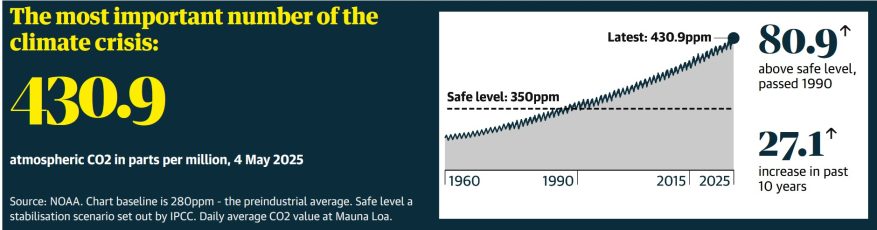
The cause of global warming is showing no signs of slowing as heat-trapping carbon dioxide in Earth’s atmosphere increased to record highs in its annual spring peak, jumping at one of the fastest rates on record, officials announced Monday.
Carbon dioxide levels in the air are now the highest they’ve been in more than four million years because of the burning of oil, coal and gas. The last time the air had similar amounts was during a less hospitable hothouse Earth before human civilization took root, scientists said.
The National Oceanic Atmospheric Administration announced that the carbon dioxide level measured in May in Hawaii averaged 424 parts per million. That’s three parts per million more than last year’s May average and 51 per cent higher than pre-industrial levels of 280 ppm. It is one of the largest annual May-to-May increases in carbon dioxide levels on record, behind only 2016 and 2019, which had jumps of 3.7 and 3.4 parts per million.
“To me as an atmospheric scientist, that trend is very concerning,” said NOAA greenhouse gas monitoring group leader Arlyn Andrews. “Not only is CO2 continuing to increase despite efforts to start reducing emissions, but it’s increasing faster than it was 10 or 20 years ago.”
Emissions used to increase by maybe one part per million per year, but now they are increasing at twice and even three times that rate, depending on whether there is an El Nino, Ms. Andrews said.
Carbon dioxide levels are rising so that each year is higher than the last. However, there’s a seasonal cycle with carbon dioxide so that it reaches its highest saturation point in May. That’s because two-thirds of the globe’s land is in the Northern Hemisphere and plants suck carbon dioxide out of the air, so during late spring and summer carbon dioxide levels fall until they start rising again in November, Ms. Andrews said.
Carbon dioxide levels rise more during El Nino climate cycles because it is hotter and drier in the tropics. An El Nino is brewing. This year’s increase may be a sign of an El Nino bump, she said.
There are two main ways of tracking greenhouse gases.
One is to monitor what’s coming out of smokestacks and exhaust pipes, but about half of that is absorbed by the oceans and lands, Ms. Andrews said.
The other way is to measure how much carbon dioxide is in the air. NOAA and partner agencies measure all around the world.
Hawaii has the longest history of direct measurements and is the home of the Scripps Institution of Oceanography’s Keeling Curve, which has kept track of carbon in the air since 1958 when the May reading peaked at 317.5. Emissions have gone up about 33 per cent since then.
“Current emissions are going to remain in the atmosphere for thousands of years and they’re going to continue to trap heat energy near Earth’s surface for thousands of years,” Ms. Andrews said.
This article was written by Bill Curry and Mike Hager, and was published in the Globe & Mail on June 6, 2023.
Canada could exceed the largest total amount of burned area recorded in this country in a single year, as climate change increases the frequency and intensity of wildfires and puts Indigenous communities at higher risk, according to new federal numbers.
Natural Resources Canada released updated data and forecasts Monday showing that, asofJune4, there had been 2,214 wildfires across Canada this year, and about 3.3 million hectares burned. The 10-year average over the same timeframe is 1,624 fires and 254,429 hectares burned.
The department said it is unusual to have blazes across most of the country this early in the wildfire season, and Canada could pass the annual record for burned area if the rate of fire activity continues.
The figures and analysis were released in conjunction with a Monday news conference by Prime Minister Justin Trudeau and his ministers to discuss the data. Mr. Trudeau expressed a willingness to spend more on support if the situation worsens.
“With the given projections, it is expected that we have enough resources to cover the summer,” Mr. Trudeau said. “If things get worse, we’re developing contingency plans and we will of course make sure that we are there … to ensure that all Canadians are protected right through this summer.”
Brian Simpson, a semi-retired consultant based in Castlegar, B.C., said Canada’s system for fighting these disasters is based on the idea that only one side of the country will burn at a time.
That way, provinces with lower levels of risk can share their firefighters and equipment, which has worked well in years past.
This year, with so many fires burning from the Atlantic to B.C. so early in the season, the system is facing major pressure.
“Now you start to get into this quandary where there’s not enough resources for the amount of fire on the ground, and the larger jurisdictions, who are typically the ones that are going to be providing lots of resources outside, are starting to pull back because they’re starting to either get fires or they’re imminently going to have [them],” Mr. Simpson, who spent four decades fighting wildfires and eventually led B.C.’s Wildfire Service, said.
Wetter weather should continue to help Alberta and Nova Scotia with the fires burning in those places, he said, but Quebec still faces major hurdles battling blazes, and B.C. is set for a very dry and dangerous June.
So far, 198 Canadian firefighters have travelled to other provinces this season to pitch in, and 957 foreign firefighters have landed in Canada, federal officials said during their Monday briefing.
Quebec Premier François Legault said more than 480 firefighters are fighting about 30 fires in his province. But more than 160 forest fires are burning there, he added, and international support is needed.
“When I talk to the premiers of other provinces, they have their hands full,” Mr. Legault told reporters in Quebec City on Monday.
Mr. Legault said an additional 200 firefighters are coming from France and the United States, and Quebec is also in talks with Costa Rica, Portugal and Chile as it searches for additional resources.
He said no lives have been lost in the province’s fires, but they have forced about 10,000 people from their homes, most of them in the northwestern Abitibi-Témiscamingue region, and the eastern Côte-Nord region.
Diane Rioux was making dinner at home in Lebel-sur-Quévil-lon on Friday, when the small city in the Abitibi-Témiscamingue region issued a warning. Immediately, she asked her oldest daughter to grab a pen so she could dictate a list of what they would need to bring if they had to go.
When the evacuation order came shortly after, Ms. Rioux, her husband and her three children packed medication, clothes and hygiene products before joining a convoy of people who had been ordered out of the area.
“We did it as a family, and it went very quickly,” she said. “We took my 83-year-old dad, and we left.”
Federal Emergency Preparedness Minister Bill Blair said Monday there were 413 wildfires burning across Canada, and that 249 of those were deemed out of control. There were 18 active wildfires impacting First Nations, including six in Alberta, five in Saskatchewan, one in the Northwest Territories, four in Quebec and two in Nova Scotia.
About 26,000 people had been evacuated from their homes across the country.
Rain over the weekend allowed Alberta to end its monthlong state of emergency Sunday, and helped contain several fires in Nova Scotia.
In Alberta, there were 63 active wildfires on Monday afternoon, with 16 deemed out of control. Five evacuation orders remained in effect, displacing more than 4,300 people. The orders were primarily impacting remote Indigenous communities.
Chief Conroy Sewepagaham, of Little Red River Cree Nation, east of High Level in Northern Alberta, said in a Cree and English update posted Friday on social media that a fire around Wood Buffalo National Park continues to grow and has burned more than 80,000 hectares of land.
”We’re just going to keep hammering and keep doing what we’re doing here. The more we can get these ground fires extinguished, the sooner we all can come home to Fox Lake,” he said.
In Nova Scotia, at the height of evacuations from a Halifax-area wildfire, more than 16,000 people were forced to leave their homes northwest of the city, and the city said about 4,886 remained displaced Monday.
Halifax has said more than 150 homes were destroyed in the blaze, but there were no reports of deaths or injuries.
The Halifax-area fire is now contained, with an estimated area of 950 hectares, and the city said Monday that it is moving into a recovery phase, which includes soil and air quality testing.
Meanwhile, in southwestern Nova Scotia, the massive Barrington Lake fire continued to burn out of control on Monday, though heavy rain on the weekend helped stop its advance.
This article was written by Marco Chown Oved and was published in the Toronto Star on June 4, 2023.
There are many origin stories for the climate movement.
Some point to the testimony of NASA scientist Jim Hansen before U.S. Congress in 1988. Others say it was the signing of the UN Convention on Climate Change in Rio de Janeiro in 1992, or the Kyoto Protocol in 1997, or the Paris Agreement in 2015.
But few remember that Toronto hosted one of the first major climate meetings in 1988, issuing a final statement warning that “the Earth’s atmosphere is being changed at an unprecedented rate” and the “ultimate consequences could be second only to a global nuclear war.” It was then that David Suzuki — one of Canada’s best known television hosts even back then — was captivated.
He wrote a book, “A Matter of Survival,” on the emerging scientific consensus around the dangers of climate change and then started his own foundation, dedicated to finding and promoting solutions. And he’s never looked back.
Accomplished geneticist, gifted communicator, author of 16 books, recipient of 29 honorary degrees, Companion of the Order of Canada and cultural icon from coast to coast, 87-year-old Suzuki is a still strident advocate for the climate and the planet.
Since announcing his retirement as host of the CBC’s flagship environmental program, “The Nature of Things,” after 44 years, he says he’s been “freed” from the travel schedule and the strictures of the national broadcaster and can now focus on his role as an elder, imparting lessons learned from a life at the nexus of science and activism.
He came into the Star’s podcast studio for a wide-ranging talk about his career, the climate movement, technological and nature-based solutions and how he sees his role evolving after TV. These are some highlights from the conversation, edited for length and clarity:
On the role of elders
When you’re an elder, you don’t have the same vested interests. I don’t have to kiss anybody’s ass to get a job, a raise, or a promotion. I’m way beyond worrying about fame or money or power. So it allows me to speak the truth from my heart without all of that stuff tempering what I say. And I believe this is the most important part of my life. As elders, we have had the privilege of living an entire life. We’ve made mistakes. We’ve had failures. We had maybe some successes. Those are life lessons. And our job now is to sift through that life for some of the important lessons to pass on to the young ones so they don’t make the same mistakes.
I was involved in the peace movement way back in the ’60s and ’70s, and one of the most powerful groups was retired admirals and generals against nuclear war. These are guys that had gone through the system saying: ‘We need nuclear deterrence. We’ve got to build up our arsenal.’ And the minute they retired, they could tell us the truth. They said: ‘This is crazy. These are not making us safer.’ And they had a powerful impact. So I call on CEOs and corporate presidents, for God’s sakes, once you’ve retired and made your money, speak the truth. Tell us the truth.
On his own bias
We have been hammered all through the years that I’ve done “The Nature of Things” because we’ve covered issues of logging, of the disappearance of birds, of (the harms caused by) fossil fuels. And does the corporate sector go, “I wonder what if ‘The Nature of Things’ is right?”
That’s never the response. It’s always: ‘You’re biased, CBC. You’re biased, ‘The Nature of Things.’ And when the criticism comes to me it’s: ‘Get that guy off the air!’ or ‘Fire him from the university!’ And they’re all ways of not confronting the issues being raised.
Yes, we are biased. There’s no doubt about it. But our bias is that we are deeply embedded in the natural world. And whatever we do to the natural world, we’re doing directly to ourselves. That’s our bias.
On who bears responsibility for addressing climate change
It’s people, but it’s also the system we’re embedded in. We all have contributed in various ways. The problem is that we’ve created systems — and this is at the heart of it — (that) have disengaged ourselves from the web of relationships (in nature).
We think the world is a pyramid in which we’re at the top, and everything else below is for us. All of our laws, our economy, our politics are built on that assumption. We’re at the top of the pyramid and we’re in charge of it all. We need to remember that we’re part of a web of relationships. We’re just a little strand within it.
On whether individual or collective action is more important
Both. People are always looking for a magic bullet. There isn’t one. They say, ‘What can we do? What’s the one thing?’ Well, you know, we can change the way we behave. And there are ways to make a big difference individually. And I could talk about that. But the other thing is that we’re living within a system within which big decisions are made and we have to hammer those who represent us.
We say democracy is the best system, (because) all people eligible to vote now can determine government policy. But children don’t vote. Future generations don’t vote. And yet they are impacted more heavily by decisions made today than we are.
On nuclear power
Of course, nuclear doesn’t have the greenhouse gas emissions that burning fossil fuels does. But I think what we’ve learned that when you put all of your eggs in big, big technology, you become very, very vulnerable. There’s no way that nuclear can be a part of the challenge we have right now.
Nuclear couldn’t possibly kick in within the next 20 years as a significant (solution). And that’s if you had an all-out building program. SMRs — small (modular) nuclear reactors — we don’t even know whether they’re a possibility. The scale of small nuclear reactors that would be needed to deal with it would be enormous. And it’s way in the future. We’re dealing (with) right now and nukes are not the answer.
They (take a long time to build) and they’re the most expensive. And, you know, there are all of the (other) problems associated with it. I know the industry likes to say, ‘Oh, no, people weren’t killed by nuclear power.’ We have no idea what the long-run effect is when you’re creating isotopes that are going to last for thousands of years.
On critical mineral mining for batteries
Mining is one of the most destructive activities we have. And I think the place we have to do almost all of our mining now is in our debris, our waste areas. We’ve got to start mining our garbage dumps and all of the places where we’ve thrown all of the crap that we’ve made and consumed.
Batteries certainly must be a part of the future towards which we’re going. I think that lithium right now is the best atom that we can use. But there are sodium batteries that are coming out. They’re heavier. They can’t hold as much energy. I think that we have to hope that there will be in the future batteries of a totally different dimension.
But the problem now is lithium has become the atom of choice and the demand is going to be enormous. Right now a decision is going to be made about whether we should be mining the ocean bottom, because there are huge lithium deposits. This is the absolute insanity now of our species. We are a terrestrial animal and we ought to be very careful. We don’t know anything about the oceans that cover 70 per cent of the planet and we want to go in and trash it in order to get lithium? That’s not the solution.
On why Canada needs to cut its emissions, though we can’t fix climate change on our own
That was the same argument (I heard) at Kyoto in ’97. The Alberta delegation was there and they were saying that we’re a trivial part (of global emissions). Why should we be subjected to (limits)? And my response then as it is now is, first of all, we are a part of the major contributors and we are the rich countries. What right have we got to ask the developing world not to do what we’ve done?
We’re setting the example for the poorer countries to try to follow. They want to achieve the kind of wealth and position that we’re in. We’re the example. If we can’t show that this is the wrong path, that we’ve got to change, why the hell should they pay any attention to us?
On nature’s version of nature-based solutions
The problem that we face is we’ve run out of time. We simply don’t have the time. Over the history of life on the planet for 3.9 billion years, there have been these five mega-extinctions. Ninety-five per cent of organisms disappear from the fossil record. And nature recovered. I mean, that’s such an astounding shift. But it took 10 million years. And this is the point. Nature will always win out.
People say, ‘We’re destroying the planet. We’re changing the planet, destroying the biosphere.’ But the earth and nature will carry on. Radically different, perhaps, but it’ll carry on. It doesn’t need us.
We’re trying to ramp up nature. So people are going, ‘We’ve got to plant six trillion trees.’ We’ve got to stop using nature as an aid to us, to talk about a forest or a wetland as a carbon sink. No, they’re this entity that has evolved on its own and it does what it does. We’ve got to just leave nature alone. But we won’t because we don’t have time.
So we’ll plant trees in the assumption they will suck in enough carbon to get us out of the problem. And it’s going to take time. And there’s no way we can ramp that up.
On nature surprising us
After (the Second World War), we ended up in Leamington, Ont., on Lake Erie, and every spring there was a hatch of mayflies you wouldn’t believe. They hatch out of the water. They live for 24 hours and they’re basically a flying gonad. They’ve just got to find a partner, mate and die and their carcasses would pile up on the beaches a meter deep. They’d cover houses so that you couldn’t see through the windows. They would cover the highways and cars would get into an accident skidding on their bodies. Within a decade, they were gone. That immense biomass was gone because of pesticides. Farmers began to apply them in massive amounts and they washed into the lake. And Lake Erie soon after that was declared dead.
Lake Erie, I gather, has rebounded now. And people are writing to me all the time saying: ‘the mayflies are back.’ Yeah, they’re back, but nothing like what they were. Our problem is that we forget what nature’s abundance really was.
On changing baselines
Daniel Polley, one of Canada’s eminent fisheries biologist, started this idea of shifting baselines. Every generation we forget what it was (like) in the previous generation.
Callum Roberts wrote a book about the oceans and there’s a shot on a dock in Florida, taken about 50 years ago. And you see the fishermen standing there with these giant fish groupers and things. And they’re all very happy and proud with these fish.
Then there’s a shot on the same dock taken 30 years later. And now the fish, they don’t have the giants, they’re medium-sized ones. The fishermen are delighted. They’re happy as can be.
And then the final one is a current picture, same dock. And now the people are holding (tiny) fish. And each generation thinks this is great. That gives you an idea of the extent to which we’ve really diminished the planet’s plenty.
We don’t remember what it was like. That’s why among Indigenous people, elders are so important to them. They remember the world as they learned it through their elders.
 Mobilize, Canada!