The advantages of fighting in-your-face effects of climate change simply don’t show up in public accounts


This article was written by Don Pittis and was published by CBC News on May 18, 2023.
This article was written by Don Pittis and was published by CBC News on May 18, 2023.
This opinion was written by John Vaillant and was published in the Globe & Mail on May 19, 2023.
:format(jpeg)/cloudfront-us-east-1.images.arcpublishing.com/tgam/MVHROMSXE5BODHG7UYOG6IKCKQ.jpg)
John Vaillant’s latest book is Fire Weather: The Making of a Beast.
We weren’t a week into May before 30,000 people had been evacuated because of dozens of fast-moving wildfires in Alberta. Structure losses were mounting, and politicians were trotting out words like “unprecedented.”
Unprecedented? Where were they in 2017, when British Columbia had its worst fire season on record and generated four simultaneous pyrocumulonimbus thunderstorms? Where were they in 2016, when Fort McMurray burned – for days – along with 6,000 square kilometres of forest? What about 2011, when Slave Lake lost its town hall, library, radio station and 500 houses in a few hours?
No, the current fire situation is not unprecedented, and calling it the “new normal” is offensive. There’s nothing “normal” about it. Do I sound angry? I have a right to be, and so do you. In the late 1970s, Exxon’s own scientists predicted that the effects of increased industrial CO2 would penetrate the “noise” of random climate fluctuations and become measurable in the form of rising global temperatures, especially at higher latitudes like ours.
:format(jpeg)/cloudfront-us-east-1.images.arcpublishing.com/tgam/3TBXET5RBJAALGR6F7IR7H4F6M.jpg)
I started working on my latest book, Fire Weather, in 2016, just days after Fort McMurray disappeared beneath a fire-borne pyrocumulus cloud 14 kilometres tall. I did so not because this was a once-in-a-lifetime fire (the intervening years have proven otherwise). I did it because I understood, way back in 2016, that if a fire could do that much damage to such a wealthy, well-equipped subarctic city when the lakes were still frozen and car-sized blocks of ice still lined the Athabasca River, imagine what it could do to more southerly towns filled with old, densely packed wooden houses? Places such as Vancouver, Moose Jaw or St. John’s? Imagine what such a fire could do in cottage country, or in the thousands of rural communities located in the wildland urban interface, where half of Canadians, and a third of Americans, now live.
I was scared, but I’m also angry: This situation was foreseen more than half a century ago, and it is now upon us with a vengeance. Wildfire seasons have been lengthening, and fires have been burning with a greater destructive intensity. I call it “21st-century fire” because that’s when fire really started to get weird. Before 2000, wildfire-generated pyrocumulonimbus thunderstorms were an extreme rarity. Now they are a common feature; Alberta generated several of them in the first week of May alone.

In Canada, and elsewhere, wildfires have traditionally been viewed as a rural problem. But as we’ve seen in recent years in Australia, the United States, Canada – and many other places – cities and towns are increasingly under threat. The area of greatest concern to Canadians is the wildland urban interface – a.k.a. the WUI (rhymes with “phooey”). The WUI is where the forest meets the built environment, i.e., those tree-lined subdivisions where so many new Canadian homes are being built. It’s a beautiful place to live, until it’s on fire. The bad news is: Whether you live in the suburbs of Victoria, Saskatoon or Calgary, your neighbourhood is more flammable than it used to be.
Here’s what else is different about 21st-century fire: In Fort McMurray on May 3, 2016, the temperature broke the record high for that date by 6 degrees Celsius, and the relative humidity plummeted to 12 per cent – drier than Death Valley. For fire, that’s as good as gasoline. The Fort McMurray fire grew so big, so fast, it overran the city in an afternoon and generated its own stratospheric storm system in the middle of what had been a bluebird Alberta day. As the city’s residents made their frantic escape, it was through apocalyptic conditions that recalled the seventh plague in the Bible’s Book of Exodus: “So there was hail, and fire mingled with the hail, very grievous, such as there was none like it in all the land since Egypt became a nation.”
There was none like it since Canada became a nation, either: The exodus of May 3 was the largest, most rapid displacement of people because of fire in modern times – anywhere on Earth. So profound was the damage, and so persistent were the flames (houses and work camps were still burning down two weeks later) that the city was closed for a full month. With the sole exception of New Orleans after Hurricane Katrina, no other North American city has been disinhabitedfor so long.
Few human beings alive have experienced what tens of thousands of our fellow citizens suddenly found themselves in the middle of on that blistering spring day. It was terrifying, and, as many survivors of the fire told me, hard to believe. Some things are just too big to fit in your head, and the Fort McMurray fire was one of those things. For some, it still is. A week into the fire, then-premier Rachel Notley tried to articulate the devastation she saw: “You go to a place where there was a house and what do you see on the ground? Nails. Piles and piles of nails.”
:format(jpeg)/cloudfront-us-east-1.images.arcpublishing.com/tgam/QE7DWAWZHZBI5NSBON24XZ4TBU.JPG)
:format(jpeg)/cloudfront-us-east-1.images.arcpublishing.com/tgam/CI2MWMZ2Z5DZPGOMSPX5WSB5SE.jpg)
:format(jpeg)/cloudfront-us-east-1.images.arcpublishing.com/tgam/U6HEXAAGXNELXIYRRDRTRWWZ6M.JPG)
In ancient times, the only things that could manifest this kind of annihilating End-Times energy were volcanoes, earthquakes and angry gods. Now, after two hundred years of relentless combustion, our fossil-fuel-driven civilization has become its own volcano.
What do I mean by that?
It’s easier to wrap your head around the impact of a fire-powered civilization when you get past euphemisms such as “fossil fuels,” “coal” and “oil and gas,” and call our prime mover by its true name: fire. In this historical moment, fire is what drives us, what empowers us, what enables and enriches us, and it raises a burning question: Who is empowering whom? Fires are now burning where they’ve never burned before: Greenland, the High Arctic, and in rainforests from B.C. to Brazil. In 2021, even the International Energy Agency – historically, a friend to the fossil-fuel industry – said: Enough! If we are to maintain any semblance of climate stability, we must stop building fossil-fuel projects right now.
If the IEA is freaked out, you know we’ve turned a corner.
Fire, and our slavish devotion to its force-multiplying power, lies at the root of our current situation. With our cars and stoves and central heating, hundreds of millions of us now live like emperors of old – only instead of enslaved people and draft animals serving us, we have fire-powered machines. Most Canadians command a vast invisible retinue. Just imagine how many horses it would take to move a two-ton minivan from Toronto to Ottawa at highway speed. Thanks to superb engineering, we remain blissfully unaware of the violent explosions taking place under the minivan’s hood with every turn of the crankshaft. Thanks to disingenuous advertising and lax laws, we are equally oblivious to the 100 kilograms of CO2 trailing behind us on that single Toronto-to-Ottawa run.
Billions of us are engaged in these activities. Lightning strikes the Earth millions of times a day, starting thousands of fires, but lightning’s got nothing on us. For starters, about three billion people are still cooking and heating with open fires. Meanwhile, in the developed world, you’ve got hundreds of millions of gas stoves, water heaters and home furnaces. The list of flammables goes on: Wars and trash generate a lot of fires; so does slash-and-burn agriculture, so do forest fires, and so does petroleum refining. According to the National Energy Board, Alberta’s bitumen industry uses more than 57,000,000 cubic metres (two billion cubic feet) of natural gas per day – the energy equivalent of 350,000 barrels of oil – for the sole purpose of separating bitumen from sand. Canada is the fifth-largest producer of natural gas in the world; in 2017, nearly a third of Canada’s total production was devoted to processing bitumen. Even after this colossal energy input, the rendered bitumen will still need further, fire-intensive upgrading to be actually burnable. Lest there be any confusion, natural gas is about 80 per cent methane, a greenhouse gas 50 times more potent than CO2.
:format(jpeg)/cloudfront-us-east-1.images.arcpublishing.com/tgam/KFVSABM3JRGNPIFVIE6FEYRQX4.JPG)
Already, we’re into the billions of daily human-caused fires, but it’s when I started looking at engines that the numbers really took off. Globally, you’ve got well over a billion cars, a quarter-billion trucks, 200 million motorcycles, 25,000 passenger jets, and 50,000 ocean-going freighters (a third of which are devoted to transporting more fuel to burn). A single six-cylinder minivan running at driving-to-school speed – 2,500 RPM – will generate around 10,000 combustions a minute, more than half a million per hour. That’s a lot of fires. Add them all up and you get tens of trillions of individual combustions.That, roughly speaking, is the number of fires humans make every day – uncountable as stars in the universe.
(Nature: “Behold my mighty volcanoes and wildfires!” Humans: “Hold my beer.”)
Every single one of those fires generates CO2 emissions, and all of it stays here on Earth (no, carbon capture will not make a dent in this). A certain amount is absorbed into limestone by chemical weathering, but the bulk of anthropogenic (human-caused) CO2 is absorbed by our oceans, or set loose in our atmosphere where it remains active for decades, if not centuries. Findings published Tuesday in the journal Environmental Research Letters revealed that, over the past 40 years, roughly 40 per cent of the area burned in wildfires in the western U.S. and southwestern Canada can be traced to industrial CO2 emissions.
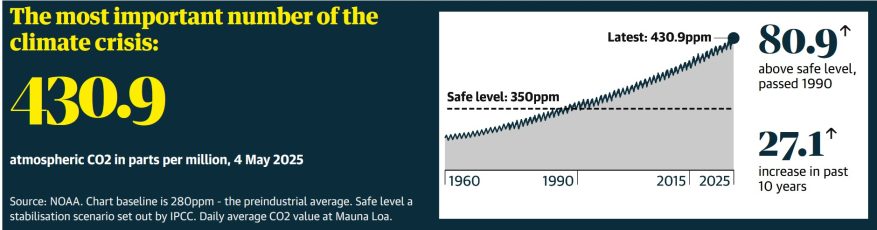
Bottom line: When you extract, upgrade, refine and burn toxic substances such as coal, bitumen, oil and gas at the rate we are burning them, decade after decade, you’re going to see changes. Atmospheric CO2 levels are now fully 50 per cent higher than preindustrial times, and it affects everything we care about, from fetuses to phytoplankton, from water to winter. “Fire weather” is not just a book title, it’s a technical term. Natural Resources Canada uses a Fire Weather Index to gauge fire risk, and when the index is high, things we care about and depend on ignite much more easily. When Fort McMurray burned, the Fire Weather Index peaked at 42 – record territory, well beyond “Extreme.” In B.C., during the heat dome of 2021, it went far higher. Now, that was “unprecedented.”
This is not unique to Canada; weather services around the world are scrambling to find new names and colours to account for these off-the-charts extremes in temperature, flammability, rainfall, ocean surge – you name it. It’s like the Spinal Tap amp that goes up to 11, only not funny: Australia’s new Fire Danger Ratings System goes from High to Extreme to Catastrophic.
This is fire weather for a new planet. A planet we have made.
This article was written by Seth Borenstein of the Associated Press and was published in the Toronto Star on May 17, 2023.
There’s a two-out-of-three chance that the world will temporarily hit a key warming limit within the next five years, the United Nations weather agency said Wednesday.
But it likely would only be a fleeting and less worrisome flirtation with the internationally agreed upon temperature threshold. Scientists expect a temporary burst of heat from El Nino — a naturally-occurring weather phenomenon — to supercharge human-caused warming from the burning of coal, oil and gas to new heights. Temperatures are expected to then slip back down a bit.
The World Meteorological Organization forecasts a 66% likelihood that between now and 2027, the globe will have a year that averages 1.5 degrees Celsius (2.7 degrees Fahrenheit) warmer than the mid 19th century.
That number is critical because the 2015 Paris climate agreement set 1.5 degrees Celsius as a global guardrail in atmospheric warming, with countries pledging to try to prevent that much long-term warming if possible.
Scientists in a special 2018 United Nations report said going past that point would be drastically and dangerously different with more death, destruction and damage to global ecosystems.
“It won’t be this year probably. Maybe it’ll be next year or the year after” that a year averages 1.5 degrees Celsius, said report lead author Leon Hermanson, a climate scientist at the United Kingdom’s Met Office.
But climate scientists said what’s likely to happen in the next five years isn’t the same as failing the global goal.
‘We need to be prepared’: El Niño and greenhouse gases could make the next 5 years warmest on record
“This report does not mean that we will permanently exceed the 1.5 C level specified in the Paris Agreement which refers to long-term warming over many years. However, WMO is sounding the alarm that we will breach the 1.5 C level on a temporary basis with increasing frequency,” WMO Secretary-General Petteri Taalas said in a statement.
“We haven’t been able to limit the warming so far and we are still moving in the wrong, wrong direction,” Taalas said at a Wednesday press conference.
Hermanson cautioned that “a single year doesn’t really mean anything.” Scientists usually use 30-year averages.
Those 66% odds of a single year hitting that threshold in five years have increased from 48% last year, 40% the year before, 20% in 2020 and 10% about a decade ago. The WMO report is based on calculations by 11 different climate science centers across the globe.
The world has been inching closer to the 1.5-degree threshold due to human-caused climate change for years. The temporary warming of this year’s expected El Nino — which starts with a warming of parts of the central Pacific Ocean and then sloshes across the globe — makes it “possible for us to see a single year exceeding 1.5 C a full decade before the long-term average,” said climate scientist Zeke Hausfather of the tech company Stripe and Berkeley Earth, who wasn’t part of the WMO report.
“We don’t expect the longer-term average to pass 1.5 C until the early-to-mid 2030s,” Hausfather said in an email.
But each year at or near 1.5 matters.
“We see this report as more of a barometer of how we’re getting close, because the closer you get to the threshold, the more noise bumping up and down is going to bump you over the threshold randomly,” Hermanson said in an interview. And he said the more random bumps over the mark occur, the closer the world actually gets to the threshold.
Key in all this is the El Nino cycle. The world is coming off a record-tying triple dip La Nina — three straight years of El Nino’s cooler cousin restraining the human-caused warming climb — and is on the verge of an El Nino that some scientists predict will be strong.
The La Nina somewhat flattened the trend of human-caused warming so that the world hasn’t broken the annual temperature mark since 2016, during the last El Nino, a super-sized one, Hermanson said.
And that means a 98% chance of breaking the 2016 annual global temperature record between now and 2027, the report said. There’s also a 98% chance that the next five years will be the hottest five years on record, the report said.
Because of the shift from La Nina to El Nino “where there were floods before, there will be droughts and where there were droughts before there might be floods,” Hermanson said.
The report warned that the Amazon will be abnormally dry for a good part of the next five years while the Sahel part of Africa — the transition zone between the Sahara on the north and the savannas to the south — will be wetter.
That’s “one of the positive things coming out of this forecast,“ Hermanson said. “It’s not all doom-and-gloom and heat waves.”
University of Pennsylvania climate scientist Michael Mann said reports like this put too much emphasis on global surface temperature, which varies with the El Nino cycle, even though it is climbing upward in the long term.
The real concern is the deep water of oceans, which absorb an overwhelming majority of the world’s human-caused warming, leading to a steady rise in ocean heat content and new records set regularly.
“I think it’s important to realize that if we pass 1.5 degrees it’s not a reason to give up,” Hermanson said at a Wednesday news conference. “We have to continue working out how much we can reduce emissions of greenhouse gases as much as possible, even after that, because it will make a difference.”
This article was written by Kevin Jiang and was published in the Toronto Star on May 18, 2023.
Human-induced climate change and the natural arrival of weather system El Niño almost guarantees the next five years will be sweltering — and temperatures are expected to shatter global records, according to the United Nations.
A new, dire update from the World Meteorological Organization, a specialized agency of the United Nations, on Wednesday finds we’re stepping into “uncharted territory,” with temperatures likely surpassing 1.5 C of warming by 2027.
El Niño coupled with climate change will “push global temperatures into uncharted territory,” WMO Secretary-General Petteri Taalas said in a release Wednesday. “This will have far-reaching repercussions for health, food security, water management and the environment. We need to be prepared.”
According to the report, there is a 98 per cent chance at least one year in the next five years, and the fiveyear period as a whole, will be the warmest ever recorded. In this time span, there’s a 66 per cent chance temperatures will be 1.5 C warmer than pre-industrial levels for at least one year.
That means we’re on track to breach the long-term warming threshold of 1.5 C above pre-industrial levels set by the 2015 Paris Agreement — at least temporarily.
“This report does not mean that we will permanently exceed the 1.5 C level specified in the Paris Agreement which refers to long-term warming over many years,” Taalas said. “However, WMO is sounding the alarm that we will breach the 1.5 C level on a temporary basis with increasing frequency.”
Case in point, there’s only a 33 per cent chance the five-year temperature mean will exceed the 1.5 C limit, the report states.
The world has been heating up across the board; in January, the WMO found the past eight years to be the warmest ever recorded. Global warming has already wreaked havoc across the globe, contributing to record-breaking heatwaves, the increased prevalence of storms and natural disasters, extreme droughts and more.
Recently, Canada has seen devastating wildfires grow in frequency and intensity, with fire seasons stretching in length. Experts say the rise in forest fires has also contributed to increasing greenhouse gas and air pollution emissions.
The last global temperature record was set in 2016, partly resulting from an especially strong El Niño event. At the time, average temperatures were measured at 0.94 C above pre-industrial levels.
El Niño and its counterpart, La Niña, describe the respective warming and cooling of surface waters in the eastern Pacific Ocean. The events typically last nine to 12 months and occur roughly every two to seven years.
When El Niño strikes, trade winds falter and the warm waters are pushed back east toward the west coast of the Americas. This may lead to warmer temperatures in general, and generate especially hot and dry conditions in northern Canada.
According to the WMO, El Niño is expected to arrive in the coming months, with an 80 per cent chance of hitting between July and September.
This Letter to the Editor was published in the Toronto Star on May 18, 2023.
Re: Wildfire officials warn of heat in Alberta’s south, May 15th, 2023
According to this latest article, there are 19,300 Albertans that have been evacuated and over 1,500 Albertans fighting the wildfires. There have been daily articles describing the conditions and the hardship being experienced by both caused by “hot and dry conditions.”
What is ironic is that the very province which emits the most heat-trapping pollutants in Canada, not only from its fossil fuel production, but from the burning of its products shipped to other parts of the world, is now suffering the most from climate change (in Canada).
What is puzzling is that there is no mention of climate change, nor the burning of fossil fuels, the primary cause of climate change, in these articles, nor in the rest of Canadian mainstream media.
Ray Nakano, Toronto
This article was written by the Associated Press and was published by CBC News on May 17, 2023.
This article was written by Fiona Harvey and was published in The Guardian on May 17, 2023.
© UNICEF/Karel Prinsloo
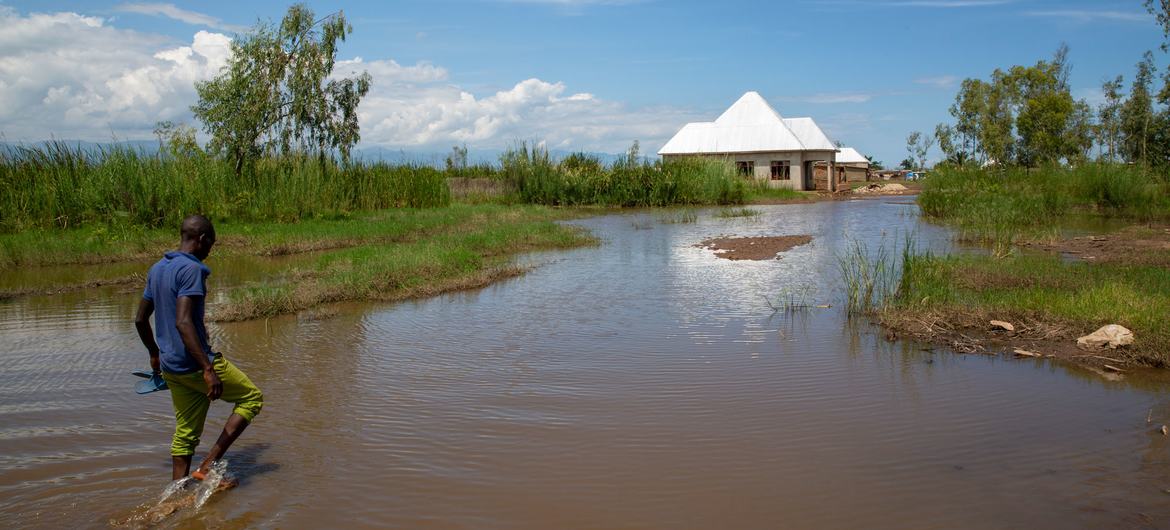
A man walks in floodwaters in Gatumba, Burundi an area which is receiving unpredictable rainfall due to climate change.
This article was written and published by United Nations News on May 17, 2023.
This article was written by Richard Carlson, director of energy at Pollution Probe, Canada’s oldest environmental NGO, and was published in the Toronto Star on May 14, 2023.
In Ontario’s cold winters we burn a lot of natural gas to stay warm. Heating accounts for over 80 per cent of the energy we use in our homes, and over 75 per cent of Ontarians use natural gas for that heating. In the GHTA, emissions from heating buildings with natural gas is the largest source of greenhouse gas emissions, even higher than from transportation.
While natural gas has proven to be cost-effective, reliable and a flexible fuel, will we always be heating with natural gas? We are in a climate emergency and we have to stop burning fossil fuels so we need to prepare for replacing natural gas.
Electrification is the most common low-carbon solution promoted, especially as we are working to decarbonize our electricity supply. Rather than heating with inefficient electric baseboard heaters, it is heat pumps, essentially air conditioners that can both heat and cool, that offer the greatest promise. As heat pumps move heat and not create heat, that can be incredibly efficient, producing more heat than the energy put in.
But heat pumps struggle at really low temperatures. While less than 10 per cent of Canadian total heat demand would be cold enough that heat pumps would struggle, on those really cold days heating is still crucial. Using electric baseboards as a backup is one idea. But as everyone would be needing these backups at the same time, there would likely lead to much higher costs as the electricity grid would need to be expanded to meet these peak heating days in the winter.
As an example, Quebec, which relies heavily on electric baseboards for heating, has almost double the electricity demand in the winter as Ontario has during our highest period of electricity demand when everyone has their air conditioning blasting.
Even if Quebec moves to heat pumps, this large winter demand would remain as the baseboard heaters would be going full out as a backup.
Studies have shown that for the electricity grid to meet heating needs on those really cold days in Ontario, and in comparable areas, it would have to almost double in size. And this is not just with power plants, but with all the wires transporting the electricity to every home.
Thus what we would see would be a lower average use of energy, with large spikes in electricity demand by everyone in a short period. It would be like building massive highways all over Toronto just to deal with the rush of cottagers north in the summer.
But given that we need to reduce our emissions, we have to do something. In a paper Pollution Probe published, we argued that we need to look beyond electrification. District heating, which is already used in Toronto, is one.
For homes, hybrid heating — systems that have both a heat pump and a natural gas furnace — could be transitional tools as we develop our electricity system and improve the energy efficiency of our homes. The City of London is testing hybrid heating, and in Quebec, the electric and gas utilities, Hydro Québec and Énergir, are working together on hybrid systems. Hybrid systems could even be made low carbon if they used renewable natural gas or other low-carbon gases.
Decarbonizing heating is likely to be extremely difficult, given our current reliance on natural gas, extremely cold winter temperatures and the need to maintain the accessibility, affordability and reliability of heating services.
Given the need to move, we cannot afford to wait and need to consider all options, not just electrification, while planning — and preparing — for a net zero future.
This article was written by Reuters and was published in the Globe & Mail on May 13, 2023.
The Competition Bureau said on Thursday it was investigating whether Pathways Alliance, a group of oil sands producers collaborating on ways to cut greenhouse-gas emissions, misled the public in its advertising campaign.
Three environmental groups complained to the bureau in March about Pathways’ “Let’s clear the air” campaign that promoted the producers’ plan to achieve net-zero emissions by 2050.
The bureau reviewed the complaint to determine if it meets technical requirements of Canada’s Competition Act prior to launching a formal investigation that is then required by law to determine the facts, a Competition Bureau spokesperson said in a statement. The spokesperson declined to provide further details, saying the work is confidential.
The bureau, an independent agency of the federal government, has authority to order financial penalties.
The environmentalists said Pathways’ net-zero claim was misleading because 80 per cent of the emissions associated with oil and gas are related to combustion, not the initial extraction on which Pathways is focused.
“We think the public deserves to be told the truth about the environmental harm caused by fossil-fuel production,” said Nola Poirier, senior researcher at Greenpeace Canada, one of the environmental groups.
The oil and gas and transportation industries are Canada’s two highest-polluting sectors, accounting for half of its emissions. Prime Minister Justin Trudeau’s government is aiming to cut overall emissions by at least 40 per cent from 2005 levels by 2030.
Pathways said it strongly disagrees with the environmental groups’ complaint.
“Our campaign acknowledges the oil sands represent a significant share of our country’s emissions and that we must work collaboratively, including with governments, to achieve our goal of net zero from operations,” said Mark Cameron, Pathways’ vice-president.
 Mobilize, Canada!