Fossil fuel firms are ‘godfathers of climate chaos’, says UN chief

Fossil fuel firms are ‘godfathers of climate chaos’, says UN chief

The secretary general of the UN said fossil fuel companies should be banned from advertising in every country, akin to the restrictions on big tobacco.

António Guterres delivered fresh scientific warnings of global heating in a major speech in New York. He called on news and tech media to stop enabling ‘planetary destruction’ by taking fossil fuel firms’ advertising money, while warning that the world faces ‘climate crunch time’ in its faltering attempts to stem the crisis.

Humanity Needs ‘Exit Ramp off Road to Climate Hell’, Secretary-General Insists, Urging Bolder, Faster Action to Save Planet, in Address at American Natural History Museum

Following is UN Secretary-General António Guterres’ special address on climate action, “A Moment of Truth”, to the American Museum of Natural History, in New York today:

This article was written and published by the United Nations on June 5, 2024.

UN chief calls for fossil fuel ads to be banned like cigarette ads

‘Stop acting as enablers to planetary destruction,’ secretary general tells PR firms

This article was written by Benjamin Shingler and was published by CBC News on June 6, 2024.

UN chief urges countries to ban fossil fuel ads

United Nations Secretary General António Guterres is calling on nations to ban fossil fuel ads, and urging media and tech companies to ‘stop taking fossil fuel advertising.’

There is an exit off ‘the highway to climate hell’, Guterres insists

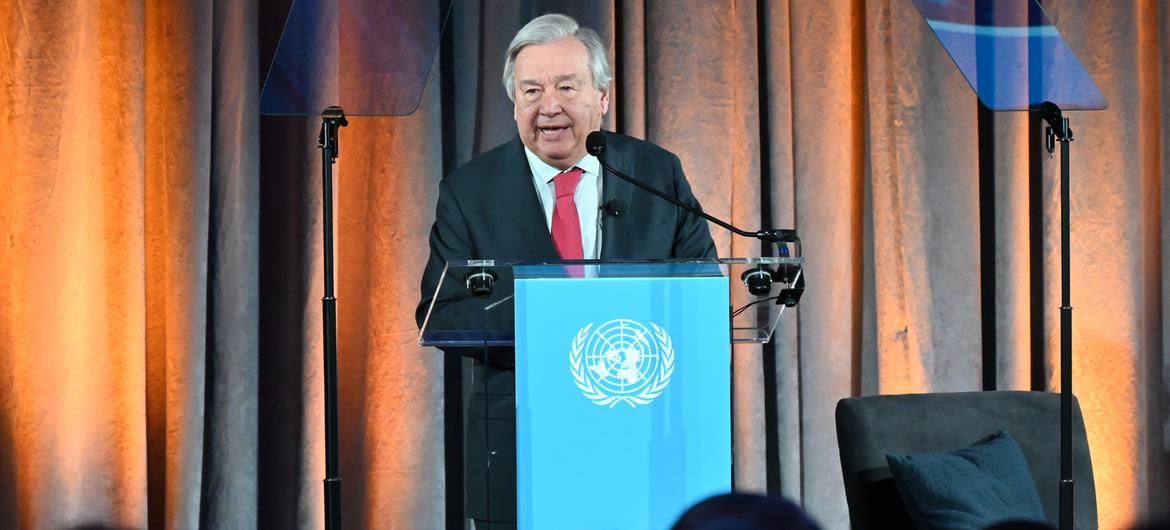
Secretary-General António Guterres delivers his special address on climate action from the American Museum of Natural History in New York.

United Nations Secretary-General António Guterres delivers his special address on climate action from the American Museum of Natural History in New York.

“It’s climate crunch time” when it comes to tackling rising carbon emissions, the UN Secretary-General said on Wednesday, stressing that while the need for global action is unprecedented, so too are the opportunities for prosperity and sustainable development.

This article was written and published by the United Nations on June 5, 2024.

UN warns of ‘highway to climate hell’

ENVIRONMENT May marks 12th straight month of record-breaking global temperatures

This article was written by Kate Allen and was published in the Toronto Star on June 6, 2024.

As the planet notched a new hot streak and scientists predicted another grim milestone on the horizon, the secretary-general of the U.N. warned Wednesday that the world needs “an exit ramp off the highway to climate hell.”

Europe’s climate agency announced that May marked the 12th consecutive month of recordbreaking global temperatures, a fevered year that startled many scientists because of the dramatic margins by which old records were broken. At the same time, the World Meteorological Organization predicted that at least one of the next five years is likely to temporarily break the 1.5 C warming threshold.

While one or two years over the 1.5-degree mark is not the same as tipping over that threshold in the long-term, U.N. Secretary-General António Guterres warned that we are edging closer to that being a new normal — the outcome the Paris Agreement is designed to avoid — and that world leaders have very little time left to avert this larger catastrophe.

“The good news is that we have control of the wheel. The battle to limit temperature rise to1.5 degrees will be won or lost in the 2020s — under the watch of leaders today,” Guterres said in a speech on Wednesday.

“We are playing Russian roulette with our planet,” he added.

The global hot streak has been so pronounced since it began last summer that scientists have debated whether unexpected forces are at play, from underwater volcanoes to new shipping fuel rules. But as that debate continues, there is broad consensus that climate change is the biggest influence: If other factors are putting a thumb on the scale, human-caused global warming is pressing down with a full fist. “We’re extremely confident that the climate change is the dominant factor driving the warming trend,” said Nathan Gillett, a research scientist at Environment and Climate Change Canada.

In recent years, the rate of warming has been speeding up. A study released Tuesday conducted by an international team of scientists calculated that fossil fuel-driven warming is increasing by 0.26 degrees per decade, the fastest rate ever measured. Last year, humancaused warming made the Earth’s surface 1.31 C hotter than the preindustrial average, the study calculated — a rise Gillett noted is not far from 1.5 degrees.

Other factors also added another tenth of a degree, the study concluded. One of those was El Niño, the natural oceanic cycle that acts like an upwards nudge on the global thermostat. An El Niño phase chugged to life at roughly the same time as the hot streak began last summer.

Aside from climate change and El Niño, which are widely agreed on, are a list of other possible contributors, including a dramatic 2022 underwater eruption in the Tonga archipelago that spewed heat-trapping water vapour into the stratosphere and an especially intense dust storm in the Sahara Desert.

But the one that scientists have debated most fiercely is a change to shipping fuels — a fix meant to help the environment. In 2020, new regulations went into effect that cut how much sulphur dioxide pollution marine traffic is allowed to release. These new rules are a boon to human health. But the pollution also created aerosols that made clouds bigger and brighter, which reflected more solar radiation back into the sky — a cooling effect, and a brake on global warming.

A study published last week in a Nature journal attributed a significant amount of last year’s “strong warming” to the marine fuel changes. But other scientists said the study’s methods were too simplistic and some of its calculations were flawed.

A related controversy has sprung up at the same time: some say the episode has acted as a kind of inadvertent experiment-in-reverse for geo-engineering, an umbrella term for purposely tinkering with the atmosphere to cool the planet, such as by seeding clouds with reflective particles in a controlled way. Others say geo-engineering is still too untested and risky.

Joel Hirschi of the U.K.’s National Oceanography Centre thinks that while the study raised valid questions, it overestimated how much warming the marine fuel regulations are responsible for — and that the last year of warming, while extreme, is still within the upper realm of expectations based on climate change and El Niño alone.

But he says the next few months will be critical to watch. The current El Niño phase is receding, forecasters say, and is likely to be replaced by a cooling La Niña by the latter half of the year.

So if the extra-hot streak continues into the summer and beyond, “Then I would definitely join the chorus of some of my colleagues who have been quite vocal about saying that this is something extremely unexpected,” Hirschi said.

The WMO’s report says there is an 80 per cent probability of at least one of the next five years exceeding the 1.5 degree threshold. What that means for a given city, or even a particular country, is lot harder to calculate.

Canada is already warming at twice the global average, Gillett noted, and even faster in the North. And while the report didn’t map out onto a calendar year, the last 12 months were already 1.63 degrees above the pre-industrial average, according to the European agency’s estimates — a year that saw Canada’s most destructive wildfire season in recorded history, displacing some 185,000 people and torching a combined area larger than Greece.

“No switch is going to flip when we exceed 1.5 degrees, in terms of Canadian climate,” Gillett said. “We’re seeing the impacts of climate change here already. Those are progressively going to intensify as global warming increases.”

Increasing global temperatures, and the extremes they bring, also raise social questions, says James Voogt, a professor in the department of geography and environment at Western University.

“Part of it is, well who’s more vulnerable and where are they? Because climate change isn’t going to be fair either.”

Big Oil, Alberta fight ad ruling

This article was written by Gillian Steward and was published in the Toronto Star on June 4, 2024.

Of course, the petroleum industry isn’t keen on reducing its output and putting itself out of business, Gillian Steward writes, just as the tobacco industry wasn’t keen on letting people know that cigarette smokers were likely to die from lung cancer or heart disease.

If you are old enough to remember when smoking was allowed in theatres, airplanes and restaurants you might also remember the tobacco industry’s advertising campaigns.

Some ads claimed smoking could actually be good for a person. There were even ads claiming pregnant women “craved” cigarettes; that doctors preferred Camels. No mention of lung cancer or heart disease, even though the industry knew smoking could kill you.

When medical science publicly fought back with evidence that proved the link between smoking and lung cancer, the tobacco industry claimed it wasn’t “sound” science. Only their science was “sound” science.

It’s this kind of dangerous propaganda that the federal government is no doubt hoping to curtail with amendments to the Competition Act, which will establish policing of claims made by businesses that stretch the truth or downright lie about their “green” credentials.

Not surprisingly, the Alberta government is outraged because it sees the legislation as an attack on the oil and gas industry.

But there is good reason to doubt some of the industry’s claims.

Just last week a leaked investigation by Ads Standards Canada, a self-regulatory organization, unanimously found that two wraparound newspaper ads sponsored by Canada Action Coalition gave an “overall misleading impression that B.C. LNG is good for the environment, amounting to greenwashing.”

Canada Action Coalition is a nonprofit that describes itself as grassroots supporters of the oil and gas industry, although it has received large donations from industry players.

It’s been well documented that many of the same people who devised those misleading propaganda campaigns for the tobacco industry later moved on to work for the petroleum industry. In the 1990s it was desperate to downplay emerging evidence that carbon emissions from fossil fuels were causing the planet to heat up.

As part of the campaign U.S.-based ExxonMobil paid for front organizations that had official sounding names such as The Advancement of Sound Science Coalition to question the science, seed doubt, or completely deny climate change was even a real thing.

In 2007, the U.S-based Union of Concerned Scientists released the results of an investigation that showed “ExxonMobil has adopted the tobacco industry’s disinformation tactics, as well as some of the same organizations and personnel, to cloud the scientific understanding of climate change and delay action on the issue.”

In April, Democrats on a U.S congressional committee investigating the oil industry revealed documents that showed it is still using those same tactics.

Maybe Rebecca Schulz, Alberta’s environment minister, has never heard about any of this. Or maybe she thinks Canada’s oil industry is somehow different. Or that it is her job to defend the petroleum industry no matter what, even though she is the environment minister. She called the greenwashing rules “an undemocratic gag order” that must be stopped even if the government has to use the Alberta Sovereignty Act.

The jargon, data, and science of global warming are complicated enough. Throw in some half-truths or complete fabrications and it’s no wonder many people are confused about the actions that need to be taken if we are to drive down the carbon emissions that are turning the planet into a hothouse.

Reducing our dependence on oil and natural gas is top of the list. Burning those fossil fuels in our cars or furnaces means we keep spewing more and more carbon into the atmosphere. If we keep doing that we can expect heat waves, wildfires, droughts and floods to plague the planet and all living things well into the future.

Of course, the petroleum industry isn’t keen on reducing its output and putting itself out of business, even if that would save the planet. Just as the tobacco industry wasn’t keen on letting people know that cigarette smokers were likely to die from lung cancer or heart disease.

Despite its deceit, we all know what happened to the tobacco industry.

Big Oil thrives as planet warms

This article was written by Linda McQuaig and was published in the Toronto Star on May 16, 2024.

The opening of the Trans Mountain Pipeline expansion this month — widely celebrated in the media — reminds us that Canada is still very much in the grip of Big Oil.

That $34-billion expansion was financed by Ottawa and it amounts to a massive public subsidy for the oil industry — at a time when we should urgently be financing renewable energy, not fossil fuels.

The renowned U.S. climatologist James Hansen famously said the oil sands were such a “dirty, carbon intensive” oil that if they were to be fully exploited, it would be “game over” for the planet.

Yet here we are, applauding the tripling of the pipeline’s capacity to carry oil from the oil sands, even as that moves us closer to “game over.”

A report last week revealed that the world’s top climate scientists believe the world is headed in a frightening direction — towards more than 2.5 C degrees of warming, charging past the international target of1.5 C, beyond which fires, floods and heat waves become seriously unpredictable.

Today, we’re at just 1.2 C of warming and look at the mess we’re in. Already this season, wildfires are burning out of control in B.C. and Alberta.

Climate scientists have been clear: the only real hope of avoiding climate disaster lies in dramatically ramping up the transition to clean energy by building new wind and solar farms at breakneck speed.

But this isn’t happening, even though the price of wind and solar power has become very competitive. That was supposed to be the trigger point at which the market would begin working in our favour, with renewables cheaper than fossil fuels, facilitating the transition to clean energy.

Renewables keep getting cheaper. The price of solar power has plunged by 90 per cent, yet Big Oil remains dominant.

That’s because, with its long-established monopoly and extensive government support, Big Oil is far more profitable — and therefore more attractive — to major financial investors than the struggling, competitive firms that make up the budding renewable sector, notes Brett Christophers, a political economist at Uppsala University in Sweden.

Clearly, given the climate emergency, we can’t just leave the vital task of transitioning to renewables up to the whims of financial investors, whose only interest is maximizing their returns.

Governments must become a lot more involved and they have to switch their loyalty from Big Oil to renewables.

The Biden administration has moved in this direction, with sweeping measures aimed at doubling renewable capacity in the U.S. over the next decade. Meanwhile, the Trudeau government is locked into serving the immensely powerful oil industry.

Over the past four years, Ottawa has provided $65 billion in financial support for oil and gas, but only a fraction as much for renewable energy. Its main program for subsidizing renewables provides less than $1 billion a year, says Julia Levin, an associate director with Environmental Defence.

The extent of Ottawa’s willingness to accommodate Big Oil became clear in 2018 when it took over the Trans Mountain Pipeline expansion, rather than let the project collapse after its original backers threatened to pull out amid intense environmental opposition.

Now Ottawa is planning to spend $10 billion, possibly much more, subsidizing Big Oil’s futile but costly efforts to reduce its carbon emissions through “carbon capture and storage” — despite ample evidence the technology is highly ineffective at reducing such emissions.

This enables Big Oil to pretend it’s serious about reducing emissions, lulling Canadians into believing we’re making progress on climate, when we’re really just spinning our wheels and wasting a lot of public money in the process.

For years, there was the comforting thought that, when the horrors of climate change truly became clear, humans would be smart enough to figure out a solution. That turned out to be true. It’s just that we haven’t figured out how to override the powerful so we can implement the solution.

Scientists say the only real hope of avoiding climate disaster is dramatically ramping up the transition to clean energy by building new wind and solar farms at breakneck speed. But this isn’t happening

Report slams Canadian banks’ oil spending

Canadian banks provided almost $104 billion (U.S.) in fossil fuel funding last year despite the urgent need to reduce emissions, says the latest annual Banking on Climate Chaos report.

The report out Monday from a coalition of climate groups said the total includes $28.2 billion from RBC to place it seventh globally and $24 billion from Scotiabank to rank 10th.

The top 60 banks together committed $708 billion.

For most of Canada’s five biggest banks, 2023 was among their lowest levels of oil and gas financing in the eight years since the Paris climate agreement.

BMO had its outright lowest year of fossil fuel financing since 2016, with $15.8 billion. CIBC, TD and RBC each had their lowest with the exception of pandemic year 2020, while it was the fourth-lowest year for Scotiabank.

While reduced, the numbers are still stark, said Richard Brooks, climate finance director at Stand.earth. “There’s still massive amounts of money on the scale of, you know, tens of billions of dollars that are flowing into extreme forms of oil and gas, that are flowing into expansion projects that lock us in for a long time.”

Canadian banks understand their important role in helping lead an orderly transition to a low-carbon future, Canadian Bankers Association spokesperson Maggie Cheung said in a statement.

“Firm commitments are required to accelerate clean economic growth and that’s why banks are implementing climate action plans that set specific targets to meet the demands of this global challenge.”

Bank climate targets are fairly long-term, including their net-zero emissions goal of 2050. Only BMO has set an absolute reduction target before then.

The reduced fossil fuel funding last year could be due to shifts in the oil and gas industry. There are no major new oil sands projects on the horizon, while oil and gas companies have also been reaping major profits that help them self-fund costs and rely less on lenders.

Funding levels could fall further this year as major projects like the Trans Mountain pipeline expansion and Coastal Gas Link pipeline are now finished.

The report notes the companies behind the projects were among the top recipients of fossil fuel expansion funding globally. TC Energy Corp. raised $15.3 billion from the 60 banks covered in the report, while Trans Mountain Corp. raised $9.54 billion.

Calgary-based Enbridge Inc. was ranked first with $35 billion raised, though the report counts money it used for acquisitions as well as expanded pipeline capacity.

While the trends in the oil and gas industry could mean less funding is needed from banks, Brooks said it’s still important for the institutions to put policies in place that will ensure they reduce financed emissions.

Here is the Banking on Climate Chaos 2024 report.