UPFRONT PRICES CAN BE A BARRIER TO ENTRY TO ELECTRIFYING A HOME

This opinion was written by Rachel Doran and Jana Elbrecht, and was published in the Toronto Star on October 16, 2024.

RACHEL DORAN IS THE VICE PRESIDENT OF POLICY AT STRATEGY AT CLEAN ENERGY CANADA. JANA ELBRECHT IS A POLICY ADVISER AT CLEAN ENERGY CANADA.

Over the last two years, Canadian households have been getting on board with the energy transition. The Greener Homes Grant helped Canadians from coast to coast to coast install heat pumps and retrofit their homes, while EV sales have risen rapidly thanks to growing model availability and purchase incentives.

Accordingly, thousands of Canadians have made a shift away from fossil fuels, reaping the affordability benefits. In fact, our latest analysis finds that a household in Toronto that switched out its gas cars for electric versions, ditched its natural gas appliances, installed a heat pump and made some modest energy efficiency upgrades would cut $550 off its monthly bill, even taking into account upfront costs.

And no wonder, Canadians’ continued reliance on fossil fuels is costing them. In fact, a recent study found that energy prices are the most volatile component of inflation in the country.

But despite the savings benefits of clean technologies, upfront price can be a barrier to entry for many middle-income Canadians. And in many cases, these costs have been moving in the wrong direction — particularly for Ontarians who receive comparatively little provincial support.

Over the past year, the federal government’s Greener Homes Grant (that offered up to $5,000 off the price of a heat pump and other energy-saving measures) was discontinued in favour of a program for lower income households.

Also, many of the most affordable and bestselling EVs in Canada have either increased in price or disappeared. Production of both the sub-$45,000 Chevrolet Bolt and the Kia Soul EV has been paused or discontinued, leaving gaps in the more affordable end of the market. And now the cheapest Tesla will no longer be available in Canada following new tariffs imposed on Chinese-made EVs.

Our evidence is clear: switching your fossil fuel-powered car for an EV saves money in every scenario, in every region of the country — even when upfront costs are included and even in Ontario. A driver opting for an electric Volkswagen ID.4 instead of a gas-powered Honda CR-V would save over $2,400 a year over the lifetime of the car. The problem is that not everyone can finance a pricier car that will start saving them money in the future.

Indeed, despite clear upsides, upfront cost remains the No. 1 concern for prospective EV buyers, despite EV sticker prices dropping in recent years. It needn’t be the case.

Europeans can choose from at least 12 different fully electric options with a purchase price of less than $45,000, compared to just three in Canada. And the playing field isn’t level across the country, either. Most provinces and territories offer some kind of rebate for buying a new or used EV. But Ontario isn’t one of them.

The implications are written in the sales numbers: Ontario continues to trail the national average and has now even fallen behind the Yukon on electric market share. In fact, EVs now make up 32 per cent of new vehicle sales in Montreal and 25 per cent in Vancouver, compared to just nine per cent in Toronto. Ontarians are missing out on EV options. The new Ontario-made electric Dodge Charger, for instance, will initially only be available in B.C. and Quebec.

This points to the critical importance of government policy, to both help cut the upfront cost via purchase incentives and encourage automakers to make more affordable models. But rebates are not universal and some key policies are at risk.

In fact, another recent report found that the federal Electric Vehicle Availability Standard (which requires automakers to make an increasing portion of EVs available for sale) will be key to incenting automakers to bring more affordable EVs to market. And yet, the future of the policy remains uncertain with the official opposition publicly stating they would repeal it if elected.

When it comes to home upgrades, many provinces stepped up after the federal government dropped its program earlier this year, retaining or expanding support for heat pumps and energy retrofits. But the result is a geographically unequal transition.

A median-income family in B.C. can receive up to $12,000 in government subsidies to switch from natural gas to a heat pump, while that same family in Ontario would receive no government support (and only up to $2,000 from the utility).

We are at a critical time in the energy transition. We have the solutions to lower energy bills and fight climate change, but it is vital that every Canadian can benefit. To that end, all levels of government must take action, offering rebates to cut upfront costs, improving charging access, simplifying financing and improving electricity rates to further incentivize cleaner options.

Anyone considering a clean energy shift can visit Clean Energy Canada’s new online calculator, mycleanbill.ca, to get a better sense of potential savings based on your location, vehicle type and home.

After all, the door to cleaner homes and lower bills must be open to all Canadians.
Opinion | Canadians are saving money with EVs and heat pumps. But only if they can afford the upfront cost

Ford and Trudeau
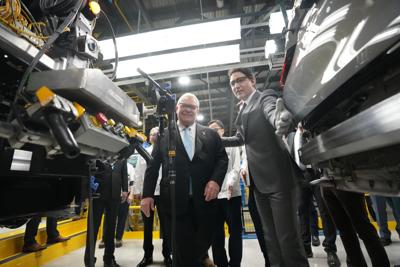
Premier Doug Ford and Prime Minister Justin Trudeau look over a vehicle along an assembly line at an event announcing plans for a Honda electric vehicle battery plant in Alliston in April 2024.  Nathan Denette/The Canadian Press

This opinion was written by Rachel Doran and Jana Elbrecht, and was published in the Toronto Star on October 16, 2024. Rachel Doran is the vice president of policy at strategy at Clean Energy Canada. Jana Elbecht is a policy advisor at Clean Energy Canada.

Over the last two years, Canadian households have been getting on board with the energy transition. The Greener Homes Grant helped Canadians from coast to coast to coast install heat pumps and retrofit their homes, while EV sales have risen rapidly thanks to growing model availability and purchase incentives.

Accordingly, thousands of Canadians have made a shift away from fossil fuels, reaping the affordability benefits. In fact, our latest analysis finds that a household in Toronto that switched out its gas cars for electric versions, ditched its natural gas appliances, installed a heat pump and made some modest energy efficiency upgrades would cut $550 off its monthly bill, even taking into account upfront costs.

And no wonder, Canadians’ continued reliance on fossil fuels is costing them. In fact, a recent study found that energy prices are the most volatile component of inflation in the country.

But despite the savings benefits of clean technologies, upfront price can be a barrier to entry for many middle-income Canadians. And in many cases, these costs have been moving in the wrong direction — particularly for Ontarians who receive comparatively little provincial support.

Over the past year, the federal government’s Greener Homes Grant (that offered up to $5,000 off the price of a heat pump and other energy-saving measures) was discontinued in favour of a program for lower income households.

Also, many of the most affordable and bestselling EVs in Canada have either increased in price or disappeared. Production of both the sub-$45,000 Chevrolet Bolt and the Kia Soul EV has been paused or discontinued, leaving gaps in the more affordable end of the market. And now the cheapest Tesla will no longer be available in Canada following new tariffs imposed on Chinese-made EVs.

Our evidence is clear: switching your fossil fuel-powered car for an EV saves money in every scenario, in every region of the country — even when upfront costs are included and even in Ontario. A driver opting for an electric Volkswagen ID.4 instead of a gas-powered Honda CR-V would save over $2,400 a year over the lifetime of the car. The problem is that not everyone can finance a pricier car that will start saving them money in the future.

Indeed, despite clear upsides, upfront cost remains the No. 1 concern for prospective EV buyers, despite EV sticker prices dropping in recent years. It needn’t be the case.

ARTICLE CONTINUES BELOW

Europeans can choose from at least 12 different fully electric options with a purchase price of less than $45,000, compared to just three in Canada. And the playing field isn’t level across the country, either. Most provinces and territories offer some kind of rebate for buying a new or used EV. But Ontario isn’t one of them.

The implications are written in the sales numbers: Ontario continues to trail the national average and has now even fallen behind the Yukon on electric market share. In fact, EVs now make up 32 per cent of new vehicle sales in Montreal and 25 per cent in Vancouver, compared to just 9 per cent in Toronto. Ontarians are missing out on EV options. The new Ontario-made electric Dodge Charger, for instance, will initially only be available in B.C. and Quebec.

This points to the critical importance of government policy, to both help cut the upfront cost via purchase incentives and encourage automakers to make more affordable models. But rebates are not universal and some key policies are at risk.

In fact, another recent report found that the federal Electric Vehicle Availability Standard (which requires automakers to make an increasing portion of EVs available for sale) will be key to incenting automakers to bring more affordable EVs to market. And yet, the future of the policy remains uncertain with the official opposition publicly stating they would repeal it if elected.

When it comes to home upgrades, many provinces stepped up after the federal government dropped its program earlier this year, retaining or expanding support for heat pumps and energy retrofits. But the result is a geographically unequal transition.

A median-income family in B.C. can receive up to $12,000 in government subsidies to switch from natural gas to a heat pump, while that same family in Ontario would receive no government support (and only up to $2,000 from the utility).

We are at a critical time in the energy transition. We have the solutions to lower energy bills and fight climate change, but it is vital that every Canadian can benefit. To that end, all levels of government must take action, offering rebates to cut upfront costs, improving charging access, simplifying financing and improving electricity rates to further incentivize cleaner options.

Anyone considering a clean energy shift can visit Clean Energy Canada’s new online calculator, mycleanbill.ca, to get a better sense of potential savings based on your location, vehicle type, and home.

After all, the door to cleaner homes and lower bills must be open to all Canadians.
Here is Clean Energy Canada’s Opening the Door, October, 2024 report.

Switching to EVs and ditching gas could save Canadians more than $500 a month, report says

A family that ditches natural gas-burning appliances and gas-powered cars would save between $550 and $777 per month, a new report from Clean Energy Canada finds. 

EVs.JPG
A family that electrifies all aspects of their home — including switching to an electric vehicle — would save between $550 and $777 per month, depending on where they live, according to a new report from Clean Energy Canada.   Mario Tama/Getty Images
Marco-Chown-Oved

This article was written by Marco Chown Oved and was published in the Toronto Star on October 15, 2024.

Burning fossil fuels is costing Canadians, not only by exacerbating climate change for their kids and grandkids, but also by increasing direct, out-of-pocket expenses now.

This is the conclusion of a new study published by Clean Energy Canada on Wednesday that quantifies just how much cheaper life is for Canadians who switch to non-combusting technologies such as electric vehicles (EVs) and heat pumps.

A family that electrifies all aspects of their home — ditching natural gas-burning appliances and gasoline-powered cars — would save between $550 and $777 per month, depending on where they live, it finds.

“We’re trying to combat some misperceptions about how much things actually cost,” said Rachel Doran, director of policy & strategy at Clean Energy Canada, a Vancouver-based think-tank. 

“Yes, electric vehicles in many cases may cost you more upfront when you just compare the sticker price. But by the time you start looking at the fact that there’s rebates available in most parts of the country and just how much you’re saving fuelling your vehicle and the maintenance, it was clear from our analysis, switching your fossil fuel powered car for an EV saves money in every scenario in every region of the country, even when upfront costs are included.”

The reports’ findings corroborate an investigation published in the Star and Corporate Knights Magazine last year that found people who decarbonize also save significant amounts of money. The customizable calculator published on the Star’s website is still available and allows people to figure out approximately how much money they’ll save by making each of the four low-carbon investments: EVheat pump, heat pump water heater and induction stove.

These four changes to your home can save you lots of cash. Use our tools to see how much

Clean Energy Canada offers a similar calculator at mycleanbill.ca.

“We often don’t think about the costs of doing things the same way we’ve always done them (i.e.: with fossil fuels). But when you actually add up how much of your income is going toward paying at the gas tank or other pieces, that’s actually a substantial amount of money,” said Doran. “So I do think this is a bit of an educational tool.”

Since the start of the pandemic, fossil fuels have been one of the most volatile expenses for Canadian families and their spike in prices after the Russian invasion of Ukraine has driven inflation in virtually every sector across the economy.

While retail gasoline and natural gas prices ride the international markets when they go up, they’re far slower to go back down when the global price wanes. This underscores the “freedom” aspect of reducing your reliance on fossil fuels. No longer will you be paying for Russia’s aggression every time you fill up.

It also means that switching your car, furnace, hot water heater and stove from fossil fuels to electricity will almost always be cheaper to operate.

The issue is the upfront cost of the switch, with EVs and heat pumps costing more than their fossil-fuel burning equivalents. The Clean Energy Canada study, however, includes that upfront cost spread out over the lifetime of the appliance and shows that even with the higher sticker price included, the electrical appliances are significantly cheaper.

A family with two cars, living in a detached house in Toronto, for example, would spend nearly $2,000 a month in energy bills, gasoline and car/furnace payments. That same family would spend just over $1,400 a month if they switched to electric alternatives, the report found.

At the same time, they would lower their carbon emissions by 94 per cent.

In a condo, the results are similar. A Toronto family with a single car is expected to spend $838 per month on bills and leasing payments. This drops to $613 after electrification.

The results vary by province — where electricity and gas prices are different — and on the size of the rebate. While Quebec tops up the federal $5,000 EV rebate with $7,000 more, Ontario does not. But Ontarians can get $5,000 off the purchase price of a heat pump through the provincial Home Energy Rebate program administered by Enbridge. 

In a section on EVs, the report compared a gas-powered Honda CR-V to the electric SUV Volkswagen ID. 4 and found the Honda would cost 44 per cent more to finance and operate.

It also priced out common road-trips to show how much cheaper charging is than gassing up.

A drive from Toronto to Ottawa, for example, would cost only $16 in electricity but $54 in gas — more than three times more.

The report calls for more government rebates to lower upfront costs that are still the biggest barrier to adoption of green technology — especially for lower-income households.

“Rebates are still really important,” said Doran. “If we can help people access these solutions, they’re going to be saving money over time. So for families that have a harder time paying their energy bills or hydro bills, having those all be reduced over time is going to be really helpful in trying to make ends meet.”

Here is Clean Energy Canada’s Opening the Door, October, 2024 report.